Apple A18 Pro
vs
Apple M2 iPad


SoC Comparison Result
Apple A18 Pro vs Apple M2 iPad: Newer Core Speed vs M2 Power
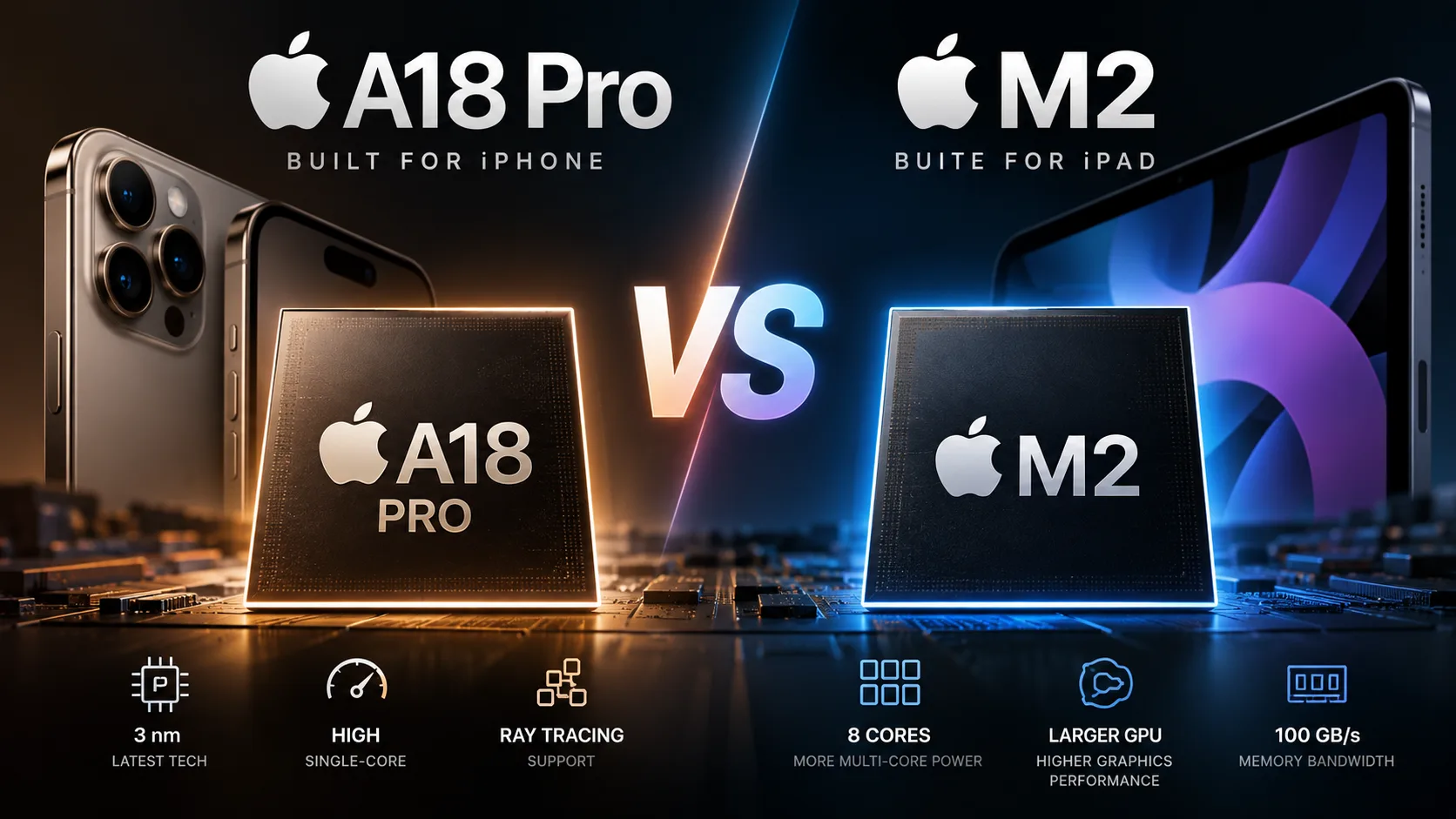
The Apple A18 Pro powers the iPhone, while the M2 is found in a much larger iPad, so a direct comparison of these chips produces an unusual result. The A18 Pro is newer: it is manufactured using a 3-nm process and features a next-generation CPU and a GPU with hardware-accelerated ray tracing. The M2 is two years older, but it has eight CPU cores, a larger GPU, and the iPad’s enclosure allows it to sustain high performance for longer.
Key Differences
| Specification | Apple A18 Pro | Apple M2 iPad |
|---|---|---|
| Year | 2024 | 2022 |
| Process technology | 3 nm | 5 nm |
| CPU | 6 cores, 2P + 4E | 8 cores, 4P + 4E |
| Maximum frequency | around 4.0 GHz | around 3.5 GHz |
| GPU | 6 cores | 9 or 10 cores depending on the iPad |
| Neural Engine | 16 cores | 16 cores |
| Memory bandwidth | Apple does not disclose an absolute figure | 100 GB/s |
| Hardware-accelerated ray tracing | Yes | No |
| Main devices | iPhone 16 Pro, 16 Pro Max | iPad Pro 2022, iPad Air 2024 |
The key CPU difference is the number of performance cores: two in the A18 Pro and four in the M2. This allows the A18 Pro to lead in Single-Core, while the M2’s four P-cores give it an advantage in multithreaded workloads.
CPU: A18 Pro Leads in Single-Core, M2 in Multi-Core
In Geekbench 6, the A18 Pro scores 3408 points in Single-Core versus 2633 for the M2 iPad. Its advantage is around 29%.
The M2 takes the lead in Multi-Core: 9898 versus 9092 points, or approximately 9%.
| Benchmark | Apple A18 Pro | Apple M2 iPad | Difference |
|---|---|---|---|
| Geekbench 6 Single-Core | 3408 | 2633 | A18 Pro +29% |
| Geekbench 6 Multi-Core | 9092 | 9898 | M2 +9% |
| AnTuTu 10 | 1 977 119 | 2 210 856 | M2 +12% |
AnTuTu 10 takes into account more than just the CPU: it also measures graphics, memory, and storage, so its result cannot be interpreted as a direct comparison of CPU cores. In this test, the M2’s advantage is also strengthened by the tablet’s more powerful GPU.
Actual Devices
The results below come from specific Geekbench 6 runs rather than average values.
| Device | Chip | GPU | Geekbench 6 Single | Geekbench 6 Multi | Launch price |
|---|---|---|---|---|---|
| iPhone 16 Pro | A18 Pro | 6 cores | 3532 | 8771 | $999 |
| iPhone 16 Pro Max | A18 Pro | 6 cores | 3516 | 8690 | $1,199 |
| iPad Pro 11" 4th Gen | M2 | 10 cores | 2651 | 10 163 | $799 |
| iPad Pro 12.9" 6th Gen | M2 | 10 cores | 2683 | 10 271 | $1,099 |
| iPad Air 11" M2 | M2 | 9 cores | 2669 | 10 248 | $599 |
| iPad Air 13" M2 | M2 | 9 cores | 2670 | 10 137 | $799 |
The advantage remains the same in the short CPU test: the iPhone is faster in Single-Core, while the M2 iPad leads in Multi-Core.
The iPad Air and iPad Pro use different GPU configurations. The 2022 iPad Pro uses the M2’s 10-core GPU, while the 2024 iPad Air received the 9-core version. This has almost no effect on CPU results, but the graphics performance of the two M2 variants differs.
GPU: M2 Is Faster in Rasterization, A18 Pro in Ray Tracing
In Steel Nomad Light, the 10-core M2 is noticeably faster than the A18 Pro, but Solar Bay Extreme produces the opposite result.
| 3DMark | iPhone 16 Pro, A18 Pro | iPad Pro 12.9 2022, M2 | Difference |
|---|---|---|---|
| Solar Bay | 7578 | 8753 | M2 +16% |
| Solar Bay Unlimited | 7534 | 8509 | M2 +13% |
| Solar Bay Extreme | 1298 | 563 | A18 Pro +131% |
| Solar Bay Extreme Unlimited | 1136 | 522 | A18 Pro +118% |
| Steel Nomad Light | 1715 | 2621 | M2 +53% |
| Steel Nomad Light Unlimited | 1545 | 2489 | M2 +61% |
The M2’s advantage reaches 53% in Steel Nomad Light and 61% in the Unlimited test. This is due to its 10-core GPU and the iPad’s ability to operate at high power for longer.
In Solar Bay Extreme, by contrast, the A18 Pro is more than twice as fast thanks to hardware-accelerated ray tracing, which the M2 lacks.
In the standard Solar Bay test, the M2 retains a 13-16% advantage. Thus, the M2 leads in Steel Nomad Light and standard Solar Bay, while the A18 Pro’s advantage appears in the more demanding ray-tracing mode.
Cooling and Sustained Workloads
The A18 Pro operates within significantly tighter thermal and power limits in the iPhone. Its compact enclosure limits sustained power consumption and heat dissipation.
The iPad has a larger cooling area, allowing the M2 to operate at high power for longer. This is especially important in extended gaming sessions, rendering, and other sustained GPU workloads.
Neural Engine and Memory
Both chips feature a 16-core Neural Engine, but their performance cannot be compared directly. Apple quotes up to 15.8 trillion operations per second for the M2, but does not provide a comparable TOPS figure for the A18 Pro.
The M2 has a measurable advantage in the memory subsystem. Its bandwidth reaches 100 GB/s, and the M2 iPad Pro was available with 8 or 16 GB of unified memory.
Conclusion
Despite the two-year age difference, neither chip is faster in every type of workload. The A18 Pro is approximately 29% ahead of the M2 in Geekbench 6 Single-Core and more than twice as fast in Solar Bay Extreme.
The M2 offsets its age with four performance CPU cores, a GPU with up to 10 cores, and 100 GB/s of memory bandwidth. As a result, it leads the A18 Pro by approximately 9% in Geekbench 6 Multi-Core and by more than 50% in Steel Nomad Light on the iPad Pro.
The A18 Pro is noticeably faster in Single-Core and in the ray-tracing-intensive test, while the M2 leads under full CPU load and in Steel Nomad Light.
Advantages
- Higher Technology: 3 nm (3 nm vs 5 nm)
- Higher Frequency: 3890 MHz (3890 MHz vs 3500 MHz)
- Newer Launch Date: September 2024 (September 2024 vs June 2022)
Basic
4x 2.2 GHz –
4x 2.4 GHz – Blizzard
GPU Specifications
Connectivity
Memory Specifications
Miscellaneous
Benchmarks
Comparison of Devices
Related SoC Comparisons





Share in social media
Or Link To Us
<a href="https://cputronic.com/index.php/soc/compare/apple-a18-pro-vs-apple-m2-ipad" target="_blank">Apple A18 Pro vs Apple M2 iPad</a>