Apple A14 Bionic
vs
Apple M2 iPad


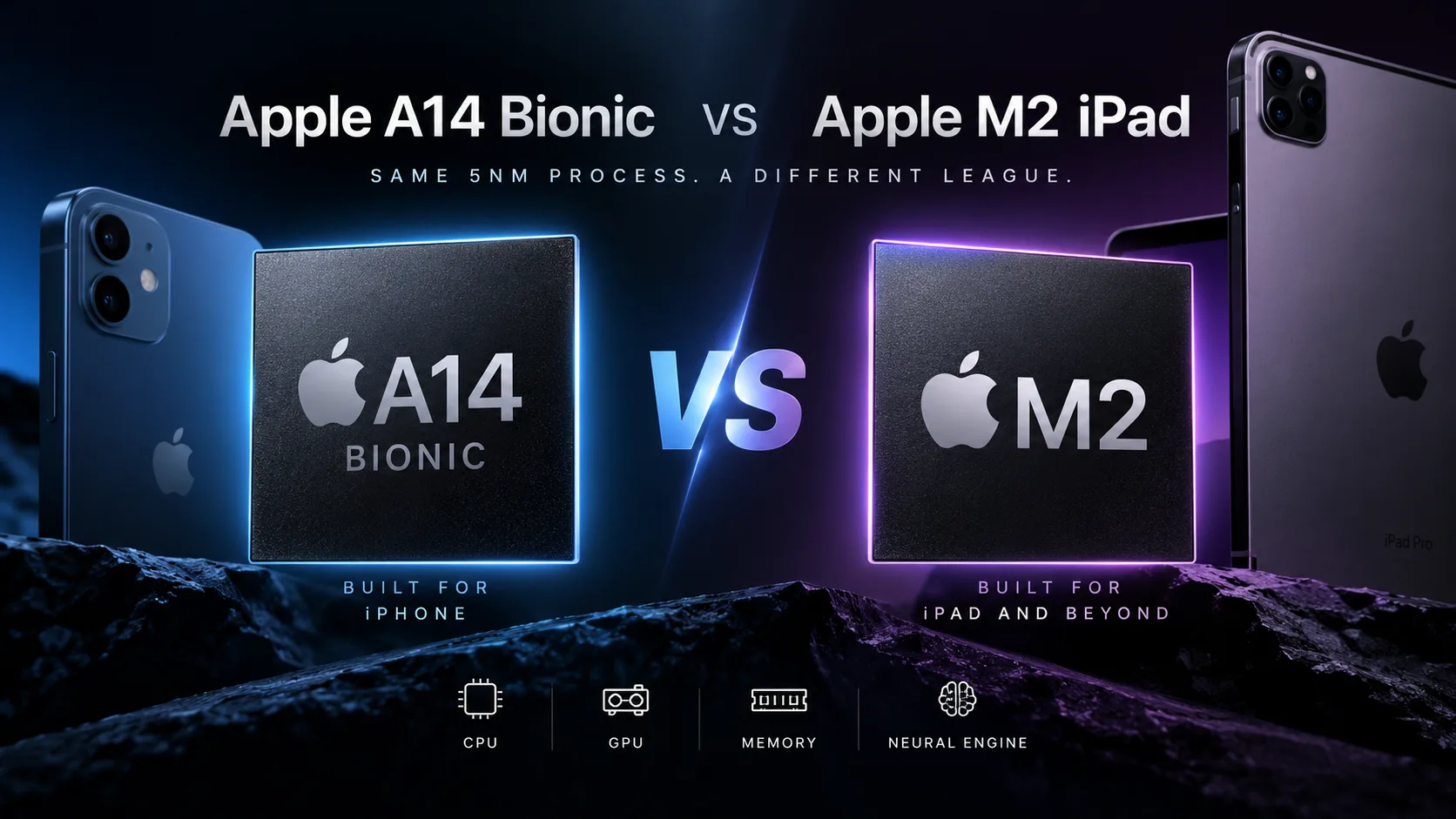
SoC Comparison Result
Apple A14 Bionic vs Apple M2 iPad: CPU and GPU Differences
The Apple A14 Bionic and M2 for iPad use a 5nm process, but they were designed for different devices. The A14 was used in iPhones, while the M2 is used in iPads and Mac computers. The M2 has four performance CPU cores versus two in the A14, a 10-core GPU instead of a 4-core GPU, and higher memory bandwidth. As a result, the difference is especially large in multithreaded and graphics tests.
Key Differences
| Specification | Apple A14 Bionic | Apple M2 iPad |
|---|---|---|
| Year | 2020 | 2022 |
| Process technology | 5 nm | 5 nm |
| CPU | 6 cores, 2P + 4E | 8 cores, 4P + 4E |
| Maximum frequency | up to 3.1 GHz | up to 3.49 GHz |
| GPU | 4 cores | 10 cores |
| Neural Engine | 16 cores | 16 cores |
| Neural Engine performance | up to 11 TOPS | up to 15.8 TOPS |
| Memory bandwidth | - | 100 GB/s |
The main differences are the number of performance CPU cores and the GPU configuration, not the clock speeds. The M2 has four performance CPU cores versus two in the A14, and 10 graphics cores versus four.
Their operating conditions are also different. The A14 operates in a compact smartphone body, while the iPad Pro chassis provides better conditions for heat dissipation under sustained loads.
CPU Performance
In Geekbench 6, the A14 typically scores around 2000-2150 points in Single-Core, while the M2 scores around 2600. The M2 is approximately 20-30% faster.
The difference is much larger in the multicore test. Devices with the A14 score approximately 4700-5100 points, while the M2-powered iPad Pro reaches around 10000.
The two additional performance cores give the M2 a major advantage in tasks that can load the entire processor, including video export, batch image processing, and compilation. In applications that mainly use one or two cores, the difference is smaller.
Results from Real Devices
| Device | Chip | Geekbench 6 Single | Geekbench 6 Multi | AnTuTu 11 | 3DMark Wild Life Extreme |
|---|---|---|---|---|---|
| iPhone 12 | A14 Bionic | 1997 | 4665 | 1 341 575 | 2155 |
| iPhone 12 mini | A14 Bionic | 2130 | 4912 | 1 306 432 | 2138 |
| iPhone 12 Pro | A14 Bionic | 2160 | 5104 | 1 328 132 | 2149 |
| iPad Pro 11 (2022) | M2 | 2622 | 10 044 | 2 536 320 | 6614 |
| iPad Pro 12.9 (2022) | M2 | 2617 | 10 085 | - | 6808 |
Results from individual runs depend on the OS version and device temperature.
The variation among the three iPhone models with the A14 is small. The two iPad Pro models also produce similar results, but the difference between them is much smaller than the gap between the M2 and A14.
GPU: The M2 Is Approximately Three Times Faster
The M2 pulls furthest ahead of the A14 in graphics tests. The A14 uses a 4-core Apple GPU, while the iPad Pro version of the M2 received a 10-core GPU.
In 3DMark Wild Life Extreme, devices with the A14 score around 2100-2200 points. The M2-powered iPad Pro scores approximately 6600-6800 points, or about three times as much.
The more powerful GPU is especially useful in demanding games, 3D applications, graphics editors, and GPU-accelerated video processing.
The M2 is also equipped with a Media Engine featuring hardware acceleration for H.264, HEVC, ProRes, and ProRes RAW. In video processing, the M2 benefits not only from its CPU and GPU: the Media Engine handles part of the workload.
Neural Engine
Both chips feature a 16-core Neural Engine. Apple stated performance of up to 11 TOPS for the A14 and up to 15.8 TOPS for the M2.
The increase here is more modest than with the CPU and GPU: 15.8 TOPS versus 11 TOPS for the A14.
Conclusion
In Geekbench 6 Single-Core, the M2 outperforms the A14 by approximately 20-30%, but its Multi-Core result is almost twice as high. In 3DMark Wild Life Extreme, the M2’s advantage reaches approximately three times.
The A14 remains significantly closer to the M2 in single-threaded workloads than in demanding multithreaded and graphics tasks. The additional CPU cores and much more powerful GPU are what create the main difference between these chips.
Advantages
- Higher Frequency: 3500 MHz (3100 MHz vs 3500 MHz)
- Newer Launch Date: June 2022 (September 2020 vs June 2022)
Basic
4x 1.8 GHz – Icestorm
4x 2.4 GHz – Blizzard
GPU Specifications
Connectivity
Memory Specifications
Miscellaneous
Benchmarks
Related SoC Comparisons




Share in social media
Or Link To Us
<a href="https://cputronic.com/index.php/soc/compare/apple-a14-bionic-vs-apple-m2-ipad" target="_blank">Apple A14 Bionic vs Apple M2 iPad</a>