Apple A17 Pro
vs
Qualcomm Snapdragon 8 Gen 3


SoC Comparison Result
Apple A17 Pro vs. Snapdragon 8 Gen 3: CPU and GPU Comparison
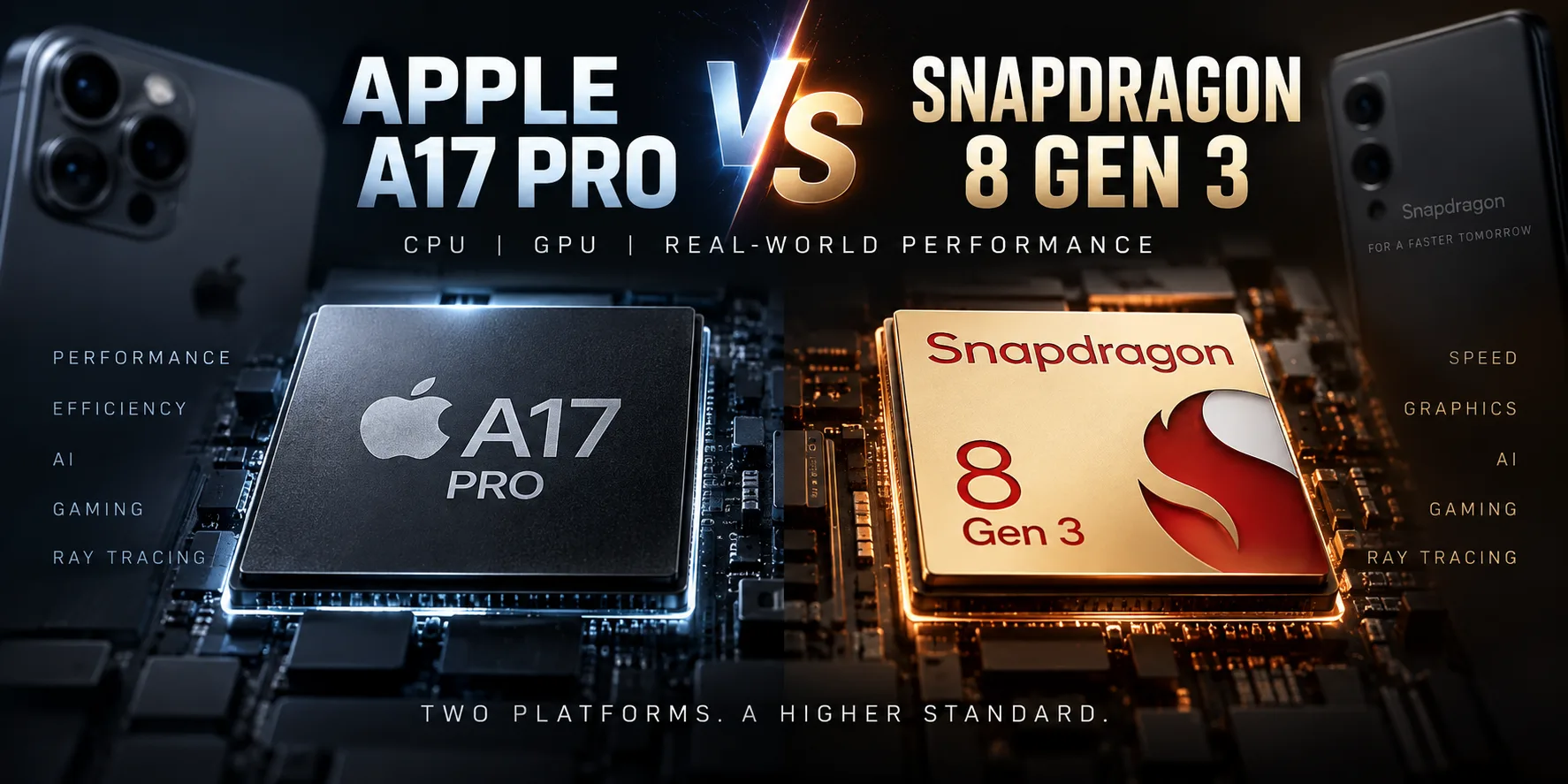
Apple A17 Pro and Qualcomm Snapdragon 8 Gen 3 belong to the same generation of flagship mobile chips, but their strengths differ. The A17 Pro is noticeably faster in single-threaded CPU tests, while the Snapdragon 8 Gen 3 narrows the gap under an all-core load and more often comes out ahead in demanding graphics benchmarks. At the same time, the Snapdragon’s results depend more heavily on the specific smartphone and its cooling system.
Key differences
| Apple A17 Pro | Snapdragon 8 Gen 3 | |
|---|---|---|
| CPU | 6 cores | 8 cores |
| Configuration | 2 performance + 4 efficiency cores | 1 Cortex-X4 + 5 Cortex-A720 + 2 Cortex-A520 |
| GPU | 6-core Apple GPU | Adreno 750 |
| Process technology | 3 nm | 4 nm |
| Ray tracing | Hardware-accelerated | Hardware-accelerated |
| Main strength | Single CPU-core performance | GPU and high multi-threaded performance |
Core count does not directly reflect overall performance here. The A17 Pro uses only six CPU cores, but its performance cores are noticeably faster on a per-thread basis. The Snapdragon 8 Gen 3 has eight cores and makes better use of them under well-parallelized workloads.
CPU: A17 Pro’s advantage is especially noticeable in Single-Core
According to CPUTronic, the A17 Pro scores around 2977 points in Geekbench 6 Single-Core, compared with 2192 for the Snapdragon 8 Gen 3. Apple’s advantage is approximately 36%.
The Multi-Core results are much closer: around 7476 versus 7085 points. The difference narrows to approximately 6% because the Snapdragon uses more CPU cores.
The same relationship can be seen on real smartphones. The iPhone 15 Pro and 15 Pro Max usually score around 2900-3000 points in Geekbench 6 Single-Core. Smartphones powered by the Snapdragon 8 Gen 3 score approximately 2180-2340 points.
The gap is much smaller in Multi-Core. The iPhone 15 Pro Max scores around 7533 points, the ROG Phone 8 Pro scores 7491, and the Galaxy S24 Ultra scores around 7330.
CPU benchmarks on real smartphones
| Smartphone | Chip | Geekbench 6 Single | Geekbench 6 Multi | AnTuTu 11* | Launch price |
|---|---|---|---|---|---|
| Apple iPhone 15 Pro | A17 Pro | 2915 | 7115 | 1 452 754 | $999 |
| Apple iPhone 15 Pro Max | A17 Pro | 2974 | 7533 | 1 467 470 | $1199 |
| Samsung Galaxy S24 Ultra | Snapdragon 8 Gen 3 for Galaxy | 2259 | 7330 | 2 341 394 | $1299.99 |
| OnePlus 12 | Snapdragon 8 Gen 3 | 2182 | 6465 | 2 401 788 | $799.99 |
| Asus ROG Phone 8 Pro | Snapdragon 8 Gen 3 | 2341 | 7491 | 2 464 181 | $1199.99 |
- AnTuTu results for iOS and Android cannot be compared directly. The test versions use different graphics APIs and differ in how the final score is calculated.
Results for a specific device also depend on the firmware version, temperature, performance mode, and testing conditions.
The A17 Pro’s main CPU advantage is specifically tied to single-core performance. In Multi-Core, the Snapdragon 8 Gen 3’s deficit narrows to approximately 5-6%.
How to interpret AnTuTu results
In AnTuTu 11, smartphones powered by the Snapdragon 8 Gen 3 can exceed 2.3-2.4 million points, while the iPhone 15 Pro scores around 1.45 million. This does not mean that the Snapdragon is 60-70% faster than the A17 Pro: the Android and iOS versions of the test use different graphics APIs and differ in methodology. Geekbench 6 and cross-platform 3DMark tests are more useful for directly comparing the two platforms.
GPU: Snapdragon 8 Gen 3 is faster in demanding 3DMark tests
The A17 Pro features a 6-core GPU and hardware-accelerated ray tracing. The Snapdragon 8 Gen 3 uses the Adreno 750, which also supports hardware ray tracing.
In demanding 3DMark tests, the advantage more often goes to the Snapdragon.
GPU benchmarks on real smartphones
| Smartphone | Chip | 3DMark Wild Life Extreme | 3DMark Solar Bay |
|---|---|---|---|
| Apple iPhone 15 Pro | A17 Pro | 3655 | 6089 |
| Apple iPhone 15 Pro Max | A17 Pro | 3655 | - |
| Samsung Galaxy S24 Ultra | Snapdragon 8 Gen 3 for Galaxy | 4531 | 7748 |
| OnePlus 12 | Snapdragon 8 Gen 3 | 4646 | 8360 |
| Asus ROG Phone 8 Pro | Snapdragon 8 Gen 3 | 5205 | 8671 |
In Wild Life Extreme, the Galaxy S24 Ultra is approximately 24% ahead of the iPhone 15 Pro, the OnePlus 12 is 27% ahead, and the ROG Phone 8 Pro is approximately 42% ahead.
Solar Bay shows a similar picture. The iPhone 15 Pro scores around 6089 points, the Galaxy S24 Ultra scores 7748, the OnePlus 12 scores 8360, and the ROG Phone 8 Pro scores 8671.
The difference between the three smartphones using the same Snapdragon 8 Gen 3 shows how important the device’s implementation is. The ROG Phone 8 Pro has a larger cooling system and higher power limits, allowing the Adreno 750 to run faster than it does in a typical thin flagship.
This is especially important under sustained gaming loads. A SoC’s peak score does not guarantee the same performance after the chassis has been heated for an extended period. Therefore, when evaluating the Snapdragon 8 Gen 3, it is important to consider not only the chip’s name but also the specific smartphone.
Gaming and ray tracing
Both chips support hardware ray tracing, but the Snapdragon 8 Gen 3 achieves higher results in most demanding synthetic GPU tests.
The Adreno 750 performs especially well in gaming smartphones with powerful cooling systems. At the same time, display resolution, thermal limits, and the manufacturer’s settings can significantly change the final FPS, so synthetic test results should not be treated as a direct prediction for every game.
The A17 Pro is used only in the iPhone 15 Pro and 15 Pro Max, so the variation between devices is significantly smaller.
Conclusion
The Apple A17 Pro is noticeably faster than the Snapdragon 8 Gen 3 in the single-threaded Geekbench 6 CPU test, with an advantage of approximately 30-35%. In Multi-Core, the difference narrows to a few percent.
The situation is reversed in graphics tests. The Snapdragon 8 Gen 3 outperforms the A17 Pro in Wild Life Extreme and Solar Bay, with its highest results appearing in smartphones equipped with more advanced cooling systems.
The A17 Pro’s main strength is single CPU-core performance. The Snapdragon 8 Gen 3 stands out with higher performance in demanding GPU tests and strong results under multi-threaded workloads.
Advantages
- Higher Technology: 3 nm (3 nm vs 4 nm)
- Higher Frequency: 3780 MHz (3780 MHz vs 3300 MHz)
- Newer Launch Date: October 2023 (September 2023 vs October 2023)
Basic
4x 2.11 GHz
5x (3x3.2 GHz/2x3.0GHz) – Cortex-A720
2x 2.3 GHz – Cortex-A520
GPU Specifications
Connectivity
Memory Specifications
Miscellaneous
Benchmarks
Comparison of Devices
Related SoC Comparisons




Share in social media
Or Link To Us
<a href="https://cputronic.com/index.php/soc/compare/apple-a17-pro-vs-qualcomm-snapdragon-8-gen-3" target="_blank">Apple A17 Pro vs Qualcomm Snapdragon 8 Gen 3</a>