NVIDIA GeForce RTX 5050
vs
NVIDIA GeForce RTX 4050
GPU Comparison Result
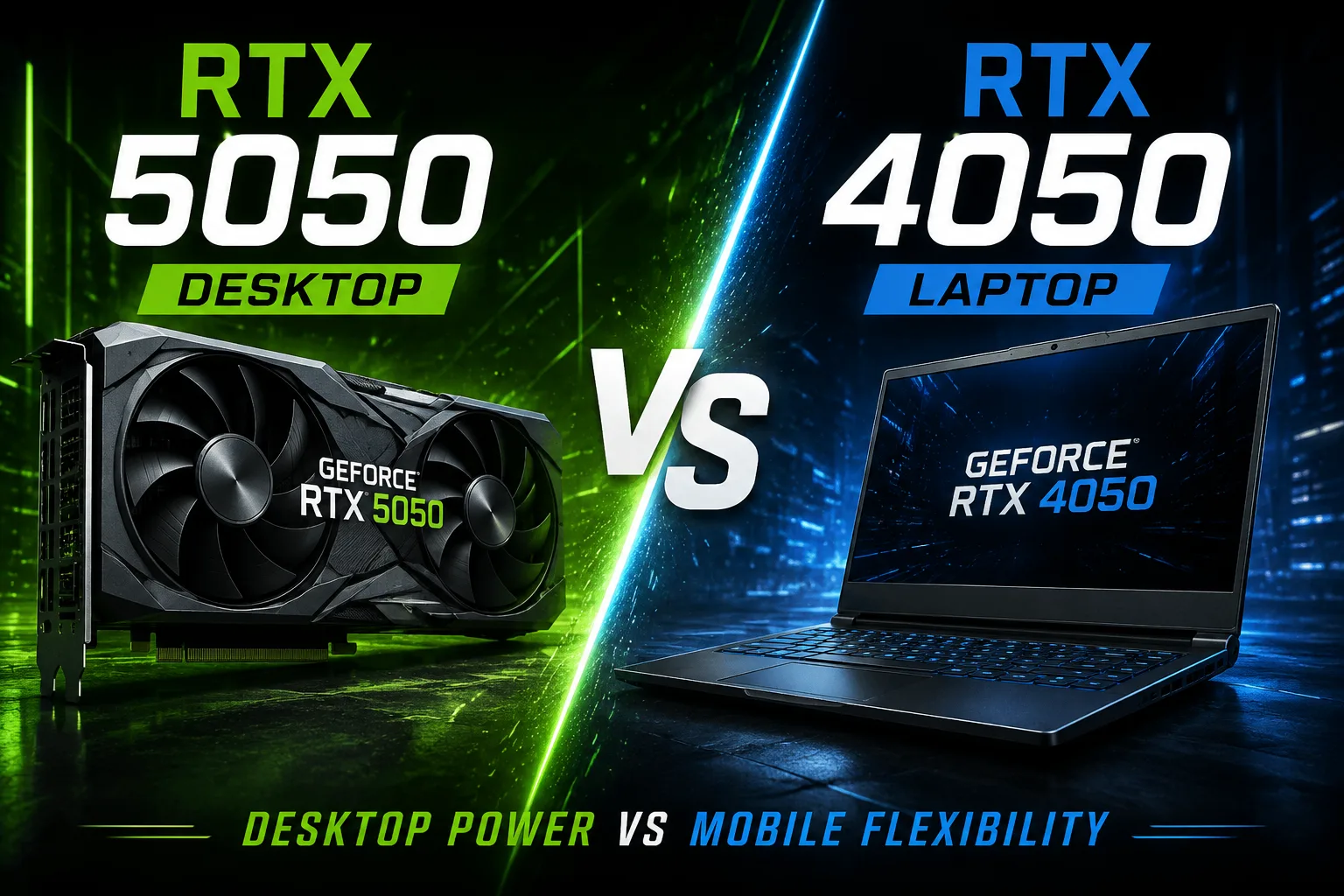
RTX 5050 vs RTX 4050: How Much Faster is the Desktop RTX 5050
By name, the RTX 5050 appears to be a direct replacement for the RTX 4050, but we are comparing different classes of devices here. The RTX 5050 is a desktop graphics card on Blackwell architecture, while the RTX 4050 is a mobile GPU on Ada Lovelace.
They have the same number of CUDA cores, but that's where the similarities end. The RTX 5050 has more memory, a wider bus, and significantly higher bandwidth.
Main Differences
| GeForce RTX 5050 | GeForce RTX 4050 | |
|---|---|---|
| Platform | Desktop | Laptop |
| Architecture | Blackwell | Ada Lovelace |
| CUDA Cores | 2560 | 2560 |
| Video Memory | 8 GB GDDR6 | 6 GB GDDR6 |
| Memory Bus | 128 bit | 96 bit |
| Bandwidth | 320 GB/s | 192 GB/s |
| Power Consumption | 130 W | 35-115 W |
| Multi Frame Generation | Yes | No |
The main limitation of the RTX 4050 today is its 6 GB of video memory. While this is sufficient at 1080p for now, heavy textures and ray tracing quickly consume that reserve.
The advantages of the RTX 5050 extend beyond the additional 2 GB of memory. Its wider bus and 320 GB/s bandwidth provide it with considerably more freedom under heavy loads.
3DMark Time Spy in Graphics Cards and Laptops
| Device | GPU | Time Spy Graphics |
|---|---|---|
| GALAX GeForce RTX 5050 Shengren OC | RTX 5050 | 10 279 |
| MSI GeForce RTX 5050 8G Gaming OC | RTX 5050 | 10 205 |
| ASUS TUF Gaming A15 FA507 | RTX 4050 Laptop | 8 692 |
| MSI Katana 15 B12VEK | RTX 4050 Laptop | 8 500 |
| Acer Nitro V 15 ANV15-51-582S | RTX 4050 Laptop | 7 818 |
Even fast laptops with an RTX 4050 fall short of the desktop RTX 5050.
The RTX 5050 outperforms the ASUS TUF Gaming A15 by approximately 18%, the MSI Katana 15 by 20%, and the Acer Nitro V 15 by 30%.
On average, the RTX 5050 demonstrates a performance advantage of around 23% in this sample.
The systems are different, so this isn't a direct GPU comparison under identical conditions. However, Time Spy Graphics effectively highlights the differences in graphical performance.
The Name RTX 4050 Says Little About the Laptop's Speed
The performance of the RTX 4050 Laptop heavily depends on its TGP.
At a limit of around 35 W, the card scores about 5300 points in Time Spy Graphics. At 65 W, the score rises to around 7500 points, and at about 80 W, it reaches 8100 points.
After that, the gains slow considerably. At 100-115 W, the score is around 8500 points.
Therefore, two laptops with RTX 4050 can differ in graphical performance by tens of percent.
The RTX 4050 should only be evaluated as part of a specific laptop. One must look at the TGP, cooling, and real-world tests of the model.
6 GB vs 8 GB: Where Memory Limitation Begins
Both cards are primarily designed for 1080p gaming, but the 8 GB of the RTX 5050 offer greater freedom in demanding games.
8 GB no longer seems like a large amount, but the 6 GB of the RTX 4050 significantly restricts settings.
The RTX 5050 supports Multi Frame Generation. This technology can noticeably increase the displayed FPS, but it does not provide the same increase in real performance.
It doesn't fix a low base FPS, just as it doesn't remedy a lack of video memory.
The RTX 4050 also offers Frame Generation, but without Multi Frame Generation.
RTX 5050 is Faster, But the RTX 5060 is Nearby
The RTX 5050 firmly outpaces the 4050, but for desktop PCs, a more critical comparison is with the RTX 5060.
The recommended price for the RTX 5050 is $249, while the RTX 5060 started at $299.
With only a $50 difference, the RTX 5050 comes too close to the RTX 5060. If the actual difference in price remains small, there's no point in saving on the RTX 5050.
The RTX 5050 is suitable for 1080p, offers 8 GB of memory, and includes the full suite of Blackwell technologies, but its price should always be compared with the RTX 5060.
Conclusion
The RTX 5050 confidently wins this comparison: it is faster, has 8 GB of memory, and is less dependent on the constraints of specific devices.
In fast laptops, the RTX 4050 trails by about 20%, while at low TGP, the gap exceeds 30%.
However, this is not a typical comparison of two neighboring generations. The RTX 5050 has a desktop TGP of 130 W, while the RTX 4050 Laptop operates within a range of 35-115 W.
For a gaming laptop, the RTX 4050 remains a viable option for 1080p, but only with good TGP and cooling.
For desktop PCs, the RTX 5050 is noticeably more interesting, but with an additional cost of about $50, it’s better to buy the RTX 5060 right away.
Advantages
- Larger Memory Size: 8GB (8GB vs 6GB)
- Higher Bandwidth: 224.0GB/s (224.0GB/s vs 192.0 GB/s)
- Newer Launch Date: January 2025 (January 2025 vs February 2023)
- Higher Boost Clock: 1605-2370MHz (2520 MHz vs 1605-2370MHz)
Basic
Memory Specifications
Display and Media
3x DisplayPort 1.4a
Theoretical Performance
Miscellaneous
Benchmarks
Related GPU Comparisons


Share in social media
Or Link To Us
<a href="https://cputronic.com/index.php/gpu/compare/nvidia-geforce-rtx-5050-vs-nvidia-geforce-rtx-4050" target="_blank">NVIDIA GeForce RTX 5050 vs NVIDIA GeForce RTX 4050</a>