AMD Radeon 780M
vs
NVIDIA GeForce GTX 1650

GPU Comparison Result
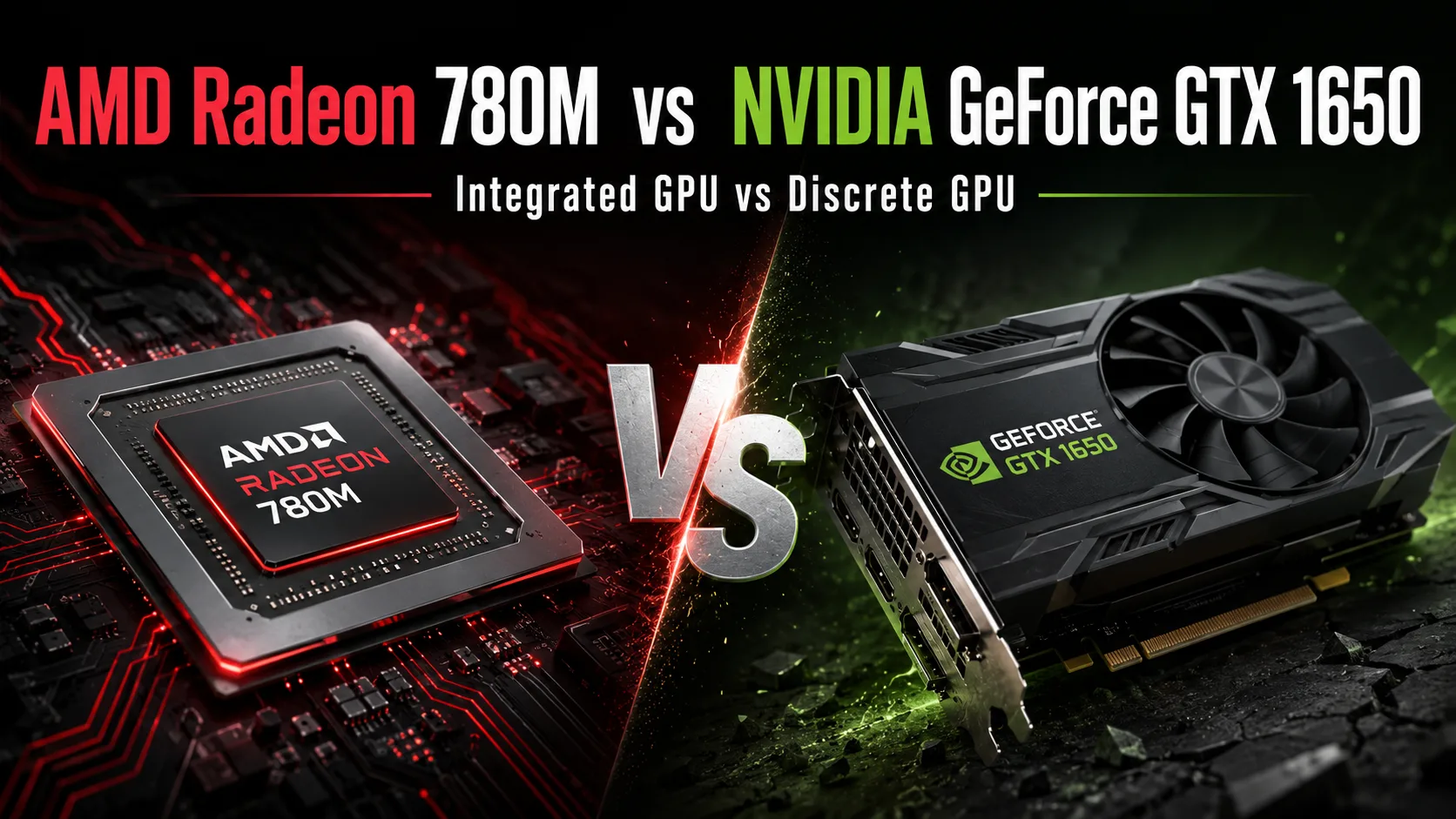
AMD Radeon 780M vs GeForce GTX 1650: How Close Has Integrated Graphics Come to an Old Discrete Card
The GeForce GTX 1650 was released in 2019 as an affordable graphics card for Full HD gaming. The Radeon 780M appeared nearly four years later within AMD’s mobile processors and operates without dedicated video memory. The GTX 1650 is still faster, but the best systems with the Radeon 780M trail it by just 15-20%.
This comparison refers specifically to the desktop GeForce GTX 1650, not the GTX 1650 Mobile. The mobile GTX 1650 is weaker, resulting in an even smaller gap with the Radeon 780M.
What is the Fundamental Difference
| Radeon 780M | GeForce GTX 1650 | |
|---|---|---|
| Type | Integrated | Discrete |
| Architecture | RDNA 3 | Turing |
| Compute Units | 12 CU, 768 shaders | 896 CUDA cores |
| Memory | System DDR5/LPDDR5X | 4 GB GDDR5/GDDR6 |
| Memory Bus | Depends on the system | 128 bits |
| Typical Use | Laptops, Mini-PCs | Desktop PCs |
| Year of Release | 2023 | 2019 |
The GTX 1650 has its own 4 GB of video memory and is powered independently from the processor. The Radeon 780M uses system memory and shares power with the CPU cores.
Therefore, the performance of the 780M significantly depends on the specific device. Fast LPDDR5X or DDR5, a high power limit, and efficient cooling can considerably enhance performance. The same iGPU in a slim ultrabook versus a more powerful laptop can yield noticeably different results.
Radeon 780M and GTX 1650 in Real Systems
For comparison, we’ll use 3DMark Time Spy Graphics. For Radeon 780M, results from specific laptops are used; for the GTX 1650, results from desktops with specific graphics cards.
| Device / Configuration | GPU | Processor | Time Spy Graphics |
|---|---|---|---|
| Tuxedo Pulse 14 Gen3 | Radeon 780M | Ryzen 7 7840HS | 3027 |
| Schenker XMG Evo 14 M24 | Radeon 780M | Ryzen 7 8845HS | 2860 |
| Ninkear A16 Pro | Radeon 780M | Ryzen 7 8845HS | 2732 |
| Framework Laptop 13.5 | Radeon 780M | Ryzen 7 7840U | 2575 |
| Acer Swift Edge 16 | Radeon 780M | Ryzen 7 7840U | 2363 |
| Gainward GeForce GTX 1650 4 GB | GTX 1650 | Ryzen 7 2700X | 3492 |
| KFA2 GTX 1650 EX | GTX 1650 | Ryzen 9 3900X | 3512 |
| KFA2 GTX 1650 EX | GTX 1650 | Ryzen 9 5900X | 3538 |
| ASUS TUF Gaming GTX 1650 | GTX 1650 | Ryzen 7 9800X3D | 3622 |
The variance in scores for the Radeon 780M is significant: from 2363 points in the Acer Swift Edge 16 to 3027 in the Tuxedo Pulse 14 Gen3. The difference between these two laptops with the same iGPU approaches 30%.
The results for the desktop GTX 1650 are much more stable, generally falling between 3490 and 3620 points.
The best laptop with the Radeon 780M in the table falls behind the typical GTX 1650 by about 15-20%. In thinner laptops with stricter power limits, the gap can exceed 30%.
The average score for the Radeon 780M is around 2755 points compared to 3521 for the GTX 1650. On average, the GTX 1650 is about 28% faster.
What Happens in Games
Gaming tests confirm the results from Time Spy. The GTX 1650 is generally faster, but the extent of that advantage depends on the specific game and the system with the Radeon 780M.
At Full HD, the GTX 1650 often outperforms the Radeon 780M by about 20-30%, although in certain titles, the gap can be significantly larger.
For the Radeon 780M, memory and power limits are particularly crucial. Slow memory, low power limits for the APU, or weak cooling can significantly reduce FPS.
The GTX 1650 is more predictable in this regard. It has dedicated video memory, and the GPU's power consumption does not share resources with the CPU cores.
The Radeon 780M has not yet matched the GTX 1650 in gaming performance, but it has reached the level of older budget discrete graphics cards.
Why TFLOPS Can Be Misleading Here
The theoretical FP32 performance of the Radeon 780M is significantly higher than that of the GTX 1650, but these values cannot be directly compared.
RDNA 3 and Turing differ significantly in architecture, so a high TFLOPS figure does not automatically translate to a corresponding increase in FPS.
Thus, Time Spy and gaming tests are much more indicative in this context.
4 GB of GTX 1650 Has Become a Limitation
Dedicated video memory remains an advantage for the GTX 1650, but 4 GB is considered insufficient by modern standards. In new games, this amount quickly limits texture quality and other settings.
The Radeon 780M can allocate more system memory for graphics, but it cannot match the speed of dedicated VRAM. The CPU and GPU share the same memory subsystem, and the bandwidth remains one of the main limitations for integrated graphics.
Today, both are primarily suitable for 1080p resolutions and moderate graphics settings.
Is it Worth Buying a GTX 1650 in 2026?
New GTX 1650 graphics cards are still found for sale, but prices for remaining cards often do not correspond to their performance. Purchasing a new GTX 1650 for several hundred dollars does not make sense.
If a used GTX 1650 can be found for around $50-70, it may still be a cheap upgrade for an older office PC. Versions without additional power requirements are particularly interesting.
The Radeon 780M cannot be purchased separately. It is part of AMD's mobile APUs and is found in laptops and mini-PCs.
Conclusion
The GeForce GTX 1650 remains faster than the Radeon 780M, but the comparison is no longer very flattering for it.
In well-optimized systems, the Radeon 780M lags behind the desktop GTX 1650 by about 15-25%, although it is integrated into a mobile processor, lacks dedicated video memory, and shares the overall power budget with it.
In thinner laptops, the gap may increase to 30% or more, making it difficult to estimate the performance of a specific laptop based solely on the Radeon 780M designation.
If the GTX 1650 is already part of a computer, switching to a system with a Radeon 780M for the sole purpose of graphics would be a step backward.
However, for a laptop or mini-PC, the situation is much more interesting. In 2019, such performance required a separate 75-watt graphics card. Now, integrated graphics within a mobile processor have come very close to that level.
Advantages
- Higher Boost Clock: 2900MHz (2900MHz vs 1665MHz)
- Newer Launch Date: January 2023 (January 2023 vs April 2019)
- Larger Memory Size: 4GB (System Shared vs 4GB)
- Higher Bandwidth: 128.1 GB/s (System Dependent vs 128.1 GB/s)
- More Shading Units: 896 (768 vs 896)
Basic
Memory Specifications
Display and Media
1x HDMI 2.0
1x DisplayPort 1.4a
Theoretical Performance
Miscellaneous
Benchmarks
Related GPU Comparisons


Share in social media
Or Link To Us
<a href="https://cputronic.com/index.php/gpu/compare/amd-radeon-780m-vs-nvidia-geforce-gtx-1650" target="_blank">AMD Radeon 780M vs NVIDIA GeForce GTX 1650</a>