AMD Radeon 680M
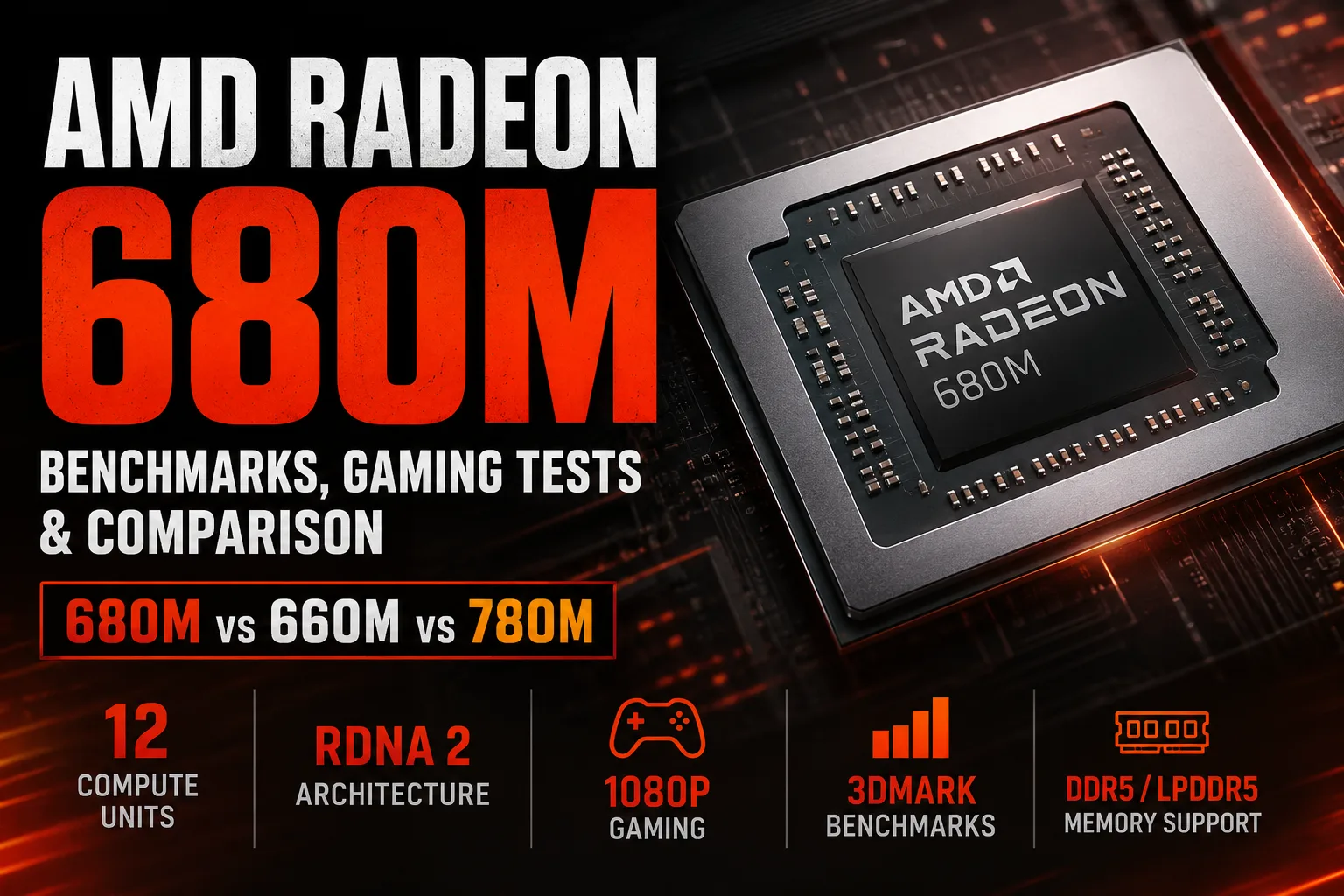
AMD Radeon 680M: Specifications, Game Tests, and Comparison with Radeon 660M and 780M
The AMD Radeon 680M has become one of the major leaps in the development of AMD's integrated graphics. Twelve RDNA 2 compute units enable it to run competitive games and many older AAA titles at Full HD without a discrete graphics card. However, performance varies by device: in tested laptops and mini-PCs, the difference in Time Spy Graphics scores can reach up to 29%.
Architecture and Position in AMD's Lineup
The Radeon 680M features 12 RDNA 2 compute units, or 768 shading units. The maximum frequency depends on the processor: in the Ryzen 7 6800U and Ryzen 7 7735HS, the graphics operate at frequencies of up to 2.2 GHz, while in the Ryzen 9 6900HS and 6900HX, it can go up to 2.4 GHz.
This iGPU is found in the Ryzen 7 6800U, Ryzen 7 6800H, Ryzen 7 PRO 6850U, Ryzen 9 6900HS, Ryzen 9 6900HX, Ryzen 7 7735U, and Ryzen 7 7735HS.
The Radeon 680M does not have its own video memory. It uses system DDR5 or LPDDR5 alongside the processor cores, making it sensitive to both memory bandwidth and available power. Beyond a certain level, further increases in the APU’s limits yield diminishing returns, as the limitation comes from the 12 compute units themselves.
The entry-level Radeon 660M is based on the same architecture but has only six compute units and a frequency of up to 1.9 GHz. This is not a slightly throttled version of the 680M, but rather a lower-class graphics card.
Radeon 680M in Specific Devices
| Device | Processor | APU and Memory Limit | 3DMark Time Spy Graphics | 3DMark Fire Strike Graphics |
|---|---|---|---|---|
| Beelink SER6 Pro | Ryzen 7 6800H | around 45 W, DDR5-4800 | 2452 | 7026 |
| Lenovo Yoga 7 14ARB7 | Ryzen 7 6800U | 25 W, 16 GB LPDDR5-6400 | 2449 | 7279 |
| Lenovo ThinkPad T14 Gen 3 AMD | Ryzen 7 PRO 6850U | -, 16 GB LPDDR5-6400 | 2289 | 7050 |
| ASUS Zenbook S 13 OLED UM5302TA | Ryzen 7 6800U | -, 16 GB LPDDR5-6400 | 2287 | 6683 |
| HP EliteBook 835 G9 | Ryzen 7 PRO 6850U | -, 16 GB DDR5-4800 | 1896 | 5654 |
The Yoga 7 with a 25-Watt Ryzen 7 6800U essentially matched the mini-PC with a Ryzen 7 6800H: 2449 versus 2452 points in Time Spy Graphics. This illustrates that the mobile U-series, with favorable power settings and fast memory, can perform on par with more powerful processors using the same Radeon 680M.
The ThinkPad T14 and Zenbook S 13 score around 2290 points-approximately 7% lower than the leaders. Scores in the range of 2300 to 2450 points can be considered typical for fast devices with the Radeon 680M.
The HP EliteBook 835 G9 is limited to 1896 points, trailing the Beelink SER6 Pro by almost 29%. This could be due to the DDR5-4800, power limits, and manufacturer settings, but it’s impossible to determine the contribution of each factor based on a single comparison.
Power increases also affect results. In the same device, lowering the APU limit from about 50 to 25 W reduced the Time Spy Graphics score by approximately 19%. Moreover, further increases in power consumption yield less noticeable gains than moving to a graphics card with a higher number of compute units.
What Radeon 680M Can Handle in Games
The Radeon 680M is most suitable for screens with a resolution of 1920 × 1080 or 1920 × 1200. In lighter games, high settings can be used, while heavier projects require switching to low presets and using FSR.
| Game and Settings | Beelink SER6 Pro | Lenovo Yoga 7 |
|---|---|---|
| Cyberpunk 2077, 1080p, low | about 43 FPS | about 34 FPS |
| Cyberpunk 2077, 1080p, medium | about 33 FPS | about 26 FPS |
| The Witcher 3, 1080p, high | - | about 43 FPS |
| Dota 2, 1080p, high | - | about 97 FPS |
In Cyberpunk 2077, the Beelink mini-PC maintains over 40 frames per second on low settings and around 33 frames on medium. The Yoga 7 is noticeably slower, but after lowering the settings or enabling FSR, the game remains playable.
In Dota 2 and other undemanding competitive games, the Radeon 680M allows for Full HD with high settings. The Witcher 3 and similarly demanding titles typically run at Full HD on low or medium presets.
Modern heavy titles require low settings, FSR, and sometimes frame rate limitations around 30 FPS. In the most demanding games, it is necessary to reduce the internal resolution to 1600 × 900 or 1280 × 720.
On screens with resolutions of 2560 × 1600 and higher, running heavy games at native resolution places too much strain on the Radeon 680M. Scaling can help increase frame rates, but it significantly reduces image sharpness.
Hardware ray tracing is supported; however, there is virtually no headroom for it. Even standard rendering in modern games can fully load all compute units.
Radeon 680M vs. Radeon 660M
The difference is clearly visible in two versions of the Morefine M600 mini-PC. The configuration with the Radeon 680M scored 2408 points in Time Spy Graphics, while the model with the Radeon 660M scored 1430 points. The advantage of the higher-end graphics was 68%.
In Fire Strike Graphics, the gap was smaller but still reached 44%: 6644 versus 4621 points.
This is not an entirely clean comparison as the devices use different processors. However, the results clearly illustrate the difference between the classes. The Radeon 680M often allows for maintaining Full HD and using medium settings, while the Radeon 660M quickly hits minimum presets and lower resolutions.
With only a slight price difference, a laptop with the Radeon 680M is significantly more advantageous for gaming.
Radeon 680M vs. Radeon 780M
The Radeon 780M has transitioned to the RDNA 3 architecture but retains 12 compute units. It operates at a higher frequency and is generally faster than the 680M; however, the performance increase is far more modest than that observed when moving from 660M to 680M.
A fast Radeon 680M with LPDDR5-6400 and a normal power limit can come close to the Radeon 780M in a slim laptop where the new iGPU is more power-constrained.
The transition from the Radeon 680M to the 780M yields a moderate boost and rarely justifies the replacement of a functioning laptop. When purchasing a new device, the Radeon 780M appears more attractive, but the overall speed still depends on memory, power, and cooling.
Conclusion
The AMD Radeon 680M is still suitable for laptops and mini-PCs without a discrete graphics card, which plan to run games regularly. It handles competitive titles, many older AAA games, and some modern releases at low settings while utilizing FSR.
The main advantage over the Radeon 660M is the doubled number of compute units. In Time Spy, the difference between them can reach almost 70%, so they are truly different classes of integrated graphics.
However, the name Radeon 680M does not guarantee a specific speed. In the tested devices, the Time Spy Graphics scores range from 1896 to 2452 points. Therefore, when selecting a model, it is essential to consider not only the processor but also the memory, power limits, and specific device results.
GPU Comparison
Compare Radeon 680M with other GPUs
Basic
Memory Specifications
Display and Media
Theoretical Performance
Miscellaneous
Benchmarks
Compared to Other GPU
Related GPU Comparisons



Share in social media
Or Link To Us
<a href="https://cputronic.com/index.php/gpu/amd-radeon-680m" target="_blank">AMD Radeon 680M</a>