Intel Xeon 6736P

Intel Xeon 6736P
Intel Xeon 6736P processor review

Intel Xeon 6736P: Benchmark Results and Servers with a 36-Core Processor

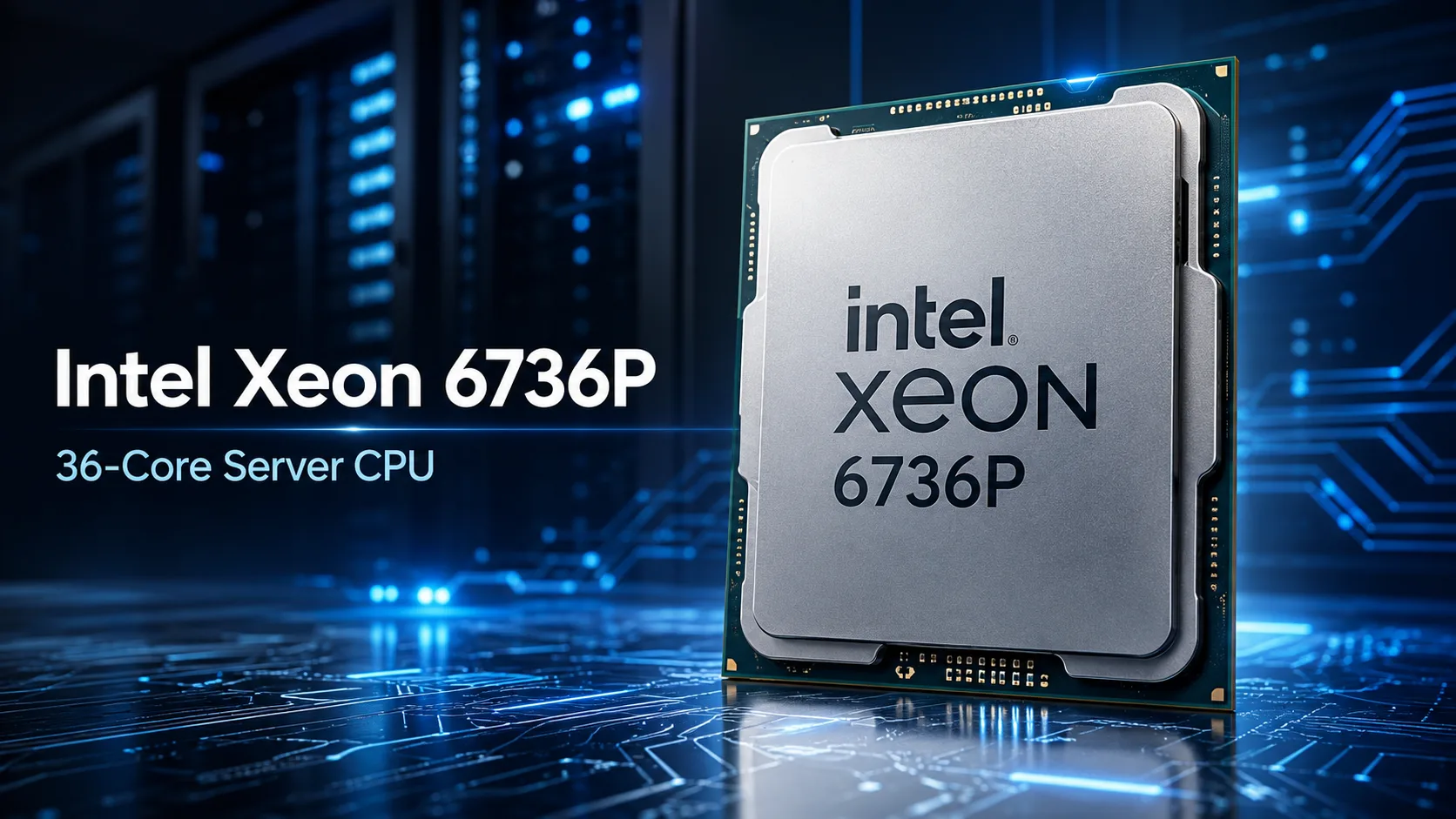
The Intel Xeon 6736P is a 36-core server processor from the Granite Rapids family, supporting 72 threads, with a clock speed of up to 4.1 GHz and a TDP of 205 W. It is designed for use in single- and dual-socket servers, optimized for virtualization, databases, enterprise applications, and other workloads where not only the number of cores matters but also the performance of individual threads.

Benchmark Results of Servers with Intel Xeon 6736P

The table below presents the SPEC CPU 2017 results for production servers. In all configurations, two Xeon 6736P processors are installed-totaling 72 cores and 144 threads.

SPECint_rate2017 measures system throughput on integer tasks, while SPECfp_rate2017 measures floating-point computations. These results represent an entire dual-socket server, not just a single processor.

Server CPU Configuration SPECint_rate2017 Base SPECfp_rate2017 Base
xFusion FusionServer 1288 V8 2 × Xeon 6736P 778 997
KAYTUS KR2280V3 2 × Xeon 6736P 757 968
HPE ProLiant Compute DL380 Gen12 2 × Xeon 6736P 750 975
HPE ProLiant Compute DL360 Gen12 2 × Xeon 6736P 748 964
Lenovo ThinkSystem SR630 V4 2 × Xeon 6736P 735 934

The difference between the fastest and slowest server is about 6%. Since all systems have the same processors, variations result from memory configuration, BIOS settings, power profiles, cooling, and the software environment used.

For server platforms, this is a typical situation: the CPU name defines only part of the final performance. A server with fully populated memory channels and a well-configured power mode can outperform another system with the same processors but less optimal configuration.

Performance and Clock Speeds

The base frequency of the Xeon 6736P is 2.0 GHz; however, under load, the processor can operate significantly faster. The maximum Turbo Boost frequency reaches 4.1 GHz, and the stated frequency under full-core load is up to 3.4 GHz.

The processor also supports Intel Speed Select Technology. Depending on the server and firmware, the administrator can choose a profile focused on compute density or higher frequency. Therefore, the behavior of the Xeon 6736P in a real system depends not only on cooling but also on the settings provided by the server manufacturer.

In terms of core count, this model is positioned in the middle of the Xeon 6 family. It lags behind higher-end processors in overall compute density but maintains higher frequencies than many configurations with 64 or more cores.

This is particularly important for mixed workloads. Virtual machines, application servers, and databases rarely load all cores evenly; some threads run in parallel, while others are sensitive to a single core's speed and memory latencies.

Dual-Socket Configuration

A system with two Xeon 6736P processors achieves 72 physical cores, 144 threads, and a total CPU TDP of 410 W. According to the SPEC CPU 2017 results, such servers show good scalability and are suitable for tasks that can distribute workloads between two sockets.

However, a dual-socket system requires proper NUMA configuration. The operating system, hypervisor, and applications need to account for which processor the memory is connected to. Frequent access to memory from the second socket increases latencies and can degrade performance, even with high overall bandwidth.

As a result, for some databases and applications, a single more powerful processor may be more efficient than two less powerful ones. Two Xeon 6736P processors are justified where the workload truly utilizes a large number of threads and the memory capacity of both sockets.

Memory and Device Connectivity

The Xeon 6736P supports eight channels of DDR5 ECC memory per processor. In a dual-socket server, 16 channels are available, but to achieve maximum bandwidth, memory modules must be evenly distributed between the processors and channels.

Partial channel utilization is particularly noticeable in analytics, modeling, rendering, and other tasks that heavily engage with large datasets. In such scenarios, saving on the number of memory modules can restrict performance more significantly than the difference between adjacent CPU models.

A large number of PCI Express 5.0 lanes allows for the connection of NVMe drives, high-speed network cards, and compute accelerators. This makes the Xeon 6736P suitable not only for general-purpose servers but also for storage systems, network infrastructure, and nodes with multiple GPUs.

Suitable Use Cases for Intel Xeon 6736P

The Xeon 6736P is aimed at virtualization, enterprise databases, application servers, software-defined storage, and mid-density computing clusters.

The model is particularly interesting for software licensed by the number of cores. In such systems, purchasing a processor with 64-86 cores increases not just hardware costs but also licensing expenses. A configuration with 36 faster cores may provide a better balance of performance and total cost of ownership.

For maximizing the number of virtual machines on a single server, higher-end Xeon 6 processors with more cores may be more advantageous. For applications sensitive to single-thread speeds, it is advisable to consider models with fewer cores and higher base frequencies.

The Xeon 6736P occupies an intermediate position: it allows for building a dual-socket server with 72 cores without moving to processors with TDPs of 300-350 W and without overpaying for cores that may remain underloaded.

Basic

Label Name
Intel
Platform
Server
Launch Date
January 2025
Model Name
?
The Intel processor number is just one of several factors - along with processor brand, system configurations, and system-level benchmarks - to be considered when choosing the right processor for your computing needs.
6736P
Code Name
Products formerly Granite Rapids

CPU Specifications

Total Cores
?
Cores is a hardware term that describes the number of independent central processing units in a single computing component (die or chip).
36
Total Threads
?
Where applicable, Intel® Hyper-Threading Technology is only available on Performance-cores.
72
Basic Frequency
2 GHz
Intel Virtualization Technology (VT-x)
?
Intel® Virtualization Technology (VT-x) allows one hardware platform to function as multiple “virtual” platforms. It offers improved manageability by limiting downtime and maintaining productivity by isolating computing activities into separate partitions.
Yes
Intel Virtualization Technology for Directed I/O (VT-d)
?
Intel® Virtualization Technology for Directed I/O (VT-d) continues from the existing support for IA-32 (VT-x) and Itanium® processor (VT-i) virtualization adding new support for I/O-device virtualization. Intel VT-d can help end users improve security and reliability of the systems and also improve performance of I/O devices in virtualized environments.
Yes
Max Turbo Frequency
?
Max Turbo Frequency is the maximum single-core frequency at which the processor is capable of operating using Intel® Turbo Boost Technology and, if present, Intel® Turbo Boost Max Technology 3.0 and Intel® Thermal Velocity Boost. Frequency is typically measured in gigahertz (GHz), or billion cycles per second.
4.1 GHz
Instruction Set Extensions
Intel® SSE4.2, Intel® AVX, Intel® AVX2, Intel® AVX-512, Intel® AMX
Number of AVX-512 FMA Units
2
Intel Hyper-Threading Technology
?
Intel® Hyper-Threading Technology (Intel® HT Technology) delivers two processing threads per physical core. Highly threaded applications can get more work done in parallel, completing tasks sooner.
Yes
Intel Turbo Boost Technology
?
Intel® Turbo Boost Technology dynamically increases the processor's frequency as needed by taking advantage of thermal and power headroom to give you a burst of speed when you need it, and increased energy efficiency when you don’t.
2.0
Cache
?
CPU Cache is an area of fast memory located on the processor. Intel® Smart Cache refers to the architecture that allows all cores to dynamically share access to the last level cache.
144 MB
CPU Socket
?
The socket is the component that provides the mechanical and electrical connections between the processor and motherboard.
FCLGA4710
Intel AES New Instructions
?
Intel® AES New Instructions (Intel® AES-NI) are a set of instructions that enable fast and secure data encryption and decryption. AES-NI are valuable for a wide range of cryptographic applications, for example: applications that perform bulk encryption/decryption, authentication, random number generation, and authenticated encryption.
Yes
Technology
?
Lithography refers to the semiconductor technology used to manufacture an integrated circuit, and is reported in nanometer (nm), indicative of the size of features built on the semiconductor.
Intel 3
TDP
205 W
PCI Express Version
?
PCI Express Revision is the supported version of the PCI Express standard. Peripheral Component Interconnect Express (or PCIe) is a high-speed serial computer expansion bus standard for attaching hardware devices to a computer. The different PCI Express versions support different data rates.
5.0
Max Number of PCI Express Lanes
?
A PCI Express (PCIe) lane consists of two differential signaling pairs, one for receiving data, one for transmitting data, and is the basic unit of the PCIe bus. Max # of PCI Express Lanes is the total number of supported lanes.
88
Intel 64
?
Intel® 64 architecture delivers 64-bit computing on server, workstation, desktop and mobile platforms when combined with supporting software.¹ Intel 64 architecture improves performance by allowing systems to address more than 4 GB of both virtual and physical memory.
Yes
Intel VT-x with Extended Page Tables (EPT)
?
Intel® VT-x with Extended Page Tables (EPT), also known as Second Level Address Translation (SLAT), provides acceleration for memory intensive virtualized applications. Extended Page Tables in Intel® Virtualization Technology platforms reduces the memory and power overhead costs and increases battery life through hardware optimization of page table management.
Yes

Memory Specifications

Memory Type
?
Intel® processors come in four different types: Single Channel, Dual Channel, Triple Channel, and Flex Mode. Maximum supported memory speed may be lower when populating multiple DIMMs per channel on products that support multiple memory channels.
DDR5(6400MT/s)
Max Memory Size
?
Max memory size refers to the maximum memory capacity supported by the processor.
4 TB
Memory Channels
?
The number of memory channels refers to the bandwidth operation for real world application.
8
Maximum Memory Speed
6400 MT/s

AI Specifications

Intel Deep Learning Boost (Intel DL Boost) on CPU
?
A new set of embedded processor technologies designed to accelerate AI deep learning use cases. It extends Intel AVX-512 with a new Vector Neural Network Instruction (VNNI) that significantly increases deep learning inference performance over previous generations.
Yes

Interfaces and Ports

Intel Volume Management Device (VMD)
?
Intel® Volume Management Device (VMD) provides a common, robust method of hot plug and LED management for NVMe-based solid state drives.
Yes

Miscellaneous

Official Website
Execute Disable Bit
?
Execute Disable Bit is a hardware-based security feature that can reduce exposure to viruses and malicious-code attacks and prevent harmful software from executing and propagating on the server or network.
Yes
Intel Boot Guard
?
Intel® Device Protection Technology with Boot Guard helps protect the system’s pre-OS environment from viruses and malicious software attacks.
Yes
Intel QuickAssist Software Acceleration
Yes
Intel Control-Flow Enforcement Technology
?
CET - Intel Control-flow Enforcement Technology (CET) helps protect against the misuse of legitimate code snippets through return-oriented programming (ROP) control-flow hijacking attacks.
Yes
Intel OS Guard
Yes

Benchmarks

Passmark CPU
Single Core Score
2024
Passmark CPU
Multi Core Score
50072

Compared to Other CPU

Passmark CPU Single Core
2048 +1.2%
2024
1992 -1.6%
1968 -2.8%
Passmark CPU Multi Core
58070 +16%
53818 +7.5%
50072
46374 -7.4%
43527 -13.1%