Intel Xeon 6315P

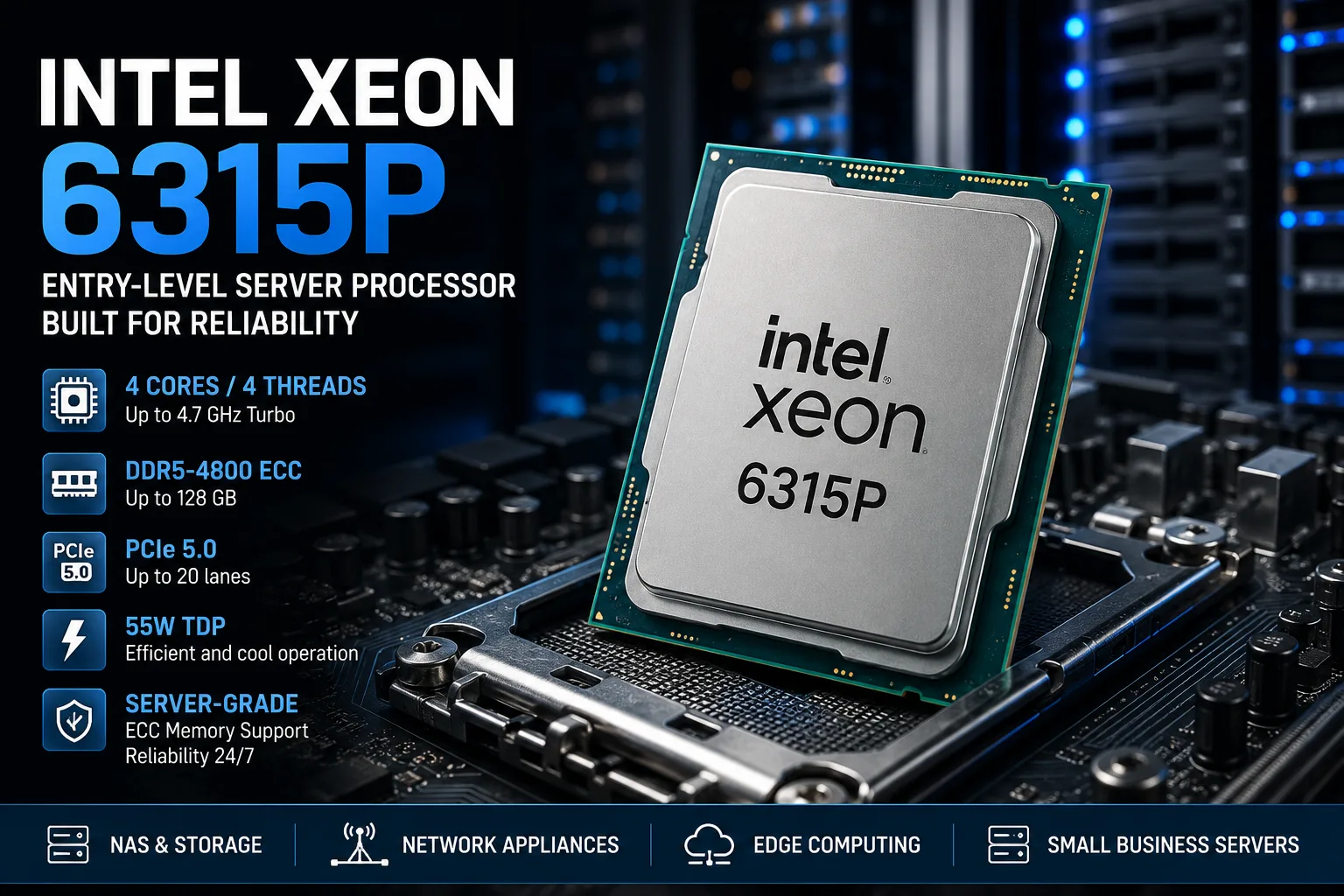
Intel Xeon 6315P: The Entry-Level Xeon 6 for Compact Servers Where Platform Matters More Than Records
The Intel Xeon 6315P is an entry-level server processor in the Intel Xeon 6 family. The name sounds impressive, but it’s important not to overestimate the class of this chip: it is neither a high-end Xeon for data centers nor a processor for heavy virtualization. It is a compact 4-core model designed for small servers, NAS, network gateways, edge systems, and enterprise tasks, where ECC memory, a stable platform, and 24/7 operation are essential.
The main idea of the Xeon 6315P is straightforward: it is not interesting as a source of high multithreaded power but as a neat entry into the server platform. It features 4 cores and 4 threads without Hyper-Threading, a base frequency of 2.8 GHz, Turbo up to 4.7 GHz, 12 MB of cache, and a TDP of 55 W. The clock speeds are decent, but the number of threads immediately shows the limits of its capabilities.
What This Processor Means in Practice
The Xeon 6315P should be seen as the minimum server option for understandable and moderate workloads. It can perform well in single-threaded tasks, is responsive in administration, and is energy-efficient for a compact system. However, it's not the CPU to choose when you're "future-proofing" for everything.
Its strength lies not in pure speed but in the combination of server capabilities and low power consumption. Support for ECC memory, DDR5, PCIe 5.0, and a single-socket platform make it a logical choice for systems where predictability is more important than the maximum number of cores.
In simple terms, the Xeon 6315P is not a "tiny monster" but a solid foundation for a small server that performs specific tasks without attempting to replace a fully-fledged multithreaded machine.
Performance in Benchmarks
| Processor | Geekbench 6 Single | Geekbench 6 Multi | PassMark Single | PassMark Multi |
|---|---|---|---|---|
| Intel Xeon 6315P | 2418 | 6947 | 3879 | 11179 |
The results clearly illustrate the character of the processor. The single-threaded performance of the Xeon 6315P is decent: Turbo up to 4.7 GHz aids in tasks where single-core speed is crucial. Therefore, web interfaces, network services, administration, lightweight databases, and services without heavy parallel loads will feel adequately responsive.
The multithreaded performance is more modest. This isn't due to a weak architecture, but rather the 4/4 configuration. When the load begins to actively parallelize, the processor quickly hits its thread limit. This may be sufficient for a small server, but for dense virtualization or a large number of containers, the headroom is limited.
Where the Xeon 6315P Fits Well
The best scenarios for this processor include:
- NAS or small file server;
- Firewall, VPN gateway, router;
- Edge system with moderate local data processing;
- Office server for internal services;
- Monitoring, controller, service infrastructure;
- Light virtualization with a small number of VMs;
- Compact corporate system with ECC memory.
In such tasks, the processor doesn't need to keep dozens of threads under load constantly. What’s more important is stability, decent memory, modern I/O, moderate power consumption, and a clear server platform. Here, the Xeon 6315P makes logical sense.
Where Limitations Begin
The main downside of the Xeon 6315P is its mere 4 threads. This is a hard ceiling for a modern server as workloads increase. One or two services, NAS, VPN, and administration - that’s fine. Several virtual machines, active databases, heavy analytics, project builds, or many containers - that’s already outside its territory.
High frequency helps only to a certain point. It makes the system responsive but does not turn a 4-thread processor into a robust server workhorse. If the server is intended with growth in mind, the Xeon 6315P may turn out to be too junior of a variant right from the start.
Why Not a Regular Core
A comparison with mainstream Core processors is inevitable here. In terms of core count, the Xeon 6315P doesn’t look impressive; regular Core i3 or Core i5 CPUs may be more appealing for a home PC or budget workstation.
However, the Xeon 6315P is chosen for different reasons. Its purpose lies in being a server platform: ECC memory, compatibility with server motherboards, corporate validation, and orientation towards 24/7 operation. If you just need a fast processor for a regular computer, it isn't the best choice. However, if you need a small server with reliable platform stability, the justification becomes clear.
Position in the Xeon 6300P Lineup
| Processor | Cores / Threads | Max Turbo | Cache | TDP | Positioning |
|---|---|---|---|---|---|
| Intel Xeon 6315P | 4 / 4 | 4.7 GHz | 12 MB | 55 W | Minimal entry into Xeon 6 for small servers |
| Intel Xeon 6325P | 4 / 8 | 5.2 GHz | 12 MB | 55 W | Same 4-core class, but noticeably livelier thanks to HT and frequencies |
| Intel Xeon 6333P | 6 / 12 | 5.2 GHz | 18 MB | 65 W | A more reasonable choice for VMs and containers |
| Intel Xeon 6353P | 8 / 16 | 5.4 GHz | 24 MB | 65 W | Now normal headroom for small servers |
Against neighboring models, the Xeon 6315P appears as the entry-level option. It's good if the task is clearly defined and doesn't demand a large number of threads. However, if the server is expected to evolve, it’s better to look at least at the Xeon 6333P: the transition from 4/4 to 6/12 in server tasks is much more important than the slight savings with the lower model.
Conclusion
The Intel Xeon 6315P is a processor for compact servers, not for heavy server loads. It should be considered when maximum speed is not the priority but rather a reliable single-socket platform with ECC, DDR5, PCIe 5.0, moderate TDP, and good single-core performance.
For NAS, VPN, firewalls, edge devices, monitoring, and small office services, the Xeon 6315P appears to be a sensible choice. However, if the server needs to handle several VMs, an active database, many containers, or scale with the load, four threads are too limiting. In that case, it’s better to transition to the Xeon 6333P or Xeon 6353P right away, as multithreaded performance will likely be the first constraint.
CPU Comparison
Compare Xeon 6315P with other CPUs
Basic
CPU Specifications
Memory Specifications
Interfaces and Ports
Benchmarks
Compared to Other CPU
Related CPU Comparisons


Share in social media
Or Link To Us
<a href="https://cputronic.com/index.php/cpu/intel-xeon-6315p" target="_blank">Intel Xeon 6315P</a>