Intel Core i7-7700
Intel Core i7-7700: Performance and Relevance in 2026
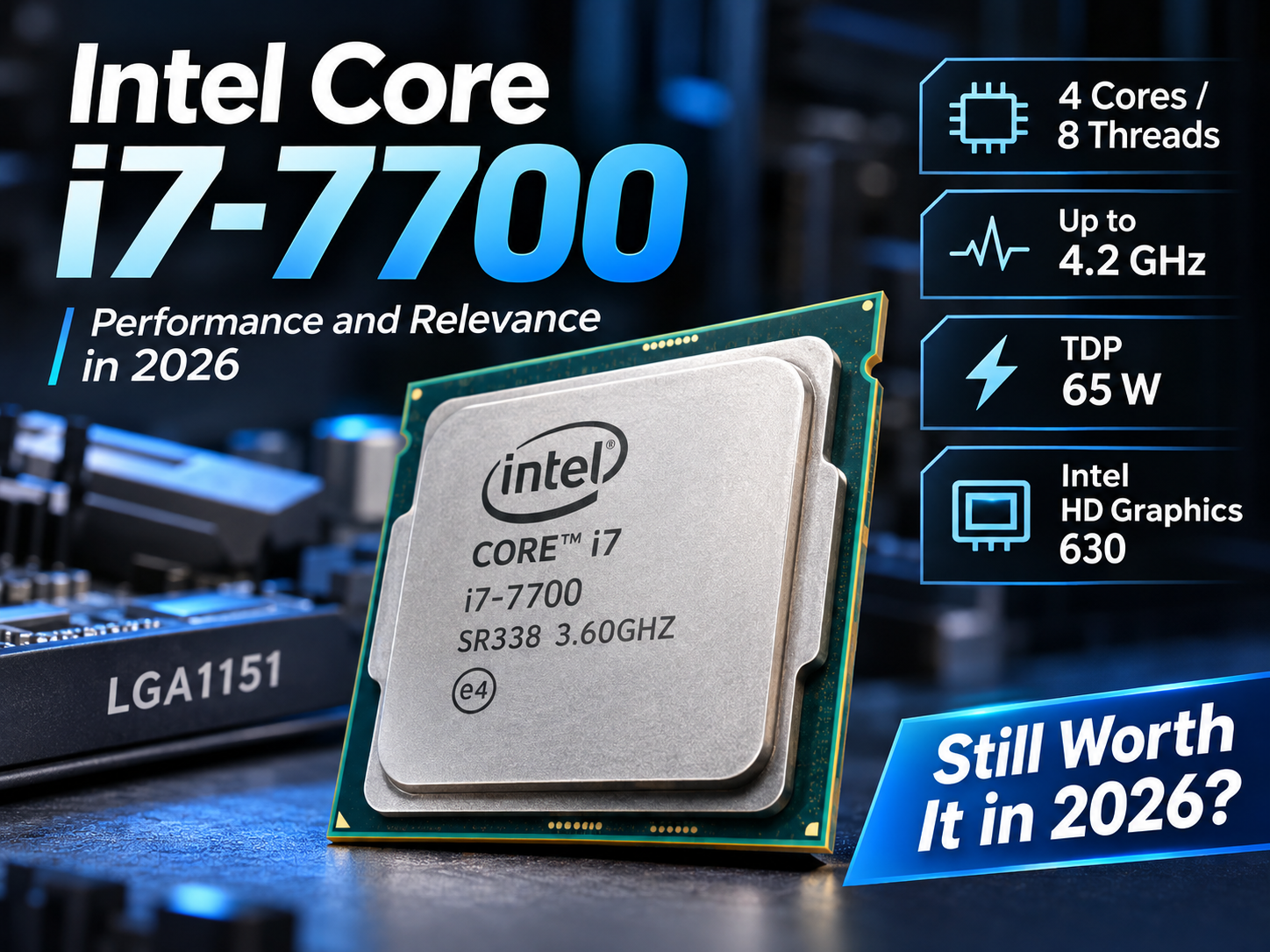
The Intel Core i7-7700 is a Kaby Lake desktop processor released in January 2017. It has four cores and eight threads, runs at up to 4.2 GHz, and has a TDP of 65 W. At the time of its release, it was one of the most powerful models for the mainstream LGA1151 platform.
In 2026, the Core i7-7700 is primarily of interest as an upgrade option for computers based on sixth- and seventh-generation Intel processors.
Comparison with Other Processors
| Specification | Core i5-7500 | Core i7-7700 | Core i7-7700K | Core i3-12100 | Ryzen 5 5600 |
|---|---|---|---|---|---|
| Release year | 2017 | 2017 | 2017 | 2022 | 2022 |
| Architecture | Kaby Lake | Kaby Lake | Kaby Lake | Alder Lake | Zen 3 |
| Process technology | 14 nm | 14 nm | 14 nm | Intel 7 | 7 nm |
| Cores / threads | 4 / 4 | 4 / 8 | 4 / 8 | 4 / 8 | 6 / 12 |
| Base clock, GHz | 3.4 | 3.6 | 4.2 | 3.3 | 3.5 |
| Maximum clock, GHz | 3.8 | 4.2 | 4.5 | 4.3 | 4.4 |
| L3 cache, MB | 6 | 8 | 8 | 12 | 32 |
| TDP / PBP, W | 65 | 65 | 91 | 60 | 65 |
| Socket | LGA1151 | LGA1151 | LGA1151 | LGA1700 | AM4 |
| PCIe | 3.0 | 3.0 | 3.0 | 5.0 | 4.0 |
| Unlocked multiplier | No | No | Yes | No | Yes |
The Core i7-7700 differs from the Core i5-7500 through its support for Hyper-Threading, larger L3 cache, and higher operating frequencies. The Core i7-7700K runs at higher frequencies and supports multiplier overclocking, but it has higher cooling requirements.
Architecture and Features
Kaby Lake is an evolution of the Skylake architecture. The main changes involve optimization of the 14 nm process technology, higher operating frequencies, and improved hardware video processing. Performance at the same clock speed changed very little compared with the previous generation.
The memory controller supports DDR4-2133/2400 and DDR3L-1333/1600 (1.35 V). The maximum amount of supported memory is 64 GB and depends on its type and the capabilities of the motherboard.
The theoretical bandwidth of dual-channel DDR4-2400 is 38.4 GB/s. Motherboards with Z170 and Z270 chipsets also support memory overclocking.
Geekbench 6 Performance
| Processor | Single-Core | Multi-Core |
|---|---|---|
| Intel Core i5-7500 | 1265 | 3590 |
| Intel Core i7-7700 | 1384 | 4655 |
| Intel Core i7-7700K | 1576 | 5530 |
| Intel Core i3-12100 | 1901 | 6812 |
| AMD Ryzen 5 5600 | 1931 | 9115 |
The results were obtained on different computer configurations and may depend on memory frequency, cooling, and system settings.
The Core i7-7700 outperforms the Core i5-7500 by 9% in the single-core test and by 30% in the multi-core test. The advantage is most noticeable in applications capable of effectively using the additional threads.
The Core i7-7700K is 14% and 19% faster, respectively. However, aggregate Geekbench results may include overclocked samples, so the difference at stock frequencies may be smaller.
Despite having the same number of cores and threads, the Core i3-12100 outperforms the Core i7-7700 by 37% in the single-core test and by 46% in the multi-core test.
The Ryzen 5 5600 achieves a 40% higher single-core result and a 96% higher multi-core result. With six cores and twelve threads, it is preferable for multithreaded tasks such as software compilation and rendering.
3DMark and Gaming Performance
The Core i7-7700 was installed in regular desktop computers, compact gaming systems, and certain laptop models with desktop processors.
| Configuration | Test | Result |
|---|---|---|
| GALLERIA Mini 1060, GTX 1060 Mobile | 3DMark Time Spy CPU | 4787 |
| ASRock B250M Pro4, HD Graphics 630 | 3DMark Night Raid Graphics | 6519 |
| MSI MS-B9061, HD Graphics 630 | 3DMark Night Raid Graphics | 5061 |
| GALLERIA Mini 1060, GTX 1060 Mobile | Ghost Recon Wildlands, 1920 × 1080, Ultra | 37.9 FPS |
| Guru Mars K, GTX 1080 Mobile | Ghost Recon Wildlands, 1920 × 1080, Ultra | 61.6 FPS |
| Guru Mars K, GTX 1080 Mobile | The Witcher 3 (2015), 1920 × 1080, Ultra | 75.9 FPS |
The Night Raid results come from individual user tests. The other measurements were performed in 2017 on a GALLERIA Mini 1060 computer with 8 GB of RAM and a Guru Mars K laptop with 16 GB.
Despite using the same processor, the systems demonstrate noticeably different gaming performance. The results are affected by the graphics card, memory, cooling, and testing conditions. The measurements shown characterize the capabilities of these configurations in games from the corresponding period and cannot be used to predict FPS in modern titles.
In demanding games, four physical cores can limit graphics card performance, cause FPS drops, and result in inconsistent frame delivery.
The GeForce GTX 1660 Super, RTX 2060, and Radeon RX 6600 remain suitable options for an existing computer. The advisability of installing a more powerful graphics card depends on the specific games, resolution, and target frame rate.
Integrated Intel HD Graphics 630
Intel HD Graphics 630 contains 24 execution units, operates at up to 1150 MHz, and uses system memory.
In the Night Raid tests shown, the system with the ASRock B250M Pro4 scored 29% more graphics points than the MSI MS-B9061. The first configuration used four memory modules, while the second used one. Dual-channel mode increases the available memory bandwidth, which is especially important for integrated graphics. However, the difference between the results may also be caused by other characteristics of the configurations.
Intel Quick Sync Video supports hardware encoding and decoding of H.264 and HEVC, including 10-bit HEVC. Hardware AV1 decoding is not supported.
The capabilities of HD Graphics 630 are sufficient for office applications, video playback, and older games at low settings. DisplayPort supports image output at 4K resolution and 60 Hz.
Compatibility and Cooling
The Core i7-7700 is compatible with motherboards based on Intel 100-series and 200-series chipsets, including H110, B150, H170, Z170, B250, H270, and Z270. A BIOS update may be required in advance for 100-series boards. Before purchasing, check the list of processors supported by the specific motherboard.
Despite having the same LGA1151 socket, 300-series motherboards do not officially support the Core i7-7700. Eighth- and ninth-generation Coffee Lake processors are also officially incompatible with 100-series and 200-series boards.
An inexpensive tower cooler is usually sufficient to run the Core i7-7700 at stock frequencies. Actual power consumption under load may exceed the stated 65 W TDP.
Advantages and Disadvantages
Advantages:
- Higher multithreaded performance compared with a Core i5 from the same generation.
- Moderate cooling requirements.
- Hardware processing of 10-bit HEVC.
- The ability to upgrade an old computer without replacing the motherboard.
Disadvantages:
- Limited performance in modern resource-intensive applications.
- Possible FPS drops in demanding games.
- Low integrated graphics performance.
- No official Windows 11 support.
- Limited options for further platform upgrades.
Is It Worth Buying the Intel Core i7-7700 in 2026?
The Core i7-7700 is suitable for office applications, web development, video playback, home servers, and undemanding games.
Purchasing this processor makes sense when upgrading an existing computer with a sixth- or seventh-generation Core i3, Core i5, or Pentium, provided that it costs significantly less than switching to another platform.
For building a computer from scratch, the Core i3-12100 or Ryzen 5 5600 is preferable. Both processors allow existing DDR4 memory to be retained when paired with a compatible motherboard. If the old computer uses DDR3L, switching to either of these platforms will also require replacing the memory.
CPU Comparison
Compare Core i7-7700 with other CPUs
Basic
CPU Specifications
Memory Specifications
GPU Specifications
Miscellaneous
Benchmarks
Compared to Other CPU
Related CPU Comparisons


Share in social media
Or Link To Us
<a href="https://cputronic.com/index.php/cpu/intel-core-i7-7700" target="_blank">Intel Core i7-7700</a>