Intel Core i7-4770
Intel Core i7-4770: Performance in Benchmarks, Games, and Everyday Use
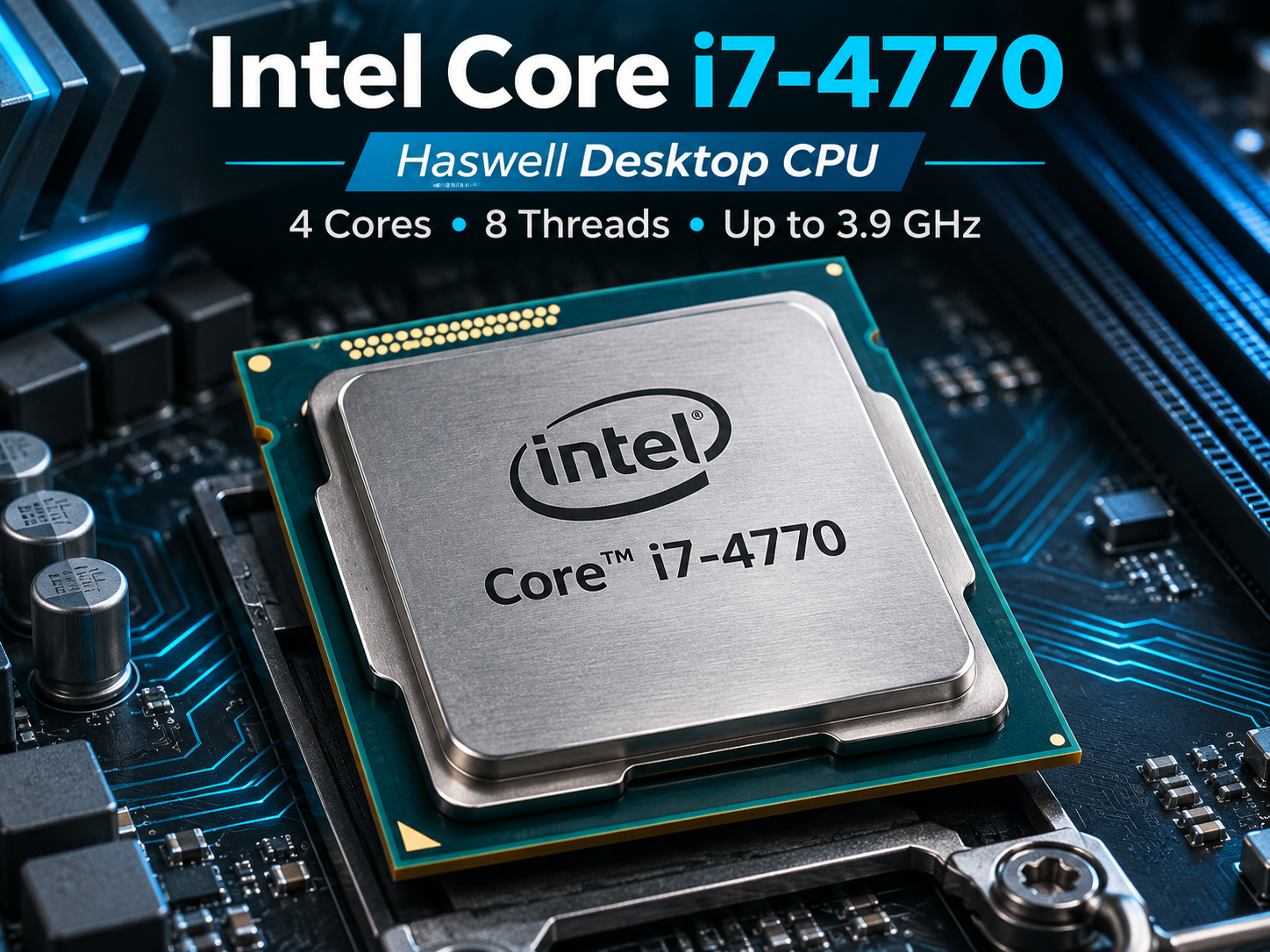
The Intel Core i7-4770 is a quad-core desktop processor from the Haswell family, released in June 2013. Thanks to Hyper-Threading, it can process eight threads simultaneously. The processor is still suitable for office work, home servers, and games from previous generations when paired with a discrete graphics card.
Performance and Comparison
The Core i7-4770 operates at a base clock speed of 3.4 GHz, boosting up to 3.9 GHz in Turbo Boost mode. Compared with quad-core Core i5 processors from the same generation, support for eight threads gives it an advantage in multithreaded applications.
| Processor | Geekbench 6 Single-Core | Geekbench 6 Multi-Core |
|---|---|---|
| Intel Core i5-4570 | 1049 | 2727 |
| Intel Core i7-4770 | 1225 | 3815 |
| Intel Core i7-4790 | 1276 | 4047 |
| Intel Core i7-4770K | 1341 | 4196 |
The Geekbench 6 scores are taken from the CPUTronic processor pages. They are not results from a single test system and may differ from other Geekbench samples.
Based on these figures, the Core i7-4770 is approximately 17% faster than the Core i5-4570 in Single-Core and 40% faster in Multi-Core. The difference is especially noticeable in applications that use multiple threads.
The Core i7-4790 has an advantage of approximately 4% in the single-core test and 6% in the multi-core test. Replacing a working i7-4770 for this level of improvement is generally not worthwhile.
The Core i7-4770K has an unlocked multiplier and a higher base clock speed-3.5 GHz versus 3.4 GHz. The maximum Turbo Boost frequency is the same for both models at 3.9 GHz. The difference in Geekbench 6 results does not prove that the 4770K offers a comparable advantage under identical conditions and stock settings.
Gaming Performance
The Core i7-4770 can be used with discrete graphics cards such as the GeForce GTX 1060 or Radeon RX 580. These combinations remain suitable for games from previous generations, although final performance depends on the specific game and graphics settings.
In more demanding games, the four physical cores may limit the frame rate. This is especially noticeable in scenes with large numbers of objects, complex simulations, and intensive processor workloads. Moving to a more powerful graphics card does not always eliminate such limitations.
The integrated Intel HD Graphics 4600 is significantly weaker than discrete solutions. Its capabilities can be assessed using test results from systems with this graphics core:
| Game | Resolution and Settings | Average FPS |
|---|---|---|
| BioShock Infinite (2013) | 1920 × 1080, Ultra | 6.8 |
| Metro: Last Light (2013) | 1920 × 1080, Very High | 6.6 |
The results were obtained on systems with Intel HD Graphics 4600 and are not direct measurements of the Core i7-4770. They characterize the capabilities of the integrated graphics under a high workload.
Even games from 2013 are too demanding for HD Graphics 4600 at maximum settings. Comfortable gaming requires significantly reducing image quality or using a discrete graphics card.
Platform Capabilities and Limitations
The Core i7-4770 uses the LGA1150 socket and supports DDR3 memory and PCIe 3.0. The processor is manufactured using a 22 nm process and has a TDP of 84 W. The integrated graphics support Intel Quick Sync Video, but hardware encoding capabilities are limited compared with modern GPUs.
Practical use cases:
- Office work. Browsing, documents, and everyday applications with an SSD and sufficient RAM.
- Home server. File storage, small web applications, and network services under moderate workloads.
- Games from previous generations. Using a discrete graphics card with settings appropriate for the system’s capabilities.
- Photo and video processing. Basic editing without high rendering-speed requirements.
The LGA1150 upgrade path is limited to processors from older generations. Replacing the i7-4770 with a Core i7-4790 usually provides only a small performance increase, while moving to a modern architecture requires a new motherboard and, in most cases, new memory.
For 24/7 operation, the power consumption of the entire system should be taken into account. Modern processors can perform similar tasks while using less electricity.
Conclusion
The Intel Core i7-4770 remains suitable for existing computers with an SSD and sufficient memory. It handles everyday tasks and can be used in an inexpensive gaming system with a discrete graphics card.
For a noticeable performance increase, upgrading the entire platform is the more sensible approach. Buying another Haswell processor rarely provides enough of an improvement to justify the additional expense.
CPU Comparison
Compare Core i7-4770 with other CPUs
Basic
CPU Specifications
Memory Specifications
GPU Specifications
Benchmarks
Compared to Other CPU
Related CPU Comparisons


Share in social media
Or Link To Us
<a href="https://cputronic.com/index.php/cpu/intel-core-i7-4770" target="_blank">Intel Core i7-4770</a>