Intel Core i7-12700H
Intel Core i7-12700H
Intel Core i7-12700H processor review

Intel Core i7-12700H: Specifications and Test Results

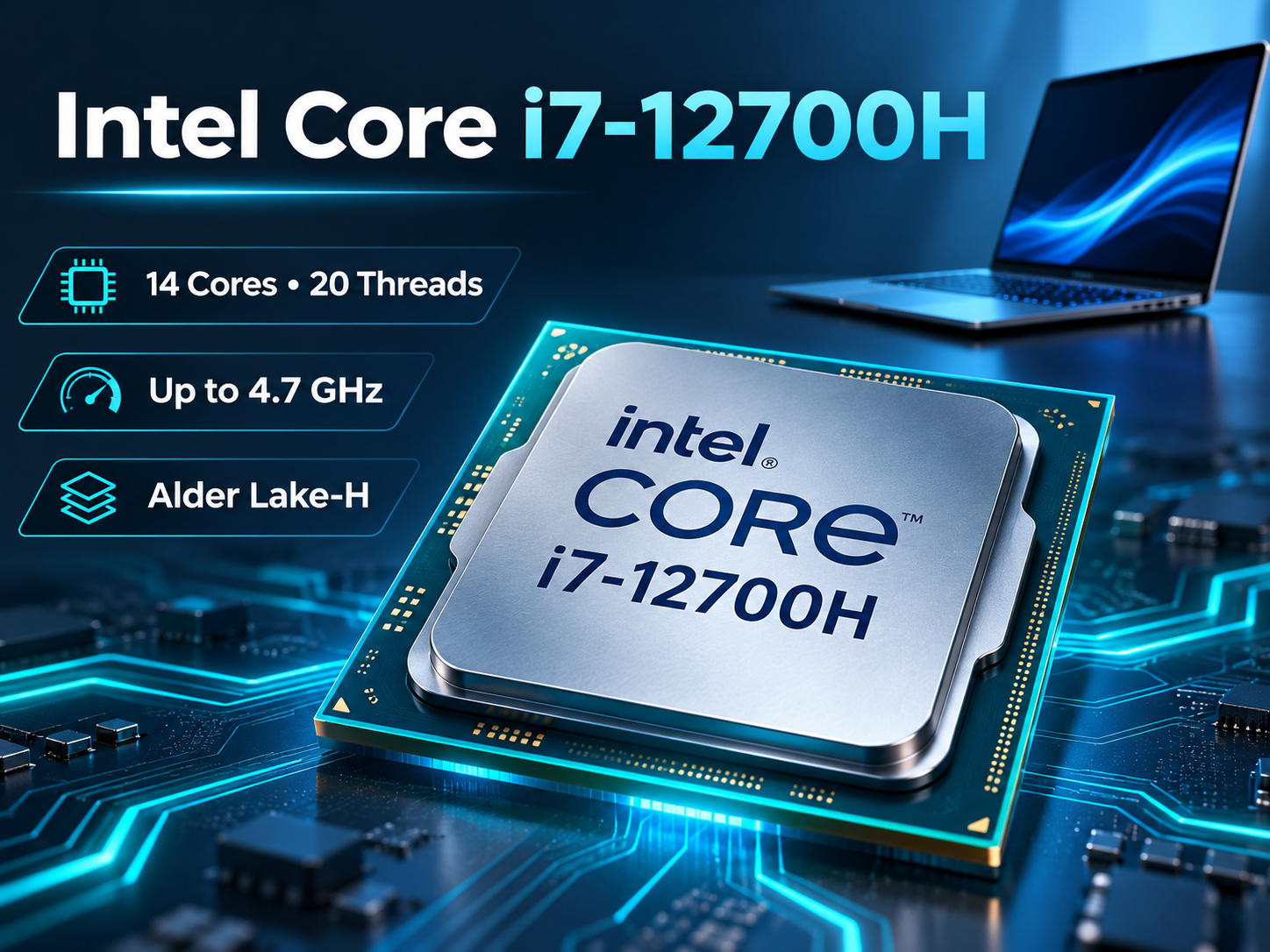
The Intel Core i7-12700H is a mobile Intel processor introduced in early 2022. It is based on the Alder Lake architecture and contains six performance P-cores and eight efficient E-cores-for a total of 14 cores and 20 threads. The processor was used in gaming laptops, mobile workstations, and models designed for demanding applications. In multithreaded tests, it outperforms the previous-generation Core i7-11800H, although the result depends on the cooling system and power limits of the particular laptop.

Architecture and Specifications

The Core i7-12700H is manufactured using the Intel 7 process. Its six Golden Cove P-cores support Hyper-Threading and can process up to 12 threads simultaneously. Its eight Gracemont E-cores each handle one thread.

Specification Intel Core i7-12700H
Architecture Alder Lake-H
Process technology Intel 7
Release date Q1 2022
Cores / threads 14 / 20
P-cores / E-cores 6 / 8
Maximum P-core frequency 4.7 GHz
Maximum E-core frequency 3.5 GHz
L3 cache 24 MB
Base power 45 W
Maximum Turbo Power 115 W
Memory DDR4-3200, DDR5-4800, LPDDR4x-4267, LPDDR5-5200
Integrated graphics Intel Iris Xe Graphics eligible, 96 EU
Supported interfaces PCIe 4.0, Thunderbolt 4

Using the Iris Xe designation requires dual-channel memory with a 128-bit bus. In a single-channel configuration, the integrated graphics are designated as Intel UHD Graphics. In both cases, the graphics core contains 96 execution units.

The platform supports PCIe 4.0 and Thunderbolt 4, but not every laptop with this processor includes a Thunderbolt 4 port.

The stated 45 W is not the Core i7-12700H’s maximum power consumption. Under a short-term load, it can reach 115 W if permitted by the power settings and cooling system.

Performance in Cinebench R23 and 3DMark

The Core i7-12700H produces substantially different results in different laptops. The table shows measurements from five models with different cooling systems and power limits.

Laptop Cinebench R23 Single Cinebench R23 Multi Time Spy CPU
HP Pavilion Plus 14 eh0097nr 1,686 12,353 8,850
Dell XPS 15 9520 1,773 14,130 11,380
HP Omen 16-b1090ng 1,799 16,253 12,651
ASUS TUF Gaming F15 FX507ZM 1,771 17,713 14,048
Lenovo Legion 5 Pro 16IAH7H 1,731 19,069 12,830

Cinebench R23 and the 3DMark Time Spy CPU test evaluate the processor in different ways, so their scores cannot be compared directly.

The largest difference appears in the multithreaded Cinebench R23 test. The Lenovo Legion 5 Pro scores 19,069 points compared with 12,353 for the HP Pavilion Plus 14-a difference of 54%.

At the same time, the gap in the single-threaded test does not exceed 3%. Under an all-core load, power limits and cooling efficiency are decisive.

The ASUS TUF Gaming F15 also delivers a high result-17,713 points in Cinebench R23 Multi-Core. That is 43% more than the HP Pavilion Plus 14.

Thus, in a well-cooled gaming laptop, the Core i7-12700H can complete sustained multithreaded workloads significantly faster than in a compact model with limited power consumption.

Geekbench 6 and Geekbench 7

Geekbench evaluates processor performance when processing images, compressing data, and working with memory.

Device Version Single-Core Multi-Core
ASUS VivoBook Pro 16 Geekbench 6.0 2,243 7,988
GMKtec NucBox M3 Ultra Geekbench 6.0 2,255 8,625
Intel NUC X15 LAPAC71H Geekbench 6.0 2,354 12,698
Intel NUC 12 Serpent Canyon Geekbench 7.0 2,030 12,951
Lenovo Legion 5 Pro 16IAH7H Geekbench 7.0 2,121 12,968

Geekbench 6.0 and Geekbench 7.0 use different test suites, so their scores cannot be compared directly.

In the multithreaded Geekbench 6.0 test, the Intel NUC X15 scores 12,698 points-59% more than the ASUS VivoBook Pro 16. In the Single-Core test, however, the difference between them is less than 5%.

This range confirms that a single Geekbench score does not accurately reflect the capabilities of a particular laptop. When buying, it is better to focus on test results for the specific model.

Comparison with the Core i7-11800H and Ryzen 7 6800H

The Core i7-12700H belongs to the next generation of Intel mobile processors after the Core i7-11800H, which is based on the Tiger Lake architecture.

The Core i7-11800H has eight performance cores. The Core i7-12700H has six, but adds eight efficient E-cores. This configuration provides higher performance under an all-core load.

Processor Cores / threads R23 Single R23 Multi
Intel Core i7-12700H 14 / 20 1,782 16,308
AMD Ryzen 7 6800H 8 / 16 1,542 13,094
Intel Core i7-11800H 8 / 16 1,508 12,197

These are aggregate Cinebench R23 results obtained on different laptops. Performance may vary with different power and cooling settings.

In Cinebench R23, the Core i7-12700H outperforms the Core i7-11800H by 34% in the multithreaded test and by 18% in the single-threaded test.

Compared with the Ryzen 7 6800H, its advantage is approximately 25% in Multi-Core and 16% in Single-Core.

However, the Ryzen 7 6800H has a more powerful integrated Radeon 680M graphics processor. Therefore, a laptop with this processor and no discrete graphics card may be better suited to gaming despite its lower CPU results in Cinebench R23.

Gaming Performance

The Core i7-12700H is suitable for gaming laptops with discrete graphics. Six P-cores are sufficient for most games, while the E-cores can handle background tasks.

The results below are from the Lenovo Legion 5 Pro 16IAH7H with a GeForce RTX 3060 Laptop GPU and 16 GB of memory.

Game Resolution Settings Average FPS
GTA V 1920 × 1080 Highest 107.8
The Witcher 3 1920 × 1080 Ultra, HBAO+ 88.2

These figures represent the entire laptop configuration, not the processor alone. They also depend on the installed RTX 3060 Laptop GPU.

In demanding games, FPS is more often limited by the graphics card, especially at high graphics settings.

Intel’s integrated graphics with 96 EU are suitable for video playback, everyday work, and less demanding games. Resource-intensive games at high graphics settings require a discrete graphics card.

Workloads and Power Consumption

With 14 cores and 20 threads, the Core i7-12700H is suitable for tasks that use multithreading:

  • Programming: compiling large projects, running Docker containers and virtual machines.
  • Media processing: photo editing, video editing, and encoding.
  • 3D graphics: scene preparation and CPU rendering.
  • Multitasking: working simultaneously with an IDE, browser, Docker containers, and other applications.

During prolonged rendering or compilation, a laptop may reduce processor clock speeds because of power and temperature limits.

When running on battery power, laptops typically impose additional limits on CPU power, so demanding tasks run more slowly.

Is a Laptop with the Core i7-12700H Worth Buying in 2026?

The Core i7-12700H remains suitable for programming, video processing, and gaming with a discrete graphics card. However, when buying a laptop based on this platform, three points should be considered:

  1. Cooling and power limits. Models with an effective cooling system are preferable for sustained all-core workloads.
  2. Memory and graphics card. RAM capacity is important for virtual machines and large projects, while gaming performance depends largely on the GPU.
  3. Price. A newer laptop with comparable CPU performance may offer better battery life and more modern graphics.

If a laptop with the Core i7-12700H costs roughly the same as a newer model, the devices should be compared as complete systems. In addition to the processor, the display, cooling, memory, graphics card, and battery life all matter.

Conclusion

The Intel Core i7-12700H remains powerful enough for most work tasks and games. In Cinebench R23 Multi-Core, it outperforms the Core i7-11800H by approximately 34% and the Ryzen 7 6800H by 25%.

However, results vary among laptops equipped with this processor, ranging from 12,353 to 19,069 points in Cinebench R23 Multi-Core. Therefore, when choosing a device, it is important to consider not only the CPU specifications but also the test results of the specific model.

In 2026, a laptop with the Core i7-12700H is worth considering if it is noticeably cheaper than newer models with comparable performance.

CPU Comparison

Compare Core i7-12700H with other CPUs

Please select CPU from the dropdown list.

Basic

Label Name
Intel
Platform
Mobile
Launch Date
January 2022
Model Name
The Intel processor number is just one of several factors - along with processor brand, system configurations, and system-level benchmarks - to be considered when choosing the right processor for your computing needs.
i7-12700H
Code Name
Alder Lake

CPU Specifications

Total Cores
Cores is a hardware term that describes the number of independent central processing units in a single computing component (die or chip).
14
Total Threads
Where applicable, Intel® Hyper-Threading Technology is only available on Performance-cores.
20
Performance-cores
6
Efficient-cores
8
Intel Virtualization Technology (VT-x)
Intel® Virtualization Technology (VT-x) allows one hardware platform to function as multiple “virtual” platforms. It offers improved manageability by limiting downtime and maintaining productivity by isolating computing activities into separate partitions.
Yes
Intel Virtualization Technology for Directed I/O (VT-d)
Intel® Virtualization Technology for Directed I/O (VT-d) continues from the existing support for IA-32 (VT-x) and Itanium® processor (VT-i) virtualization adding new support for I/O-device virtualization. Intel VT-d can help end users improve security and reliability of the systems and also improve performance of I/O devices in virtualized environments.
Yes
Max Turbo Frequency
Max Turbo Frequency is the maximum single-core frequency at which the processor is capable of operating using Intel® Turbo Boost Technology and, if present, Intel® Turbo Boost Max Technology 3.0 and Intel® Thermal Velocity Boost. Frequency is typically measured in gigahertz (GHz), or billion cycles per second.
4.70 GHz
Efficient-core Max Turbo Frequency
Maximum E-core turbo frequency derived from Intel® Turbo Boost Technology.
3.50 GHz
Instruction Set Extensions
Intel® SSE4.1, Intel® SSE4.2, Intel® AVX2
Performance-core Max Turbo Frequency
Maximum P-core turbo frequency derived from Intel® Turbo Boost Technology.
4.70 GHz
Intel Hyper-Threading Technology
Intel® Hyper-Threading Technology (Intel® HT Technology) delivers two processing threads per physical core. Highly threaded applications can get more work done in parallel, completing tasks sooner.
Yes
Intel Turbo Boost Max Technology 3.0
Intel® Turbo Boost Max Technology 3.0 identifies the best performing core(s) on a processor and provides increased performance on those cores through increasing frequency as needed by taking advantage of power and thermal headroom.
Yes
Intel Turbo Boost Max Technology 3.0 Frequency
Intel® Turbo Boost Max Technology 3.0 identifies the best performing core(s) on a processor and provides increased performance on those cores through increasing frequency as needed by taking advantage of power and thermal headroom. Intel® Turbo Boost Max Technology 3.0 frequency is the clock frequency of the CPU when running in this mode.
4.70 GHz
L3 Cache
24 MB
Cache
CPU Cache is an area of fast memory located on the processor. Intel® Smart Cache refers to the architecture that allows all cores to dynamically share access to the last level cache.
24 MB Intel® Smart Cache
CPU Socket
The socket is the component that provides the mechanical and electrical connections between the processor and motherboard.
FCBGA1744
Intel AES New Instructions
Intel® AES New Instructions (Intel® AES-NI) are a set of instructions that enable fast and secure data encryption and decryption. AES-NI are valuable for a wide range of cryptographic applications, for example: applications that perform bulk encryption/decryption, authentication, random number generation, and authenticated encryption.
Yes
Technology
Lithography refers to the semiconductor technology used to manufacture an integrated circuit, and is reported in nanometer (nm), indicative of the size of features built on the semiconductor.
Intel 7
TDP
45 W
Processor Base Power
The time-averaged power dissipation that the processor is validated to not exceed during manufacturing while executing an Intel-specified high complexity workload at Base Frequency and at the junction temperature as specified in the Datasheet for the SKU segment and configuration.
45 W
Maximum Turbo Power
The maximum sustained (>1s) power dissipation of the processor as limited by current and/or temperature controls. Instantaneous power may exceed Maximum Turbo Power for short durations (<=10ms). Note: Maximum Turbo Power is configurable by system vendor and can be system specific.
115 W
Minimum Assured Power
35 W
Max. Operating Temperature
Junction Temperature is the maximum temperature allowed at the processor die.
100°C
Max Number of PCI Express Lanes
A PCI Express (PCIe) lane consists of two differential signaling pairs, one for receiving data, one for transmitting data, and is the basic unit of the PCIe bus. Max # of PCI Express Lanes is the total number of supported lanes.
28
Instruction Set
An instruction set refers to the basic set of commands and instructions that a microprocessor understands and can carry out. The value shown represents which Intel’s instruction set this processor is compatible with.
64-bit
Intel VT-x with Extended Page Tables (EPT)
Intel® VT-x with Extended Page Tables (EPT), also known as Second Level Address Translation (SLAT), provides acceleration for memory intensive virtualized applications. Extended Page Tables in Intel® Virtualization Technology platforms reduces the memory and power overhead costs and increases battery life through hardware optimization of page table management.
Yes
Microprocessor PCIe Revision
Gen 4

Memory Specifications

Memory Type
Intel® processors come in four different types: Single Channel, Dual Channel, Triple Channel, and Flex Mode. Maximum supported memory speed may be lower when populating multiple DIMMs per channel on products that support multiple memory channels.
Up to DDR5 4800 MT/s Up to DDR4 3200 MT/s Up to LPDDR5 5200 MT/s Up to LPDDR4x 4267 MT/s
Max Memory Size
Max memory size refers to the maximum memory capacity supported by the processor.
64 GB
Memory Channels
The number of memory channels refers to the bandwidth operation for real world application.
2
ECC Memory Support
ECC Memory Supported indicates processor support for Error-Correcting Code memory. ECC memory is a type of system memory that can detect and correct common kinds of internal data corruption. Note that ECC memory support requires both processor and chipset support.
No
Intel Flex Memory Access
Yes

GPU Specifications

Integrated Graphics Model
An integrated GPU refers to the graphics core that is integrated into the CPU processor. Leveraging the processor's powerful computational capabilities and intelligent power efficiency management, it delivers outstanding graphics performance and a smooth application experience at a lower power consumption.
Intel® Iris® Xe Graphics eligible
Intel Iris Xe Graphics 96EU
Graphics Frequency
Graphics max dynamic frequency refers to the maximum opportunistic graphics render clock frequency (in MHz) that can be supported using Intel® HD Graphics with Dynamic Frequency feature.
1.40 GHz
DirectX Support
DirectX* Support indicates support for a specific version of Microsoft’s collection of APIs (Application Programming Interfaces) for handling multimedia compute tasks.
12.1
Execution Units
The Execution Unit is the foundational building block of Intel’s graphics architecture. Execution Units are compute processors optimized for simultaneous Multi-Threading for high throughput compute power.
96
Max Resolution (DP)
Max Resolution (DP) is the maximum resolution supported by the processor via the DP interface (24bits per pixel & 60Hz). System or device display resolution is dependent on multiple system design factors; actual resolution may be lower on your system.
7680 x 4320 @ 60Hz
Max Resolution (eDP - Integrated Flat Panel)
Max Resolution (Integrated Flat Panel) is the maximum resolution supported by the processor for a device with an integrated flat panel (24bits per pixel & 60Hz). System or device display resolution is dependent on multiple system design factors; actual resolution may be lower on your device.
4096 x 2304 @ 120Hz
Max Resolution (HDMI)
Max Resolution (HDMI) is the maximum resolution supported by the processor via the HDMI interface (24bits per pixel & 60Hz). System or device display resolution is dependent on multiple system design factors; actual resolution may be lower on your system.
4096 x 2304 @ 60Hz
Number of Displays Supported
4
Graphics Output
Graphics Output defines the interfaces available to communicate with display devices.
eDP 1.4b | DP 1.4a | HDMI 2.1
OpenGL Support
OpenGL (Open Graphics Library) is a cross-language, multi-platform API (Application Programming Interface) for rendering 2D and 3D vector graphics.
4.6
OpenCL Support
OpenCL (Open Computing Language) is a multi-platform API (Application Programming Interface) for heterogeneous parallel programming.
3.0
Intel Quick Sync Video
Intel® Quick Sync Video delivers fast conversion of video for portable media players, online sharing, and video editing and authoring.
Yes

AI Specifications

Intel Gaussian Neural Accelerator
Intel® Gaussian & Neural Accelerator (GNA) is an ultra-low power accelerator block designed to run audio and speed-centric AI workloads. Intel® GNA is designed to run audio based neural networks at ultra-low power, while simultaneously relieving the CPU of this workload.
3.0
Intel Deep Learning Boost (Intel DL Boost) on CPU
A new set of embedded processor technologies designed to accelerate AI deep learning use cases. It extends Intel AVX-512 with a new Vector Neural Network Instruction (VNNI) that significantly increases deep learning inference performance over previous generations.
Yes

Interfaces and Ports

Intel Volume Management Device (VMD)
Intel® Volume Management Device (VMD) provides a common, robust method of hot plug and LED management for NVMe-based solid state drives.
Yes

Miscellaneous

Intel Image Processing Unit Version
Intel® Image Processing Unit is an integrated image signal processor with advanced hardware implementation that improves image and video quality of cameras.
6.0
Execute Disable Bit
Execute Disable Bit is a hardware-based security feature that can reduce exposure to viruses and malicious-code attacks and prevent harmful software from executing and propagating on the server or network.
Yes
Intel High Definition Audio
Yes
Intel Boot Guard
Intel® Device Protection Technology with Boot Guard helps protect the system’s pre-OS environment from viruses and malicious software attacks.
Yes
Intel Hardware Shield Eligibility
Yes
Intel QuickAssist Software Acceleration
Yes
Intel Control-Flow Enforcement Technology
CET - Intel Control-flow Enforcement Technology (CET) helps protect against the misuse of legitimate code snippets through return-oriented programming (ROP) control-flow hijacking attacks.
Yes
Intel OS Guard
Yes

Benchmarks

Geekbench 6
Single Core Score
2202
Geekbench 6
Multi Core Score
11406
Geekbench 5
Single Core Score
1451
Geekbench 5
Multi Core Score
8372
Passmark CPU
Single Core Score
3594
Passmark CPU
Multi Core Score
26259
3DMark CPU Profile
Single Core Score
947
3DMark CPU Profile
Multi Core Score
7027

Compared to Other CPU

Geekbench 6 Single Core
2275 +3.3%
2146 -2.5%
2068 -6.1%
Geekbench 6 Multi Core
12738 +11.7%
12046 +5.6%
10709 -6.1%
10126 -11.2%
Geekbench 5 Single Core
1588 +9.4%
1384 -4.6%
1330 -8.3%
Geekbench 5 Multi Core
9497 +13.4%
8930 +6.7%
7915 -5.5%
7551 -9.8%
Passmark CPU Single Core
3722 +3.6%
3670 +2.1%
3531 -1.8%
3470 -3.5%
Passmark CPU Multi Core
28621 +9%
27450 +4.5%
25412 -3.2%
24526 -6.6%
3DMark CPU Profile Single Core
949 +0.2%
947 +0%
946 -0.1%
943 -0.4%
3DMark CPU Profile Multi Core
7176 +2.1%
7133 +1.5%
6937 -1.3%
6928 -1.4%