Intel Core i5-6300U

Intel Core i5-6300U
Intel Core i5-6300U processor review

Intel Core i5-6300U in 2026: Performance and Relevance

The Intel Core i5-6300U was released in 2015 and is still found in used ThinkPads, Latitudes, EliteBooks, and Surfaces. Its two cores and four threads are still sufficient for browsing, documents, and simple office work, but the performance quickly hits the limits of the processor when running several heavy applications simultaneously. Additionally, standard support for Windows 10 has ended, and this CPU is not officially supported by Windows 11.

The Core i5 label here doesn't say much; we are looking at a processor that is a decade old. The purchasing decision largely depends on the price and the condition of the laptop itself.

What You Need to Know About the Core i5-6300U

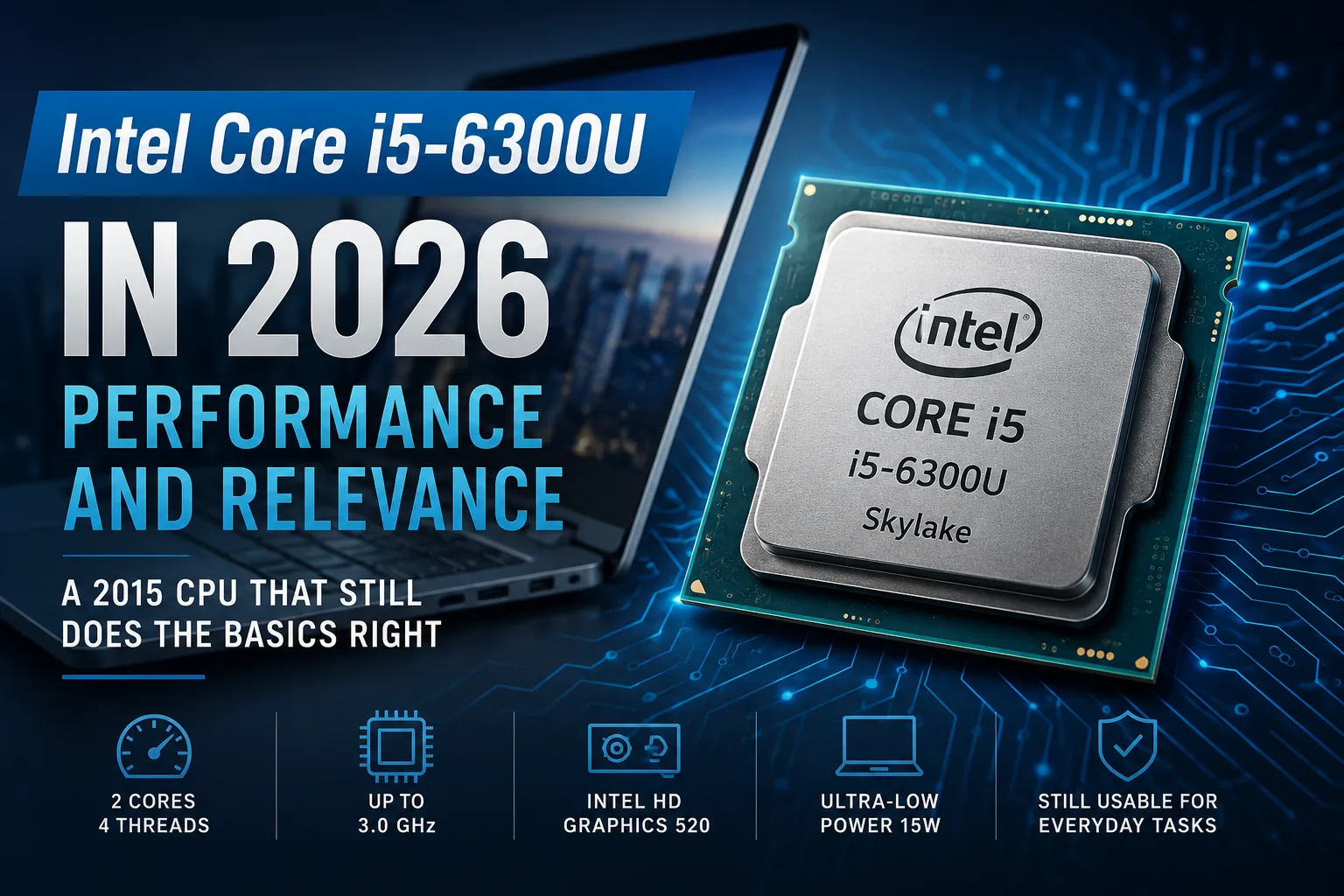
The Core i5-6300U belongs to the Skylake generation. It has 2 cores, 4 threads, a frequency of up to 3.0 GHz, and a TDP of 15W. The processor supports DDR4-2133 and is equipped with integrated Intel HD Graphics 520. Intel released it in the third quarter of 2015.

In the mid-2010s, the i5-6300U was often found in premium corporate ultrabooks. It can be found in the Dell Latitude E7470, Lenovo ThinkPad X260, HP EliteBook Folio 1040 G3, Microsoft Surface Pro 4, and other business models.

Many of these laptops are still available on the secondary market. The chassis, keyboard, and repairability of an older Latitude or ThinkPad may prove superior to that of a cheap modern model. Nevertheless, the processor remains a two-core Skylake from 2015.

Benchmarks in Real Laptops

The results of the i5-6300U depend on cooling, power settings, and memory, but for functioning laptops, the variance is relatively small.

Device RAM Geekbench 6 Single-Core Geekbench 6 Multi-Core
Dell Latitude E7470 12 GB DDR4 1079 2176
Lenovo ThinkPad X260 16 GB DDR4 1073 2111
Microsoft Surface Pro 4 4 GB DDR3 1067 2070
HP EliteBook Folio 1040 G3 8 GB DDR4 1007 2057

The results for the four models fall approximately in the range of 1000-1080 points in Geekbench 6 Single-Core and 2050-2180 Multi-Core. For a processor of this age, this is a fairly stable range, provided the laptop does not throttle the CPU due to temperature or power issues.

In PassMark, the Core i5-6300U scores around 3198 points in CPU Mark and 1629 points in Single Thread. For comparison, the Core i5-8250U shows approximately 5783 and 1870 points respectively.

Processor Cores / Threads PassMark CPU Mark Single Thread
Core i5-6300U 2 / 4 3198 1629
Core i5-8250U 4 / 8 5783 1870

The Core i5-8250U is not much faster in single-thread performance, but the four cores instead of two give it a significant advantage in multi-threaded workloads. In CPU Mark, the difference is about 81%.

What It Can Handle in Everyday Work

With an SSD and 8-16 GB of RAM, a laptop with the i5-6300U can handle documents, email, video, and a moderate number of browser tabs quite well. Such a computer is still suitable for studying, as a simple home server, or as a backup laptop.

However, a browser, video call, several office applications, and background processes can fully load the processor. With active multitasking, noticeable delays occur when switching between programs.

Small projects can be written and compiled without too many issues, but large compilations, virtual machines, heavy containers, photo editing, and video editing quickly hit the limits of the two physical cores.

An SSD is essential for such a laptop. It significantly speeds up the launch of the system and applications. After replacing the HDD with an SSD, the computer becomes more responsive, but the speed of heavy computations remains the same.

Intel HD Graphics 520

The i5-6300U has the Intel HD Graphics 520 integrated, which has a maximum frequency of 1 GHz. It uses system memory and supports DirectX 12.

Median results for the HD Graphics 520 in the Notebookcheck database:

Test Result
3DMark 11 Performance GPU 1294
3DMark Fire Strike Graphics 804
3DMark Time Spy Graphics 263

263 points in Time Spy Graphics highlight the capabilities of this graphics solution. It's sufficient mainly for older and less demanding games. Modern AAA titles are well beyond what the HD Graphics 520 can handle, even with lowered settings.

Since integrated graphics use system memory, a dual-channel configuration gives it a noticeable advantage over a single RAM module.

Windows Has Become a Separate Problem

Standard support for Windows 10 ended on October 14, 2025. The computer continues to function, but without the Extended Security Updates program, standard security updates for the system are no longer provided.

The Core i5-6300U is absent from the official list of supported processors for Windows 11. Windows 11 can be installed by bypassing the processor check, but Microsoft does not officially support such a configuration.

For browsing, documents, and multimedia, an alternative remains Linux. This allows an old home laptop to avoid being tied to an unsupported version of Windows.

Is It Worth Buying a Laptop with i5-6300U?

For the i5-6300U, price is more important than the brand on the lid. An old ThinkPad or Latitude might be very well built, but a quality chassis does not eliminate the limitation of having two cores.

At around 100-120 euros, such a laptop can still be considered as a backup computer, especially if it already has an SSD, 8-16 GB of RAM, and a Full HD screen.

At around 150 euros, expectations should be higher: good condition of the chassis, a functioning battery, enough memory, and no immediate need for repairs.

At 200-250 euros, buying a laptop with the i5-6300U in 2026 is too late. In this price range, it's better to look for models with the Core i5-8250U, i5-8350U, and other quad-core Intel 8th generation processors. Even the basic i5-8250U is about 81% faster than the i5-6300U in PassMark CPU Mark.

Rare new units with processors from this generation do appear as well. Usually, these are old stock or Chinese OEM models with the 6th-generation Core i5, not modern laptops with a new platform. The i5-6300U is notably rarer in such new Chinese models compared to refurbished ThinkPads, Latitudes, and EliteBooks.

One should especially avoid overpaying just for the Core i5 label in the listing. The names Core i5-6300U and Core i5-8250U may sound similar, but there is a fundamental difference: the former has 2 cores and 4 threads, while the latter has 4 cores and 8 threads. For an old laptop, this core count is much more critical than the minor differences in frequencies.

Conclusion

The Core i5-6300U in 2026 remains a processor for very cheap laptops. Its two cores limit multitasking, the HD Graphics 520 scores around 263 points in 3DMark Time Spy Graphics, and Windows 11 is not officially supported.

For 100-120 euros, a functioning business laptop with SSD can still be useful for simple tasks. However, at 200-250 euros, such a purchase looks poor.

If a functioning laptop with the Core i5-8250U or i5-8350U is available nearby for a small additional cost, there’s no reason to choose the i5-6300U.

Basic

Label Name
Intel
Platform
Mobile
Launch Date
July 2015
Model Name
?
The Intel processor number is just one of several factors - along with processor brand, system configurations, and system-level benchmarks - to be considered when choosing the right processor for your computing needs.
i5-6300U
Code Name
SkyLake

CPU Specifications

Total Cores
?
Cores is a hardware term that describes the number of independent central processing units in a single computing component (die or chip).
2
Total Threads
?
Where applicable, Intel® Hyper-Threading Technology is only available on Performance-cores.
4
Basic Frequency
2.40 GHz
Intel Virtualization Technology (VT-x)
?
Intel® Virtualization Technology (VT-x) allows one hardware platform to function as multiple “virtual” platforms. It offers improved manageability by limiting downtime and maintaining productivity by isolating computing activities into separate partitions.
Yes
Intel Virtualization Technology for Directed I/O (VT-d)
?
Intel® Virtualization Technology for Directed I/O (VT-d) continues from the existing support for IA-32 (VT-x) and Itanium® processor (VT-i) virtualization adding new support for I/O-device virtualization. Intel VT-d can help end users improve security and reliability of the systems and also improve performance of I/O devices in virtualized environments.
Yes
Max Turbo Frequency
?
Max Turbo Frequency is the maximum single-core frequency at which the processor is capable of operating using Intel® Turbo Boost Technology and, if present, Intel® Turbo Boost Max Technology 3.0 and Intel® Thermal Velocity Boost. Frequency is typically measured in gigahertz (GHz), or billion cycles per second.
3.00 GHz
Enhanced Intel SpeedStep Technology
?
Enhanced Intel SpeedStep® Technology is an advanced means of enabling high performance while meeting the power-conservation needs of mobile systems. Conventional Intel SpeedStep® Technology switches both voltage and frequency in tandem between high and low levels in response to processor load. Enhanced Intel SpeedStep® Technology builds upon that architecture using design strategies such as Separation between Voltage and Frequency Changes, and Clock Partitioning and Recovery.
Yes
Intel Hyper-Threading Technology
?
Intel® Hyper-Threading Technology (Intel® HT Technology) delivers two processing threads per physical core. Highly threaded applications can get more work done in parallel, completing tasks sooner.
Yes
Intel Turbo Boost Technology
?
Intel® Turbo Boost Technology dynamically increases the processor's frequency as needed by taking advantage of thermal and power headroom to give you a burst of speed when you need it, and increased energy efficiency when you don’t.
2.0
Intel Turbo Boost Technology 2.0 Frequency
3.00 GHz
Cache
?
CPU Cache is an area of fast memory located on the processor. Intel® Smart Cache refers to the architecture that allows all cores to dynamically share access to the last level cache.
3 MB Intel® Smart Cache
CPU Socket
?
The socket is the component that provides the mechanical and electrical connections between the processor and motherboard.
FCBGA1356
Intel AES New Instructions
?
Intel® AES New Instructions (Intel® AES-NI) are a set of instructions that enable fast and secure data encryption and decryption. AES-NI are valuable for a wide range of cryptographic applications, for example: applications that perform bulk encryption/decryption, authentication, random number generation, and authenticated encryption.
Yes
Technology
?
Lithography refers to the semiconductor technology used to manufacture an integrated circuit, and is reported in nanometer (nm), indicative of the size of features built on the semiconductor.
14 nm
TDP
15 W
Max. Operating Temperature
?
Junction Temperature is the maximum temperature allowed at the processor die.
100°C
PCI Express Version
?
PCI Express Revision is the supported version of the PCI Express standard. Peripheral Component Interconnect Express (or PCIe) is a high-speed serial computer expansion bus standard for attaching hardware devices to a computer. The different PCI Express versions support different data rates.
3.0
Max Number of PCI Express Lanes
?
A PCI Express (PCIe) lane consists of two differential signaling pairs, one for receiving data, one for transmitting data, and is the basic unit of the PCIe bus. Max # of PCI Express Lanes is the total number of supported lanes.
12
Instruction Set
?
The instruction set is a hard program stored inside the CPU that guides and optimizes CPU operations. With these instruction sets, the CPU can run more efficiently. There are many manufacturers that design CPUs, which results in different instruction sets, such as the 8086 instruction set for the Intel camp and the RISC instruction set for the ARM camp. x86, ARM v8, and MIPS are all codes for instruction sets. Instruction sets can be extended; for example, x86 added 64-bit support to create x86-64. Manufacturers developing CPUs that are compatible with a certain instruction set need authorization from the instruction set patent holder. A typical example is Intel authorizing AMD, enabling the latter to develop CPUs compatible with the x86 instruction set.
64-bit
Intel 64
?
Intel® 64 architecture delivers 64-bit computing on server, workstation, desktop and mobile platforms when combined with supporting software.¹ Intel 64 architecture improves performance by allowing systems to address more than 4 GB of both virtual and physical memory.
Yes
Intel VT-x with Extended Page Tables (EPT)
?
Intel® VT-x with Extended Page Tables (EPT), also known as Second Level Address Translation (SLAT), provides acceleration for memory intensive virtualized applications. Extended Page Tables in Intel® Virtualization Technology platforms reduces the memory and power overhead costs and increases battery life through hardware optimization of page table management.
Yes
PCI Express Configurations
?
PCI Express (PCIe) Configurations describe the available PCIe lane configurations that can be used to link to PCIe devices.
1x4 | 2x2 | 1x2+2x1 and 4x1

Memory Specifications

Memory Type
?
Intel® processors come in four different types: Single Channel, Dual Channel, Triple Channel, and Flex Mode. Maximum supported memory speed may be lower when populating multiple DIMMs per channel on products that support multiple memory channels.
DDR4-2133 | LPDDR3-1866 | DDR3L-1600
Max Memory Size
?
Max memory size refers to the maximum memory capacity supported by the processor.
32 GB
Memory Channels
?
The number of memory channels refers to the bandwidth operation for real world application.
2
Bus Speed
4 GT/s
Max Memory Bandwidth
?
Max Memory bandwidth is the maximum rate at which data can be read from or stored into a semiconductor memory by the processor (in GB/s).
34.1 GB/s
ECC Memory Support
?
ECC Memory Supported indicates processor support for Error-Correcting Code memory. ECC memory is a type of system memory that can detect and correct common kinds of internal data corruption. Note that ECC memory support requires both processor and chipset support.
No
Intel Flex Memory Access
Yes

GPU Specifications

Integrated Graphics Model
?
An integrated GPU refers to the graphics core that is integrated into the CPU processor. Leveraging the processor's powerful computational capabilities and intelligent power efficiency management, it delivers outstanding graphics performance and a smooth application experience at a lower power consumption.
Intel® HD Graphics 520
Graphics Base Frequency
?
Graphics Base frequency refers to the rated/guaranteed graphics render clock frequency in MHz.
300 MHz
Graphics Frequency
?
Graphics max dynamic frequency refers to the maximum opportunistic graphics render clock frequency (in MHz) that can be supported using Intel® HD Graphics with Dynamic Frequency feature.
1.00 GHz
4K Support
Yes | at 60Hz
Graphics Video Max Memory
32 GB
DirectX Support
?
DirectX* Support indicates support for a specific version of Microsoft’s collection of APIs (Application Programming Interfaces) for handling multimedia compute tasks.
12
Max Resolution (DP)
?
Max Resolution (DP) is the maximum resolution supported by the processor via the DP interface (24bits per pixel & 60Hz). System or device display resolution is dependent on multiple system design factors; actual resolution may be lower on your system.
4096x2304@60Hz
Max Resolution (eDP - Integrated Flat Panel)
?
Max Resolution (Integrated Flat Panel) is the maximum resolution supported by the processor for a device with an integrated flat panel (24bits per pixel & 60Hz). System or device display resolution is dependent on multiple system design factors; actual resolution may be lower on your device.
4096x2304@60Hz
Max Resolution (HDMI)
?
Max Resolution (HDMI) is the maximum resolution supported by the processor via the HDMI interface (24bits per pixel & 60Hz). System or device display resolution is dependent on multiple system design factors; actual resolution may be lower on your system.
4096x2304@24Hz
Number of Displays Supported
3
Graphics Output
?
Graphics Output defines the interfaces available to communicate with display devices.
eDP/DP/HDMI/DVI
Intel Clear Video HD Technology
?
Intel® Clear Video HD Technology, like its predecessor, Intel® Clear Video Technology, is a suite of image decode and processing technologies built into the integrated processor graphics that improve video playback, delivering cleaner, sharper images, more natural, accurate, and vivid colors, and a clear and stable video picture. Intel® Clear Video HD Technology adds video quality enhancements for richer color and more realistic skin tones.
Yes
Intel Clear Video Technology
Yes
Intel InTru 3D Technology
Yes
OpenGL Support
?
OpenGL (Open Graphics Library) is a cross-language, multi-platform API (Application Programming Interface) for rendering 2D and 3D vector graphics.
4.5
Intel Quick Sync Video
?
Intel® Quick Sync Video delivers fast conversion of video for portable media players, online sharing, and video editing and authoring.
Yes

Miscellaneous

Intel Standard Manageability (ISM)
?
Intel® Standard Manageability is the manageability solution for Intel vPro® Essentials platforms and is a subset of Intel® AMT with out-of-band management over Ethernet and Wi-Fi, but no KVM or new life cycle management features.
Intel® SSE4.1 | Intel® SSE4.2 | Intel® AVX2
Execute Disable Bit
?
Execute Disable Bit is a hardware-based security feature that can reduce exposure to viruses and malicious-code attacks and prevent harmful software from executing and propagating on the server or network.
Yes
Intel OS Guard
Yes

Benchmarks

Geekbench 6
Single Core Score
865
Geekbench 6
Multi Core Score
1638
Geekbench 5
Single Core Score
709
Geekbench 5
Multi Core Score
1593
Passmark CPU
Single Core Score
1667
Passmark CPU
Multi Core Score
3239

Compared to Other CPU

Geekbench 6 Single Core
957 +10.6%
904 +4.5%
807 -6.7%
744 -14%
Geekbench 6 Multi Core
1962 +19.8%
1791 +9.3%
1508 -7.9%
1354 -17.3%
Geekbench 5 Single Core
744 +4.9%
731 +3.1%
666 -6.1%
Geekbench 5 Multi Core
1843 +15.7%
1689 +6%
1492 -6.3%
1417 -11%
Passmark CPU Single Core
1715 +2.9%
1695 +1.7%
1633 -2%
1604 -3.8%
Passmark CPU Multi Core
3556 +9.8%
3392 +4.7%
3074 -5.1%
2940 -9.2%