Intel Celeron N4000
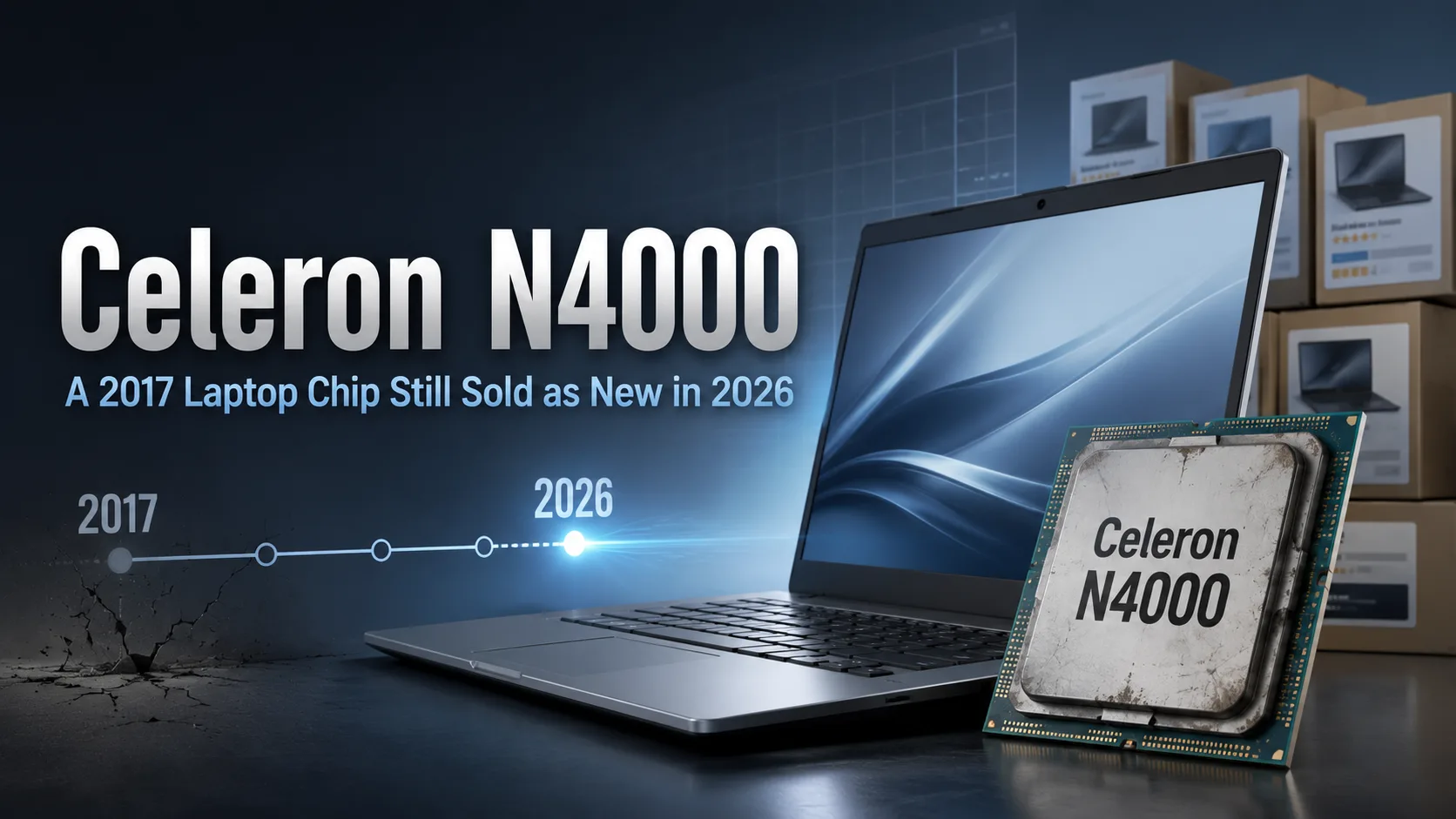
Celeron N4000: A laptop chip from 2017 that is still being marketed as new
In 2026, new laptops featuring a processor released by Intel at the end of 2017 are still being sold on Amazon and Walmart. The Celeron N4000 is the entry-level model of the Gemini Lake family: it has two cores, two threads, a TDP of 6W, and a base frequency of 1.1 GHz. Intel discontinued this model, and service updates for it ended in late 2024. However, nameless brands continue selling laptops with the N4000 as "new arrivals of 2026", equipped with 8 GB of RAM, an SSD, and Windows 11 Pro for around $190-230. Sometimes, these machines are even labeled as Gaming Laptops.
It is a rare case where a processor has outlasted itself twice: first in performance and then in the support lifecycle from the manufacturer.
Position in the lineup and architecture
The Celeron N4000 belongs to the Gemini Lake generation and is built on the Goldmont Plus microarchitecture. It is an evolution of Apollo Lake on the same 14nm process node.
Compared to its predecessors, Intel increased the cache size to 4 MB and added support for DDR4 and LPDDR4-2400.
The N4000 has two cores without Hyper-Threading. The base frequency is 1.1 GHz, and the maximum burst frequency reaches 2.6 GHz on one core and about 2.5 GHz when both are under load.
With a TDP of 6W, the processor is primarily aimed at simple, inexpensive devices with minimal cooling requirements. The performance variability between specific laptops is usually small, but the influence of cooling solutions, power settings, firmware, and memory cannot be completely ruled out.
Higher in the lineup was the Celeron N4100 with four cores at the same stated TDP. The additional cores gave it a noticeable advantage in multi-threaded tasks.
Later, Intel released Gemini Lake Refresh. The Celeron N4020 retained two cores, 4 MB of cache, 6W TDP, and UHD Graphics 600, but received a burst frequency of up to 2.8 GHz instead of 2.6 GHz. While there is a difference, in 2026, an additional 200 MHz does not fundamentally change the situation. The N4120 is more interesting due to its four cores, but it remains a very slow processor today.
Confusing the N4000 with the Celeron N4500 or Intel Processor N100 is inadvisable: Jasper Lake and especially Alder Lake-N are noticeably more modern and much faster.
Performance
The Celeron N4000 scores approximately 350-380 points in Geekbench 6 Single-Core and around 500-560 points in Multi-Core. For a modern laptop, this is an extremely low level.
The results on a specific device are affected by memory configuration, power settings, the operating system version, and background load. For such a slow dual-core processor, even a few active processes can significantly alter the final result.
In Cinebench R23, the N4000 shows approximately 440 points in the single-threaded test and around 700-730 in the multi-threaded test.
Even at launch, this processor was not designed for speed. Gemini Lake was primarily created for inexpensive devices with low power consumption, simple cooling, and basic performance.
Notably, in the old Cinebench R15, the multi-core result of the N4000 was roughly on par with a four-core Celeron N3160 released several years earlier. Memory and multimedia capabilities improved, but the two weak cores remain the main limitation.
Benchmark Results
| Device | Geekbench 6 Single-Core | Geekbench 6 Multi-Core |
|---|---|---|
| HP Stream Laptop 14-cb1xxx | 381 | 582 |
| HP Laptop 14-ck0xxx | 347 | 582 |
| ASUS VivoBook TP203MAH | 322 | 574 |
| HP Laptop 15-bs2xx | 328 | 451 |
Results for individual devices vary significantly. They are influenced by the operating system, power settings, memory, background load, and the condition of the specific system. The average result of the N4000 in the Geekbench database is around 376 points in Single-Core and 554 points in Multi-Core.
Even the best results in this sample appear extremely weak today, and modern budget processors are already several times faster.
Integrated Graphics
UHD Graphics 600 belongs to the Intel Gen9 generation and contains 12 execution units with a frequency of up to 650 MHz.
In terms of speed, it is close to the older HD Graphics 500 from Apollo Lake. Gemini Lake brought significant platform updates, but there was no substantial leap in graphics performance.
For interface use, office applications, and video playback, the UHD 600 is sufficient. It supports hardware decoding of H.265 and VP9, so playing modern video is not a serious problem for it.
Gaming is a much different story: Minecraft, older online games, and other undemanding projects can still be launched at minimal settings and low resolution, but one should not expect a stable frame rate. The UHD Graphics 600 is not designed for modern demanding games.
Thus, a laptop with the N4000 marketed as a "Gaming Laptop" is not just aggressive marketing; it simply lacks gaming performance.
Real Devices and Prices
Several types of devices with the N4000 remain on the market.
Chromebooks from Major Brands
Stores still have remnants of models from around 2019-2021.
The HP Chromebook 14 with 4 GB of RAM and a 32 GB storage drive can be found for about $140. The Acer Chromebook 311 is available for approximately $145, and the Chromebook 315 for about $150-165.
These are older generations. Manufacturers have long transitioned their budget lines to newer Intel, AMD, and MediaTek chips, so the N4000 is the cheapest remnant of the old assortment found here.
New Windows Laptops from Unknown Brands
The situation with nameless Windows laptops is worse. Brands like EYY, HYPERSTRIX, RNRUO, and DUNHOO offer 15.6-inch laptops with N4000, 8 GB of RAM, and a 256 GB SSD for around $190-230. They often come with Windows 11 Pro, and the devices are marketed as new models from 2026.
Formally, everything with Windows is fine: Microsoft still includes the Celeron N4000 Series in the lists of processors permissible for new devices running Windows 11 24H2 and 25H2.
The paradox is that Microsoft still allows this processor to be used in new computers running current Windows 11, even though Intel has already discontinued the N4000 and ended service updates for it. But formal compliance with Windows requirements does not transform an eight-year-old dual-core processor into a suitable foundation for a new laptop.
Modern Windows, a browser with several heavy tabs, antivirus, updates, and office applications can load those two weak cores even before launching a heavy program.
Refurbished Chromebooks
For refurbished Chromebooks, the N4000 is more appropriate. HP Chromebook 11 G8 EE, Dell Chromebook 3100, and Lenovo 100e can be found refurbished for about $45-80.
At this price, weak performance no longer appears to be the main drawback. ChromeOS is lighter than modern Windows, and the typical tasks for such devices generally involve browsing, documents, YouTube, and educational services. For $50-70, such a purchase still makes sense.
Old Laptops at Inflated Prices
There are also much stranger offers on the market. For example, older models like the Lenovo V130 with the N4000 can cost around $400 and up. At this price, discussing the merits of the N4000 seems pointless: for that money, one can get laptops with much more modern platforms featuring four, six, or more cores.
Competitors and Alternatives
Intel Processor N100
The main alternative is the Intel Processor N100. It has four Alder Lake-N cores and is also aimed at inexpensive energy-efficient devices.
In Geekbench 6, the N4000 scores about 365 points in Single-Core and 620 in Multi-Core, while the N100 scores around 1220 and 3129 points respectively. This results in approximately a 3.3 times advantage for the N100 in single-threaded tests and a fivefold advantage in multi-threaded tasks.
The gap is too large to consider it a simple generational shift, especially given that budget laptops with the N100 are found in roughly the same price range-around $180-250.
Thus, purchasing a new Windows laptop with the N4000 for $200 looks particularly poor. Buyers are not even offered substantial savings in exchange for an old platform; they are offered an old processor at roughly the same price.
Celeron N4020 and N4120
The N4020 is slightly faster than the N4000, thanks to a burst frequency of 2.8 GHz instead of 2.6 GHz, but it is still a Gemini Lake Refresh processor with two cores. In 2026, choosing a laptop simply because it has an N4020 instead of an N4000 makes little sense.
The N4120, with four cores, is significantly better in multi-threaded tasks, but by modern standards, it is still very slow.
AMD Athlon Silver 3050e
The Athlon Silver 3050e offers two cores and four threads, and its integrated Vega 3 is significantly more interesting than the UHD 600. However, the Athlon 3050e has also become quite outdated by 2026, so it should only be considered at a truly low price.
Refurbished Chromebook with N4000
This is the only case where comparing processors almost loses its meaning. If a functioning Chromebook costs $50-70 and is only needed for browsing, YouTube, or studying, the price outweighs the CPU name.
Conclusion
The Celeron N4000 has not become worse since 2017. It remains the same dual-core processor for the simplest tasks, while the requirements of software, browsers, and operating systems have continued to grow.
The N4000 itself does not hinder anyone-problems arise when it is placed in a "new laptop for 2026."
A new Windows laptop with the N4000 for $190-230 is a poor purchase. For comparable money, models based on the Intel Processor N100 are already available, which are about three times faster for single-core tasks and approximately five times faster under multi-threaded loads.
A new Chromebook with the N4000 for $140-165 is a questionable purchase. Its capabilities are still sufficient for browsing, but these are remnants of old generations that manufacturers have long replaced with more modern platforms.
A refurbished Chromebook for $50-80 is a different matter. As a cheap second device, a student laptop, or a machine solely for browsing, the N4000 can still do its job.
Outside of this niche, there are virtually no reasons left to buy a device with the Celeron N4000 in 2026.
CPU Comparison
Compare Celeron N4000 with other CPUs
Basic
CPU Specifications
Memory Specifications
GPU Specifications
Interfaces and Ports
Benchmarks
Compared to Other CPU


Share in social media
Or Link To Us
<a href="https://cputronic.com/index.php/cpu/intel-celeron-n4000" target="_blank">Intel Celeron N4000</a>