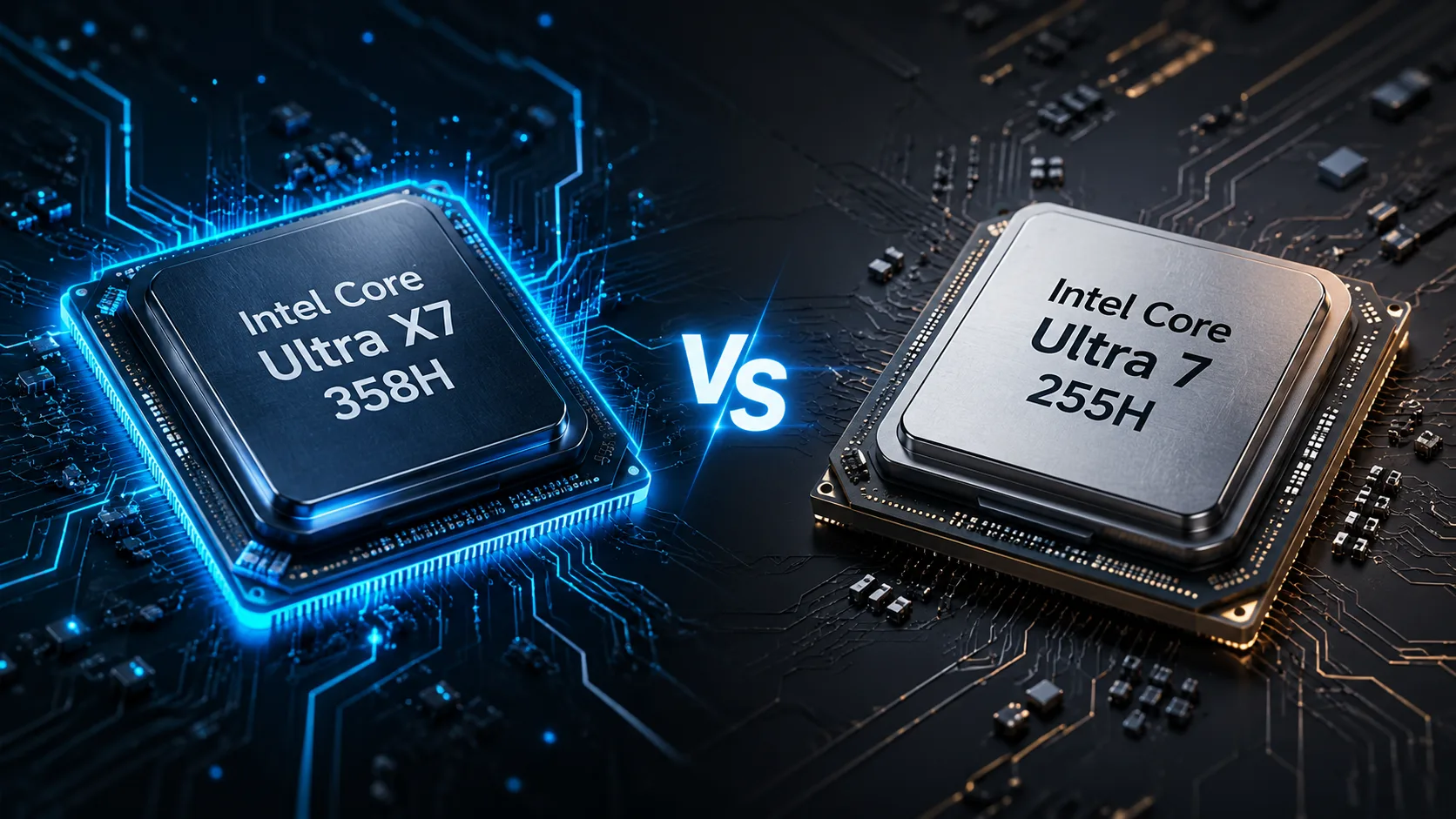
Intel Core Ultra X7 358H
vs
Intel Core Ultra 7 255H
CPU Comparison Result
Intel Core Ultra X7 358H vs Intel Core Ultra 7 255H: Performance and Integrated Graphics Comparison
The Intel Core Ultra X7 358H and Core Ultra 7 255H belong to the mobile H-class and both feature 16 cores and 16 threads, but they are built on different generations of architecture. The Core Ultra 7 255H is part of Arrow Lake, while the Core Ultra X7 358H belongs to the newer Panther Lake.
On classic specifications, the 255H looks compelling: it has six performance cores, a frequency of up to 5.1 GHz, and 24 MB of cache. The 358H has only four P-cores, a frequency of up to 4.8 GHz, and 18 MB of cache. However, in selected laptops, the newer processor proves to be faster in Geekbench 6, with its integrated graphics and NPU belonging to a noticeably higher class.
Key Differences
| Specification | Intel Core Ultra X7 358H | Intel Core Ultra 7 255H |
|---|---|---|
| Generation | Panther Lake, Series 3 | Arrow Lake, Series 2 |
| Core Configuration | 4P + 8E + 4 LP E | 6P + 8E + 2 LP E |
| Max Frequency | 4.8 GHz | 5.1 GHz |
| L3 Cache | 18 MB | 24 MB |
| Base Power | 25 W | 28 W |
| Max Turbo Power | 80 W | 115 W |
| Supported Memory | LPDDR5X-9600, up to 96 GB | LPDDR5X-8400 or DDR5-6400, up to 128 GB |
| Integrated Graphics | Intel Arc B390, 12 Xe cores | Intel Arc 140T, 8 Xe cores |
| Graphics Frequency | up to 2.5 GHz | up to 2.25 GHz |
| NPU Performance | 50 TOPS | 13 TOPS |
The Core Ultra 7 255H offers more P-cores, a larger cache, and supports DDR5 configurations. The Core Ultra X7 358H is designed for lower power limits, faster LPDDR5X, and significantly enhanced integrated graphics.
Performance in Specific Laptops
The table below provides individual Geekbench 6 results under Windows. These show the behavior of the processors in specific devices rather than the average performance of all laptops using these chips. The results are influenced by cooling, power limits, memory, BIOS version, and the chosen performance profile.
| Processor | Laptop | Single Core | Multi Core |
|---|---|---|---|
| Core Ultra X7 358H | HP OmniBook 7 16-bh0xxx | 2896 | 16 566 |
| Core Ultra X7 358H | Acer Swift 16 AI SF16-71T | 2852 | 16 459 |
| Core Ultra X7 358H | Samsung Galaxy Book6 Pro | 2850 | 16 733 |
| Core Ultra 7 255H | ASUS Zenbook 14 UX3405CA | 2801 | 14 808 |
| Core Ultra 7 255H | Acer Swift Go 14 SFG14-74T | 2644 | 14 717 |
| Core Ultra 7 255H | Dell Pro Max 16 MC16250 | 2622 | 16 057 |
In this small sample, the Core Ultra X7 358H averages around 2866 points in single-core and 16,586 points in multi-core tests. The Core Ultra 7 255H produces approximately 2689 and 15,194 points.
The advantage of the 358H is about 7% in Single Core and 9% in Multi Core. This reflects the results from selected laptops and is not a guaranteed difference between any systems using these processors.
Notably, the 358H performs better despite having fewer P-cores, a lower maximum frequency, and a turbo power limit of 80 W. However, the Dell Pro Max 16 demonstrates that a well-optimized laptop with the 255H can almost catch up to Panther Lake in multi-core testing.
Integrated Graphics
The Core Ultra X7 358H is equipped with Intel Arc B390, which features 12 Xe cores and a frequency of up to 2.5 GHz. The Core Ultra 7 255H uses Arc 140T with eight Xe cores and a frequency of up to 2.25 GHz.
In Geekbench OpenCL, the Arc B390 in the Samsung Galaxy Book6 Pro scored 57,001 points, while the Arc 140T in the Acer Swift Go 14 scored 41,544 points. The difference in this pair is about 37%.
One OpenCL test does not allow us to accurately determine the advantage in all games and professional applications. However, the combination of 12 vs. 8 Xe cores, higher frequency, and markedly larger scores in computational tests indicates a clear superiority for the Arc B390.
For laptops without a discrete graphics card, the graphics become the main argument in favor of the Core Ultra X7 358H. It is better suited for gaming, image processing, editing, and applications that support GPU acceleration.
NPU and Local AI Tasks
The NPU in the Core Ultra X7 358H achieves 50 TOPS compared to 13 TOPS in the Core Ultra 7 255H.
In typical office applications, this difference has little impact on speed. The advantage becomes more evident in applications using the NPU for noise reduction, camera effects, transcription, image processing, and local AI functions.
Paying more just for a higher TOPS rating does not always make sense. In this case, the more powerful NPU complements the accelerated graphics and newer CPU architecture, rather than being the only improvement.
Power Consumption and Memory
Official power limits for the 358H are lower: 25 W in base mode and up to 80 W in turbo compared to 28 and 115 W for the 255H. This makes Panther Lake a more suitable foundation for thin laptops, although actual power consumption depends on the manufacturer's settings.
The Core Ultra X7 358H supports LPDDR5X-9600. The high memory bandwidth is especially beneficial for integrated graphics using shared system memory.
The Core Ultra 7 255H is more versatile in configurations. It supports both LPDDR5X and DDR5. The availability of removable modules, however, depends on the design of the specific laptop.
Conclusion
The Intel Core Ultra X7 358H appears to be preferable in most laptops without a discrete graphics card. In the selected results from Geekbench 6, it is approximately 5-10% faster, and the Arc B390 is significantly more powerful than the Arc 140T. An additional advantage is the NPU rated at 50 TOPS.
The Core Ultra 7 255H remains sensible if the laptop featuring it is significantly cheaper or equipped with a discrete graphics card.
When priced similarly, choosing the Core Ultra X7 358H seems more logical: it is faster in the CPU tests considered, significantly stronger in integrated graphics, and designed for lower power limits.
Advantages
- Newer Launch Date: December 2025 (December 2025 vs January 2025)
- Higher Performance-core Max Turbo Frequency: 5.1 GHz (4.8 GHz vs 5.1 GHz)
- Larger L3 Cache: 24 MB shared (18 MB shared vs 24 MB shared)
- Higher Technology: 3 nm (Intel 18A vs 3 nm)
Basic
CPU Specifications
Memory Specifications
GPU Specifications
Interfaces and Ports
Benchmarks
Related CPU Comparisons





Share in social media
Or Link To Us
<a href="https://cputronic.com/index.php/cpu/compare/intel-core-ultra-x7-358h-vs-intel-core-ultra-7-255h" target="_blank">Intel Core Ultra X7 358H vs Intel Core Ultra 7 255H</a>