AMD Ryzen AI 7 PRO 450
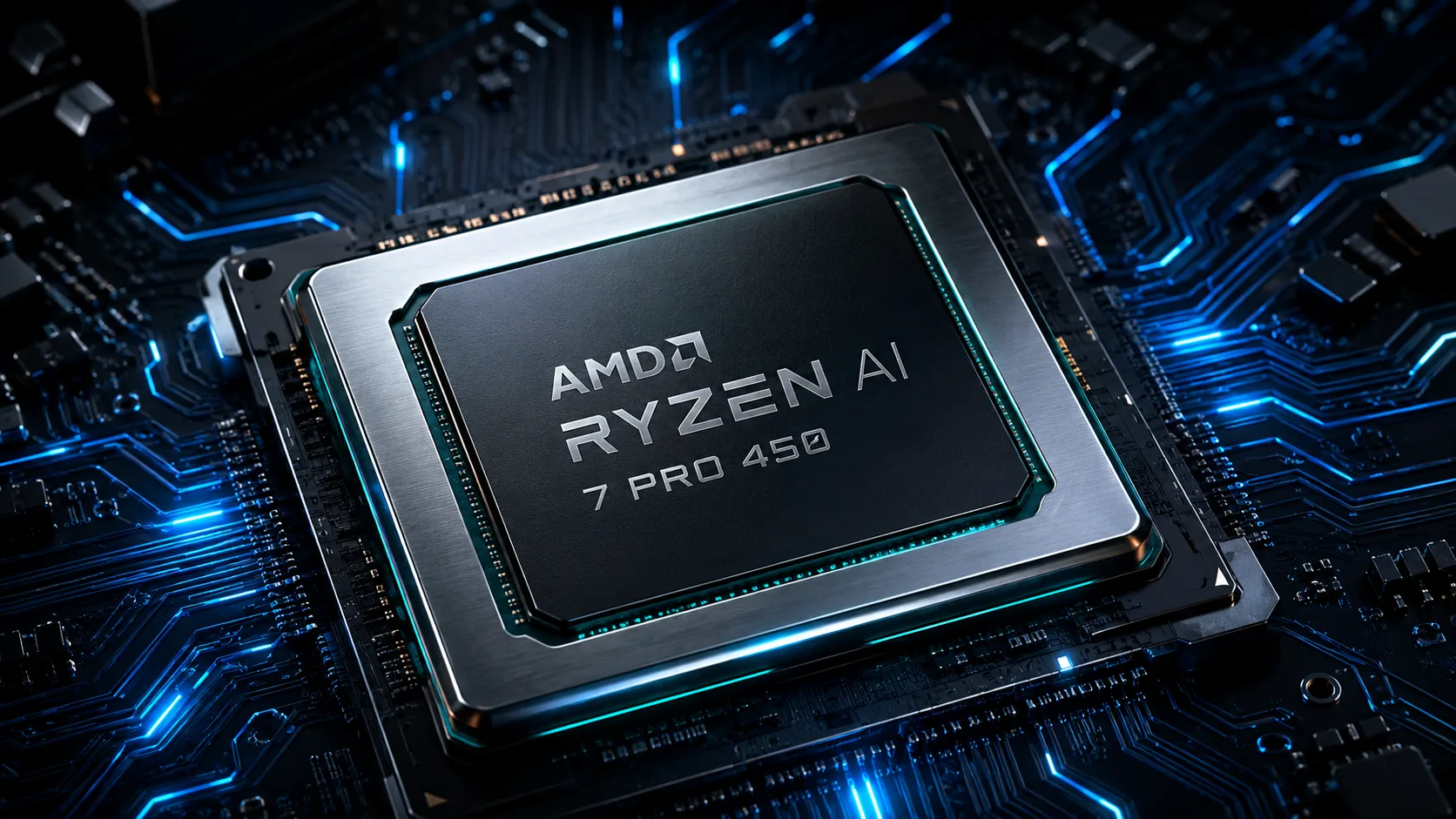
AMD Ryzen AI 7 PRO 450: The Business Version of Ryzen AI 7 with a Strong NPU and Adequate CPU Supply
The AMD Ryzen AI 7 PRO 450 is interesting not just because of the PRO designation itself. The main idea is different: AMD has brought a full-fledged class of AI PCs into corporate laptops, but without venturing into expensive and hot workstations. This processor is designed for devices where cores and frequencies are not the only requirements, but also manageability, security, local AI functions, modern graphics, and a long platform lifecycle.
Essentially, the Ryzen AI 7 PRO 450 is close to the standard Ryzen AI 7 450, but it is aimed at the business segment. It features 8 cores and 16 threads in a 4x Zen 5 + 4x Zen 5c configuration, integrated graphics Radeon 860M, an NPU of up to 50 TOPS, and an overall AI potential of up to 66 TOPS. The base TDP is 28 W, with an adjustable range of 15-54 W. This is not an extreme chip for maximum benchmarks, but a solid universal platform for modern work laptops.
The Main Difference of PRO - Not Speed, But Purpose
The PRO designation does not make the Ryzen AI 7 PRO 450 faster in games, rendering, or standard tests. What matters more is that such processors are designed for corporate devices, where management, security, standardization, and long-term support functions are needed. For home users, this may be almost imperceptible. For a company that purchases and maintains a fleet of laptops, these aspects are already significant.
In simpler terms, the Ryzen AI 7 PRO 450 is not an "enhanced version for FPS" but rather a business variant of the ordinary Ryzen AI 7 450.
| Model | CPU | Graphics | NPU | PRO Features | Main Purpose |
|---|---|---|---|---|---|
| Ryzen AI 7 450 | 8/16 | Radeon 860M | up to 50 TOPS | no | Standard laptops and compact PCs |
| Ryzen AI 7 PRO 450 | 8/16 | Radeon 860M | up to 50 TOPS | yes | Business laptops, management, security |
This table clearly explains the essence of the model: the hardware is almost the same, but the scenario is different. If a laptop is purchased for home use, the standard Ryzen AI 7 450 may be just as good, especially at a lower price. If the device is intended for a company, the PRO version makes more sense.
Architecture: Balance of Zen 5 and Zen 5c
The Ryzen AI 7 PRO 450 employs a hybrid configuration for AMD: 4 full Zen 5 cores and 4 compact Zen 5c cores. The maximum frequency reaches 5.1 GHz, while the Zen 5c cores operate up to 3.6 GHz. The L3 cache amounts to 16 MB.
This is a successful balance for a work laptop. The full Zen 5 cores are responsible for responsiveness, active tasks, and high frequencies. The Zen 5c cores assist in background tasks, multitasking, and long-term loads without inflating power consumption and die size.
It is important to understand: Zen 5c cores are not "weak cores" in the rough sense. They are smaller and typically lower in frequency, but architecturally remain close to Zen 5. Therefore, the Ryzen AI 7 PRO 450 appears significantly more serious than the lower Ryzen AI 5 models, although it still falls short of the higher Ryzen AI 9 models with more cores.
NPU: Useful, but Not a Replacement for the CPU
The NPU of up to 50 TOPS is one of the key reasons for the existence of this model. In corporate laptops, local processing of AI tasks is becoming increasingly important: camera effects, noise cancellation, Windows background functions, image processing, local assistants, and future Copilot+ PC scenarios.
The advantage of a local NPU in the business segment is especially clear. Some tasks can be performed on the device without constant reliance on the cloud. This is beneficial not only for speed and autonomy but also for scenarios where privacy and data control are important.
However, the NPU should not be overvalued. It will not accelerate regular compiling, archiving, rendering, or heavy spreadsheets unless the specific software can utilize the neural block. The Ryzen AI 7 PRO 450 is good because it has a dedicated AI accelerator, but the main everyday performance is still determined by the CPU, memory, cooling, and specific laptop settings.
Radeon 860M: Strong Graphics Without a Discrete GPU
The integrated Radeon 860M is an important advantage of the Ryzen AI 7 PRO 450. It has 8 graphics cores and a frequency of up to 3100 MHz. This is not a gaming graphics card, but for a business laptop, such an iGPU covers more tasks than just displaying images on the screen.
The Radeon 860M is suitable for multiple monitors, presentations, video, hardware encoding and decoding, light photo editing, simple editing, old games, and less demanding online projects. Support for AV1, HDMI 2.1, DisplayPort 2.1, and up to four displays makes the chip convenient for workstations with docks and external monitors.
This is an important practical plus: a laptop with the Ryzen AI 7 PRO 450 can be a complete working machine without discrete graphics. For office work, analytics, development, presentations, and multimedia, this is often sufficient.
Performance: A Strong Universal Processor, but Not a Workstation
According to early tests, the Ryzen AI 7 PRO 450 appears to be a confident 8-core mobile processor. It should handle browsing, office tasks, video calls, multiple work applications, light editing, photo processing, presentations, and moderate development well.
| Test | AMD Ryzen AI 7 PRO 450 | What This Means |
|---|---|---|
| Geekbench 6 Single-Core | around 2800 | High system responsiveness |
| Geekbench 6 Multi-Core | around 13000-13500 | Good level for an 8-core mobile APU |
| Cinebench 2024 | around 970 | Adequate reserve for a thin work laptop |
| PassMark Single Thread | around 3900 | Strong single-thread performance |
| PassMark CPU Mark | around 27000 | Strong universal result |
These numbers indicate the correct class of the processor. The Ryzen AI 7 PRO 450 does not seem weak or compromised. However, it is also not a replacement for the Ryzen AI 9, HX processors, or mobile workstations with discrete graphics. If heavy virtual machines, continuous rendering, complex editing, 3D, or prolonged multi-threaded workloads are needed, it is better to look higher.
Where the Ryzen AI 7 PRO 450 Makes Sense
This processor shines best in work laptops where not one maximum metric is important, but the overall balance: performance, battery life, security, graphics, AI functions, and ease of maintenance.
It is well-suited for mid-range and high-end corporate laptops, devices for managers, analysts, office professionals, and developers, as well as work systems without discrete graphics cards. In a gaming laptop, the chip performs less admirably: its task is not the maximum FPS but a stable work platform without evident weak points.
The Main Question - Is the PRO Version Necessary?
For the average consumer, the Ryzen AI 7 PRO 450 may be excessive. If there is a laptop with the Ryzen AI 7 450 nearby that has a good screen, memory, cooling, and a lower price, it may be a more reasonable choice.
For businesses, the situation is different. There, not only benchmarks are important, but also security, management, configuration stability, platform support, and the ability to maintain a fleet of devices properly. It is in such scenarios that the PRO designation begins to make sense.
There is also another risk: if a laptop with the Ryzen AI 7 PRO 450 costs almost the same as a model with the Ryzen AI 9 PRO, it is worth carefully comparing configurations. Higher chips will provide more CPU headroom, which can be more important if the device is purchased for several years.
Conclusion
The AMD Ryzen AI 7 PRO 450 is a successful processor for modern business laptops. It has a sufficiently strong CPU block, a configuration of 4x Zen 5 + 4x Zen 5c, integrated Radeon 860M, an NPU of up to 50 TOPS, modern interfaces, and corporate AMD PRO features. This is not a junior compromise but also not a top mobile workstation.
This chip is best suited for work laptops: fast, quiet, autonomous, with good graphics without a discrete GPU and support for local AI functions. A home user should compare it with the standard Ryzen AI 7 450. For companies, the Ryzen AI 7 PRO 450 is particularly interesting as a balanced platform, where not only test numbers matter, but also manageability, security, and a long device lifecycle.
CPU Comparison
Compare Ryzen AI 7 PRO 450 with other CPUs
Basic
CPU Specifications
Memory Specifications
GPU Specifications
Miscellaneous
Benchmarks
Compared to Other CPU
Related CPU Comparisons

Share in social media
Or Link To Us
<a href="https://cputronic.com/index.php/cpu/amd-ryzen-ai-7-pro-450" target="_blank">AMD Ryzen AI 7 PRO 450</a>