AMD Ryzen AI 5 435

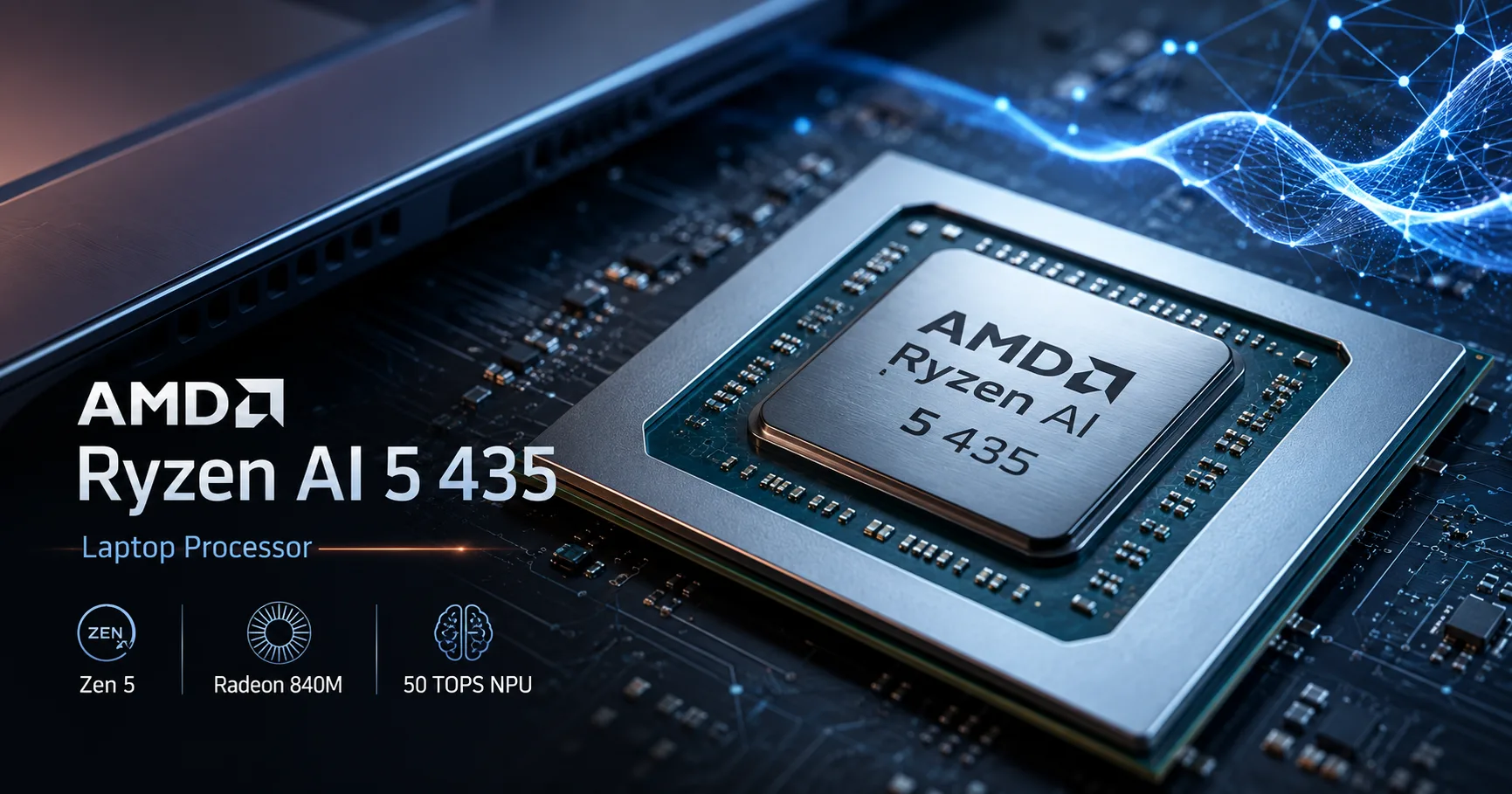
AMD Ryzen AI 5 435: A Modern Laptop Processor Where Price Takes Precedence Over the Buzzword AI
The AMD Ryzen AI 5 435 is a mid-range mobile processor from the Ryzen AI 400 series. By name, it appears to be part of AMD's new AI wave, but in essence, it's a practical chip for mainstream laptops: fast enough for everyday tasks, built on a fresh platform, equipped with a dedicated NPU, yet without the claim to flagship status.
The main takeaway is simple: the Ryzen AI 5 435 is not worth purchasing solely because of the AI in its name. It becomes interesting when paired with a well-made laptop: one with a good screen, adequate cooling, sufficient memory, and a reasonable price. In such a scenario, it provides a solid processor for work, study, web browsing, video calls, multimedia consumption, and moderate multitasking.
Within the Ryzen AI 400 lineup, this model occupies a clear position. The Ryzen AI 5 435 is significantly more appealing than its younger sibling, the Ryzen AI 5 430, due to its 6 cores instead of 4, but it doesn’t look like an unequivocally better choice compared to the Ryzen AI 5 PRO 440. The PRO 440 has higher clock speeds and more L3 cache, making it potentially more advantageous with only a slight price difference. However, since this is a PRO model, it may appear less frequently in conventional consumer laptops.
The Ryzen AI 7 445 should also not be perceived as a transition to a completely different level. Despite its name suggesting a higher classification, it is technically quite close to the Ryzen AI 5 435: it is more of a neighbor with slightly higher positioning rather than a radically more powerful processor.
Interestingly, the Ryzen AI 5 340 is worth a mention. While it belongs to a different series, it shouldn’t be dismissed purely based on its index. In certain configurations, it may even seem more appealing due to its larger L3 cache and higher clock speeds. Therefore, the Ryzen AI 5 435 is not always automatically better just because the number in its name is higher.
Performance: A Decent Mid-Level with No Headroom for Heavy Tasks
The Ryzen AI 5 435 uses a hybrid configuration of Zen 5 and Zen 5c. This is not an Intel-style setup with powerful and very small energy-efficient cores. Zen 5c is closer to full-fledged Zen 5 cores but is designed for denser placement and usually operates at lower frequencies.
In real-world usage, the processor should feel fast. Multiple browser tabs, documents, messengers, video calls, music, light photo processing - these are all normal scenarios for the Ryzen AI 5 435. For a thin mid-range laptop, this provides a solid base.
In benchmarks, the Ryzen AI 5 435 clearly shows its place: it is noticeably faster than the younger Ryzen AI 5 430 in multi-threaded performance, holds its own against the Ryzen AI 5 340, but does not quite reach the performance of the stronger Ryzen AI 7 350.
| Processor | Geekbench 6 Single | Geekbench 6 Multi | PassMark Single | PassMark Multi | Level |
|---|---|---|---|---|---|
| Ryzen AI 5 430 | 2214 | 6942 | 3877 | 13958 | younger variant |
| Ryzen AI 5 435 | 2488 | 9210 | 3654 | 18592 | mid-level |
| Ryzen AI 5 340 | 2537 | 9120 | 4050 | 21029 | close competitor |
| Ryzen AI 7 350 | 2700 | 13100 | 3840 | 20715 | significantly higher |
Single-threaded performance on the Ryzen AI 5 435 is solid: the interface, browser, office applications, and most everyday tasks shouldn’t max out the CPU. Multi-threaded results are also good for a 6-core mobile chip, but without illusions: for prolonged rendering, serious editing, compiling large projects, or heavy workloads, it’s better to look at Ryzen AI 7/9 or more powerful H/HX models.
The Ryzen AI 5 435 is not a workstation in a compact form factor, but rather a fast, versatile processor for everyday laptops.
Radeon 840M: Adequate Integrated Graphics, But Not for Gaming Laptops
The integrated Radeon 840M is modern entry-level graphics for this platform. It is suitable for the Windows interface, video playback, external displays, older games, less demanding online projects, and light gaming on low settings.
However, if the laptop is being purchased specifically for gaming, the Ryzen AI 5 435 is a weak benchmark. The Radeon 840M is significantly simpler than the Radeon 860M, 880M, or 890M found in older APUs. It’s essential not to be misled by the Ryzen AI name: the processor is fresh, but its graphics component is not gaming-oriented.
NPU: Impressive Numbers, But Not a Reason to Blindly Overpay
The dedicated NPU is the most noticeable marketing aspect of the Ryzen AI 5 435. Up to 50 TOPS for the neural processor is a good figure for a laptop with modern AI capabilities, such as Windows features, noise cancelling, video processing, local AI tools, and future applications that could leverage the NPU instead of the CPU or GPU.
However, for the average user, the benefit of the NPU isn’t always evident on a daily basis. If the laptop is needed for browsing, documents, movies, work, and studying, then the screen, memory, SSD, battery, and cooling will be more critical than the impressive TOPS figure. The NPU is a solid foundation for the future, but it’s not an argument for overpricing when there’s a more attractive model available with a better screen or greater memory capacity.
What to Check Before Buying
The same Ryzen AI 5 435 can behave differently in different laptops. In a thin, quiet model, it will be more efficient but may drop frequencies faster under prolonged load. In a larger chassis with proper cooling, the processor can maintain high performance for a longer time.
Before buying, it’s wise to check:
- 16 GB of memory is the minimum; 32 GB is better for longevity;
- memory type and operating mode, as integrated graphics are sensitive to bandwidth;
- power limits and cooling quality;
- screen quality since a poor matrix can spoil the impression more than the difference between closely matched CPUs;
- presence of USB4 if docking stations, fast storage, or modern peripherals are needed;
- price compared to Ryzen AI 5 PRO 440, Ryzen AI 7 445, and Ryzen AI 5 340.
Conclusion: A Good Processor If the Laptop Is Priced Right
The AMD Ryzen AI 5 435 is a solid choice for a mainstream laptop, but it lacks a wow factor. It’s modern, efficient, sufficiently fast for everyday use, and equipped with a strong NPU. In terms of platform and AI capabilities, it seems fresher than many older Ryzen 5 models, but in pure CPU performance, it doesn’t always have to be better than comparable models from the previous generation.
The main weak point is not a shortcoming but a limited buffer. The CPU configuration here is average, and the Radeon 840M is more suited for multimedia and light gaming than for full-fledged gaming. The best scenario for Ryzen AI 5 435 is a laptop with a good screen, 16-32 GB of memory, decent cooling, and a reasonable price.
If a model with the Ryzen AI 5 PRO 440, Ryzen AI 7 445, Ryzen AI 5 340, or more powerful integrated graphics is available for a small premium, it’s essential to compare. The Ryzen AI 5 435 excels only when the price is right. Without that, it simply becomes another modern processor with an attractive AI label.
CPU Comparison
Compare Ryzen AI 5 435 with other CPUs
Basic
CPU Specifications
Memory Specifications
GPU Specifications
Miscellaneous
Benchmarks
Compared to Other CPU
Related CPU Comparisons



Share in social media
Or Link To Us
<a href="https://cputronic.com/index.php/cpu/amd-ryzen-ai-5-435" target="_blank">AMD Ryzen AI 5 435</a>