AMD Ryzen 7 9700X
AMD Ryzen 7 9700X: Why Zen 5 with the Same Eight Cores
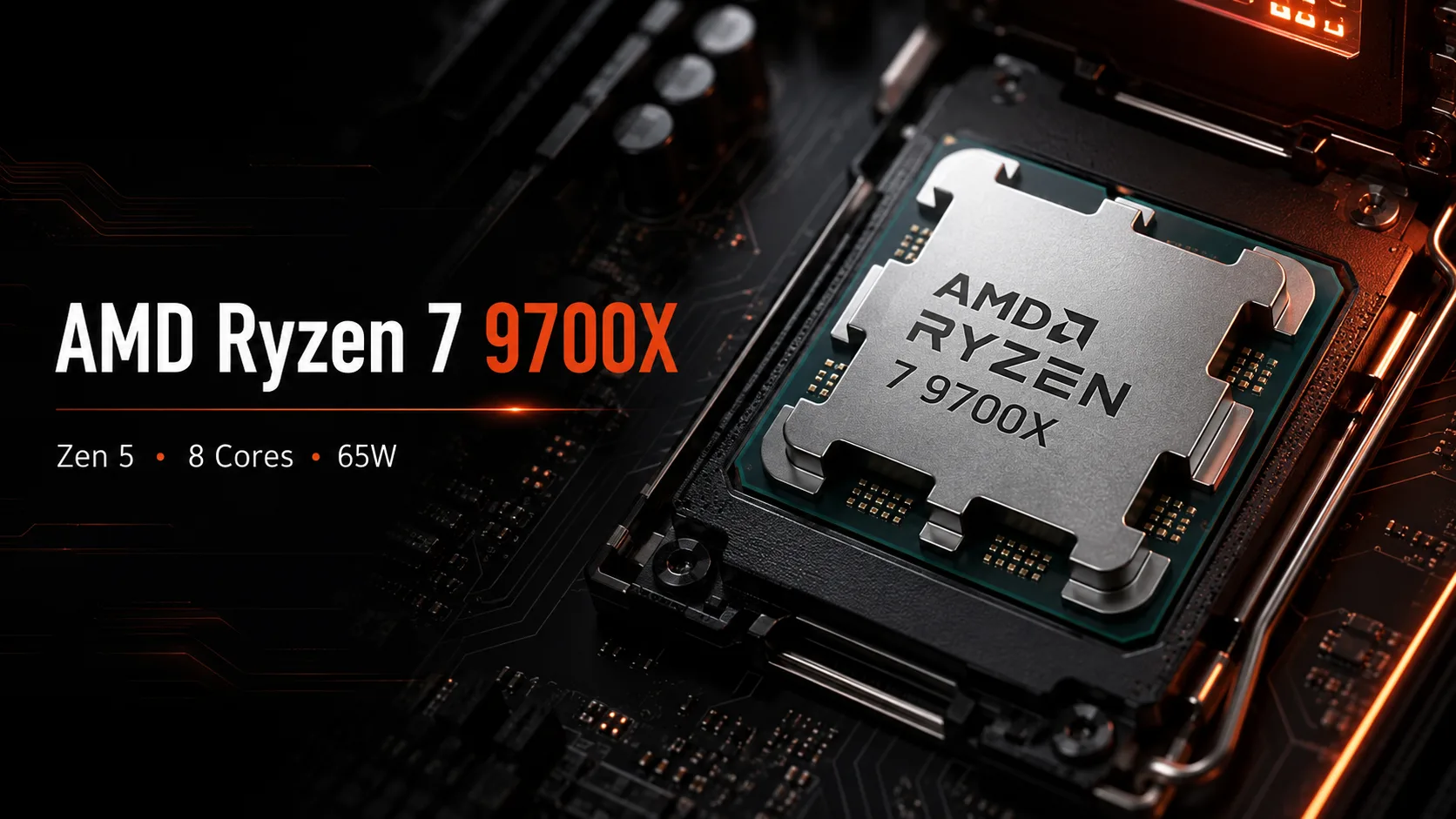
According to the specifications table, the Ryzen 7 9700X looks almost like a repeat of the Ryzen 7 7700X. It features the same eight cores, sixteen threads, and 32 MB of L3 cache, with the maximum frequency only increasing from 5.4 to 5.5 GHz. The difference lies in the Zen 5 architecture and a standard TDP of 65 W instead of 105 W. The main question is how well the new architecture utilizes the previous eight cores under a lower power limit.
What Changed Compared to the Ryzen 7 7700X
The Ryzen 7 9700X is built on the Zen 5 architecture. The core chips are manufactured by TSMC using a 4nm process, while the I/O chip retains a 6nm process. The processor has eight cores, sixteen threads, 8 MB of L2 cache, and 32 MB of L3 cache.
According to AMD, Zen 5 executes, on average, 16% more instructions per clock than Zen 4. Changes in branch prediction and the execution unit have improved performance per clock, but the actual gain heavily depends on the application.
A comparison with neighboring eight-core models better illustrates the niche the Ryzen 7 9700X occupies.
| Processor | Architecture | Cores / Threads | Max Frequency | L3 Cache | TDP |
|---|---|---|---|---|---|
| Ryzen 7 7700X | Zen 4 | 8 / 16 | 5.4 GHz | 32 MB | 105 W |
| Ryzen 7 9700X | Zen 5 | 8 / 16 | 5.5 GHz | 32 MB | 65 W |
| Ryzen 7 9800X3D | Zen 5 | 8 / 16 | 5.2 GHz | 96 MB | 120 W |
The key generational change is not additional cores or a sharp increase in frequency, but higher performance per core at a lower standard power limit.
Gaming: Faster Than Standard Ryzens, Slower than X3D
The Ryzen 7 9700X can fully load most modern graphics cards, especially at 1440p and 4K. Eight cores are sufficient for gaming, gameplay recording, and background applications.
High performance per core is especially important in strategy games, simulators, and competitive games, where the processor affects minimum FPS and frame time smoothness. However, in terms of gaming performance, the 9700X lags behind the Ryzen 7 9800X3D.
The 9800X3D features an L3 cache increased to 96 MB compared to 32 MB in the 9700X. In games sensitive to memory latency, this gives the X3D model a noticeable advantage.
The gap is best observed at 1080p with a powerful graphics card when the system can deliver over 200 frames per second. At 1440p and 4K, the load often shifts to the graphics card, thus narrowing the practical difference between the processors.
The Ryzen 7 9800X3D justifies the extra cost in a build aimed at maximum FPS. The advantage of the 9700X arises at a lower price and stricter power consumption and cooling requirements.
Workloads: Fast, but Not for Continuous Rendering
In tasks sensitive to single-thread speed, the Ryzen 7 9700X can compete with more multi-core models from previous generations. Its eight cores are sufficient for photo processing, editing short projects, code compilation, and running multiple virtual machines.
In local AI tasks, the processor is suitable for data preparation and running small models, but the primary speed is still determined by the graphics card.
In prolonged multi-threaded workloads, the limitation on the number of cores becomes noticeable. For extended rendering, batch video encoding, building large projects, and several resource-intensive virtual machines, a twelve-core Ryzen 9 is more advantageous.
The Ryzen 7 9700X is better suited for mixed workloads where both single-core speed and the ability to periodically utilize all sixteen threads are important.
Energy Efficiency - The Main Argument for the 9700X
The standard TDP has been reduced to 65 W from 105 W in the Ryzen 7 7700X. Lower consumption allows for a mid-range tower cooler and reduces noise under prolonged load.
Through PBO and Curve Optimizer, power limits can be increased or voltage decreased. Typically, this is more beneficial than manually fixing the frequency: automation maintains a high single-thread boost and uses the thermal headroom better.
However, the 65 W TDP should not be perceived as the exact maximum power consumption. Under full load, the processor can consume more, especially after activating PBO. Nevertheless, it remains significantly less demanding in terms of power and cooling than many higher-end models.
Integrated Graphics for Display Output
The Ryzen 7 9700X is equipped with a simple integrated Radeon graphics core with two compute units. This is enough for display output, system diagnostics, and operation without a discrete graphics card.
In terms of performance, this graphics capability pales in comparison to the Radeon 780M in the Ryzen 7 8700G and is primarily suitable for basic tasks.
AM5 Allows CPU Upgrade Without Platform Change
The Ryzen 7 9700X uses the AM5 socket and is supported by motherboards with chipset series 600 and 800. Most B650, B650E, X670, and X670E boards work with Ryzen 9000 after a BIOS update, so there is usually no need to change the motherboard.
The processor supports only DDR5. The optimal choice for most builds remains a kit of two memory modules since installing four sticks may require reducing the frequency.
The platform supports PCIe 5.0 for graphics cards and NVMe drives, although the available slots depend on the specific motherboard.
Who Should Choose the Ryzen 7 9700X
The Ryzen 7 9700X is justified in the following cases:
- The computer is used for both gaming and tasks sensitive to single-thread speed;
- Moderate consumption and low noise levels are important;
- An AM5 motherboard is already available;
- Tasks rarely manage to load more than eight cores.
For a gaming build with a high-end graphics card, it is more advantageous to choose the X3D model. For continuous rendering and prolonged multi-threaded calculations, the Ryzen 9 is better suited.
For owners of the Ryzen 7 7700X, upgrading to 9700X does not make sense: the gain is too small to justify replacing the processor. Transitioning from older six-core Ryzens or when building a new system on AM5 looks more reasonable.
Conclusion
The Ryzen 7 9700X is not the best CPU for maximum FPS or continuous rendering. Its niche is a versatile AM5 build where high single-core speed, moderate consumption, and simple cooling are essential.
The purchase is especially justified if it is significantly cheaper than the Ryzen 7 9800X3D. For owners of the Ryzen 7 7700X, upgrading is nearly meaningless, while the difference when transitioning from older six-core models will be much more noticeable.
CPU Comparison
Compare Ryzen 7 9700X with other CPUs
Basic
CPU Specifications
Memory Specifications
GPU Specifications
Miscellaneous
Benchmarks
Compared to Other CPU
Related CPU Comparisons


Share in social media
Or Link To Us
<a href="https://cputronic.com/index.php/cpu/amd-ryzen-7-9700x" target="_blank">AMD Ryzen 7 9700X</a>