AMD Ryzen 7 5700G
AMD Ryzen 7 5700G: processor and Radeon Vega 8 tests, comparison with the 5700X
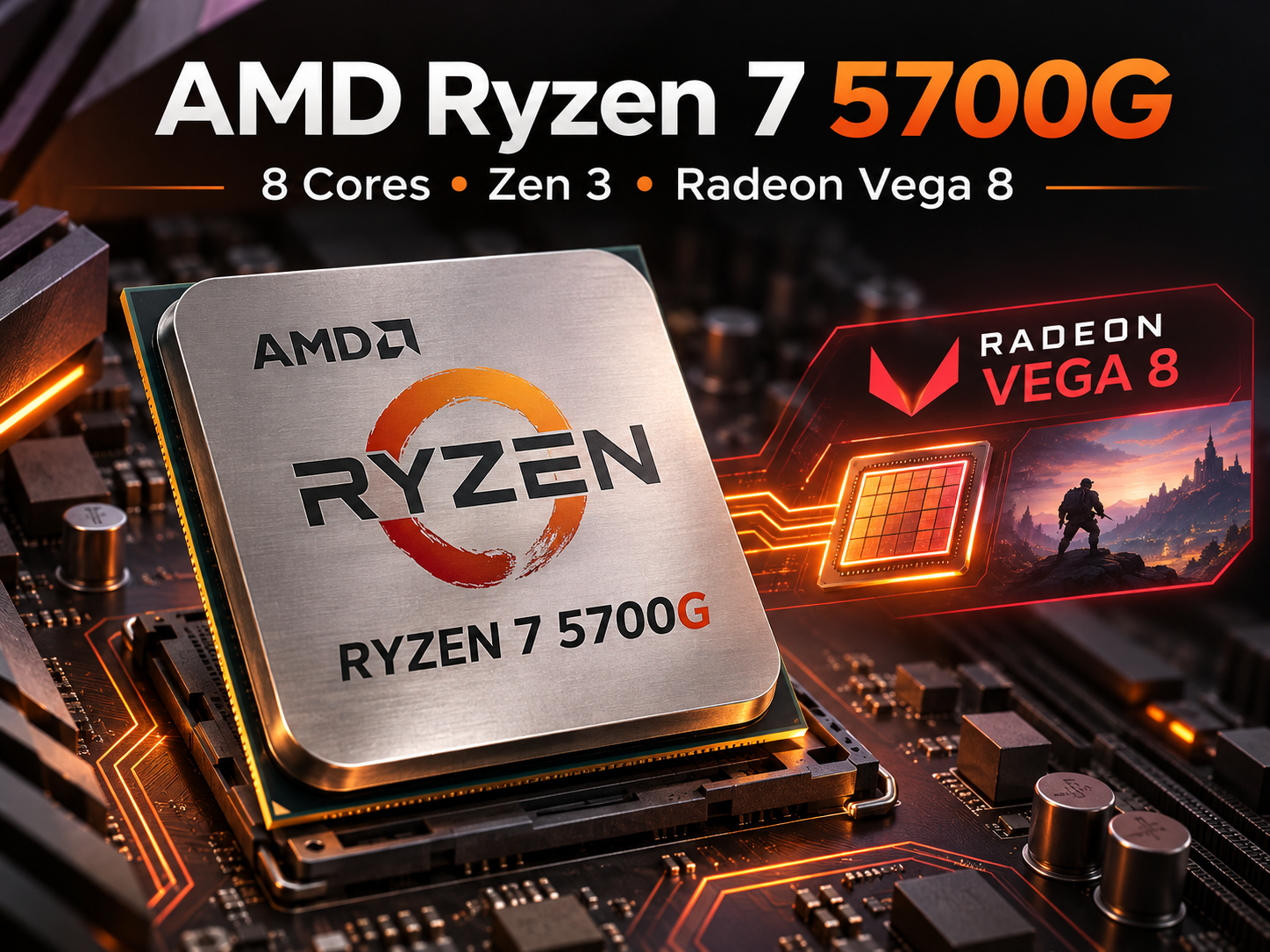
The AMD Ryzen 7 5700G is an eight-core desktop processor based on the Zen 3 architecture, with integrated Radeon Vega 8 graphics, released in 2021. Its integrated graphics eliminate the need for a discrete graphics card, while its eight cores are useful for rendering, compilation, and video encoding. However, the 5700G has only 16 MB of L3 cache compared with 32 MB on the Ryzen 7 5700X, and it does not support PCIe 4.0. In games with a discrete graphics card, the 5700G may lag behind the 5700X, primarily because of its smaller L3 cache.
Differences from the Ryzen 5 5600G and Ryzen 7 5700X
All three models are based on the Zen 3 architecture, are designed for the AM4 socket, and have a TDP of 65 W, but they differ in core count, cache, and integrated graphics.
| Specification | Ryzen 7 5700G | Ryzen 5 5600G | Ryzen 7 5700X |
|---|---|---|---|
| Cores / threads | 8 / 16 | 6 / 12 | 8 / 16 |
| Base clock | 3.8 GHz | 3.9 GHz | 3.4 GHz |
| Maximum clock | 4.6 GHz | 4.4 GHz | 4.6 GHz |
| L3 cache | 16 MB | 16 MB | 32 MB |
| Integrated graphics | Radeon Vega 8 | Radeon Vega 7 | None |
| Graphics clock | 2000 MHz | 1900 MHz | - |
| PCI Express | 3.0 | 3.0 | 4.0 |
The Ryzen 7 5700G has eight cores, like the 5700X, but also includes integrated graphics. The Ryzen 5 5600G uses the same monolithic Cezanne die, but has six processor cores and seven graphics compute units instead of eight.
Architecture and specifications
The Ryzen 7 5700G is manufactured using TSMC’s 7 nm process. Thanks to SMT, its eight physical cores can execute 16 threads simultaneously. The base clock is 3.8 GHz, while the maximum Boost clock is 4.6 GHz.
The processor is equipped with 4 MB of L2 cache and 16 MB of L3 cache shared by all eight cores.
Other Ryzen 7 5700G specifications:
- Support for dual-channel DDR4-3200 memory.
- An unlocked multiplier for overclocking.
- Precision Boost 2 and Precision Boost Overdrive technologies.
- Integrated Radeon Vega 8 with 512 stream processors.
- AM4 socket and a rated TDP of 65 W.
Even on a B550 or X570 motherboard, the Ryzen 7 5700G uses the PCIe 3.0 interface. As a result, an NVMe SSD with PCIe 4.0 support will not be able to reach its maximum sequential read and write speeds.
The PCIe limitation can have the greatest effect on the FPS of graphics cards that use only four interface lanes, such as the Radeon RX 6500 XT. Performance degradation is usually smaller on models connected via PCIe x16.
Benchmark performance
In Geekbench 6 Multi-Core, the Ryzen 7 5700G scores almost as much as the Ryzen 5 5600X and Intel Core i5-12400. The Ryzen 7 5700X posts a higher result.
| Processor | Geekbench 6 Single-Core | Geekbench 6 Multi-Core |
|---|---|---|
| AMD Ryzen 7 5700G | 1,981 | 8,751 |
| AMD Ryzen 5 5600G | 1,916 | 7,672 |
| AMD Ryzen 5 5600X | 2,084 | 8,641 |
| AMD Ryzen 7 5700X | 2,116 | 9,715 |
| Intel Core i5-12400 | 2,170 | 8,817 |
Aggregated Geekbench 6 results for different configurations. Scores may vary depending on the memory, BIOS, and system settings.
In the multithreaded Geekbench 6 test, the Ryzen 7 5700G is approximately 14% faster than the Ryzen 5 5600G, but is practically no different from the Ryzen 5 5600X. In Cinebench R23, the advantage of the eight-core processor is more noticeable.
| Processor | Cinebench R23 Multi-Core |
|---|---|
| AMD Ryzen 7 5700G | 13,887 |
| AMD Ryzen 7 3700X | 12,614 |
| AMD Ryzen 5 5600X | 11,159 |
| AMD Ryzen 5 4600G | 9,195 |
Results from a single set of tests without additional processor overclocking.
The Ryzen 7 5700G outperforms the six-core 5600X by approximately 24% thanks to its higher core count. Its advantage over the eight-core Ryzen 7 3700X is around 10%, primarily due to the transition from Zen 2 to Zen 3.
Eight cores are useful for compiling large projects, encoding video, and running several demanding tasks simultaneously. However, in applications that are sensitive to L3 cache capacity, the Ryzen 7 5700X may be faster even with the same number of cores.
Radeon Vega 8: integrated graphics performance
The Radeon Vega 8 has eight compute units, 512 stream processors, and a clock speed of up to 2000 MHz. It does not have dedicated video memory: the graphics use the computer’s system memory. As a result, FPS depends heavily on DDR4 bandwidth.
The Ryzen 7 5700G and Ryzen 5 4600G were tested with DDR4-4000 CL18, while the Ryzen 5 3400G used DDR4-3000 CL14. The games were run at a resolution of 1920 × 1080.
| Processor and graphics | 3DMark Time Spy | Shadow of the Tomb Raider, FPS | Assassin's Creed Valhalla, FPS |
|---|---|---|---|
| Ryzen 7 5700G - Vega 8 | 1,754 | 49 | 33 |
| Ryzen 5 4600G - Vega 7 | 1,537 | 44 | 30 |
| Ryzen 5 3400G - Vega 11 | 1,402 | 38 | 26 |
Time Spy shows the overall test score. Shadow of the Tomb Raider was run at minimum settings, while Assassin's Creed Valhalla was run at low settings. The average FPS is shown. Because of differences in memory, the comparison does not show how the processors would perform at the same DDR4 frequency.
The Vega 8 has fewer compute units than the Vega 11 in the Ryzen 5 3400G, but it was faster in these tests. Its advantage was approximately 29% in Shadow of the Tomb Raider and 27% in Assassin's Creed Valhalla.
In Assassin's Creed Valhalla, a system with the Ryzen 7 5700G delivers 33 FPS at low settings. That is not enough for smooth gameplay. The Vega 8 is primarily suitable for older games and modern titles with modest graphics requirements.
With standard DDR4-3200 memory, FPS may be lower because the tested 5700G was running with overclocked memory.
Games with a discrete graphics card
In games with a discrete graphics card, the Ryzen 7 5700G is usually slower than the Ryzen 7 5700X and 5800X, which have twice as much L3 cache.
In tests with a GeForce RTX 3090, it lagged behind the Ryzen 7 5800X by 6% in F1 2020, 12% in Watch Dogs: Legion, and 15% in Death Stranding. In some games, the difference reached 20%. These figures apply to the specific test configurations and do not extend to all resolutions and graphics settings.
One of the main reasons is the smaller L3 cache: 16 MB on the 5700G versus 32 MB on the 5800X. When FPS is limited by the processor, a larger cache helps reduce accesses to system memory.
When performance is limited by the graphics card, the differences between processors usually become smaller. This is especially noticeable at higher resolutions and graphics settings.
Memory and compatibility
Officially, the Ryzen 7 5700G supports DDR4-3200 in dual-channel mode. The memory can be overclocked beyond this frequency, but the result depends on the processor’s memory controller, the modules, and the motherboard.
If the Vega 8 is used, it is advisable to install two 8 GB or 16 GB memory modules. In single-channel mode, bandwidth is lower, which can significantly reduce FPS.
If desired, DDR4-3600 can be tried if the memory and motherboard support operation at that frequency. The FPS gain from overclocking depends on the game.
The Ryzen 7 5700G is compatible with many AM4 motherboards based on the A520, B450, B550, and X570 chipsets. Older motherboards may require a BIOS update.
Before purchasing, check processor support with the motherboard manufacturer. To use the integrated graphics, the motherboard must also have video outputs.
Power consumption and cooling
The Ryzen 7 5700G has a rated TDP of 65 W. This does not mean that the processor always consumes no more than 65 W. Actual power consumption varies depending on the workload and the configured power limits.
The boxed version includes a Wraith Stealth cooler designed to run the processor at its standard settings. Under sustained load, a larger tower cooler will help reduce temperatures and noise.
Precision Boost Overdrive allows the power limits to be adjusted and operating frequencies to be increased. For PBO tuning, it is advisable to use a cooler more powerful than the included Wraith Stealth.
Is the Ryzen 7 5700G worth buying in 2026?
The Ryzen 7 5700G makes sense when upgrading an AM4 system that needs eight cores but is not intended to use a discrete graphics card.
Examples of prices in the United States as of November 2026:
- Ryzen 7 5700G - approximately $195-207. For a system without a discrete graphics card.
- Ryzen 5 5600G - approximately $195. Six cores and integrated Vega 7 graphics.
- Ryzen 7 5700X - approximately $159. Eight cores, 32 MB of L3 cache, and PCIe 4.0, but no integrated graphics.
- Ryzen 5 5600X - approximately $134. Six cores, 32 MB of L3 cache, and PCIe 4.0.
These are prices from individual sellers in the United States, not market averages. Offers may differ in processor condition, included accessories, and warranty.
At a similar price, the Ryzen 7 5700G is a better choice than the Ryzen 5 5600G: it has more cores and slightly faster integrated graphics.
With a discrete graphics card, the Ryzen 7 5700X is usually faster and, in some offers, is also cheaper. If a discrete graphics card is already available, there is usually no reason to choose the 5700G over the 5700X.
On the used market, the 5700G is primarily worth considering when it is offered at a significant discount compared with the alternatives. For a completely new build, it makes sense to compare it with AM5 processors. Such a system will cost more because of the new motherboard and DDR5, but it will offer more options for a future processor upgrade.
Conclusion
The Ryzen 7 5700G is worth considering for an AM4-based computer if eight processor cores and integrated graphics are required. In multithreaded workloads, it is faster than the six-core Ryzen 5 5600G, while the Vega 8 can handle older and less demanding games.
For a computer with a discrete graphics card, the Ryzen 7 5700X is a better choice: it has twice as much L3 cache and supports PCIe 4.0. The main argument in favor of the 5700G is the ability to use the system without a separate GPU.
CPU Comparison
Compare Ryzen 7 5700G with other CPUs
Basic
CPU Specifications
Memory Specifications
GPU Specifications
Benchmarks
Compared to Other CPU
Related CPU Comparisons


Share in social media
Or Link To Us
<a href="https://cputronic.com/index.php/cpu/amd-ryzen-7-5700g" target="_blank">AMD Ryzen 7 5700G</a>