AMD Instinct MI455X

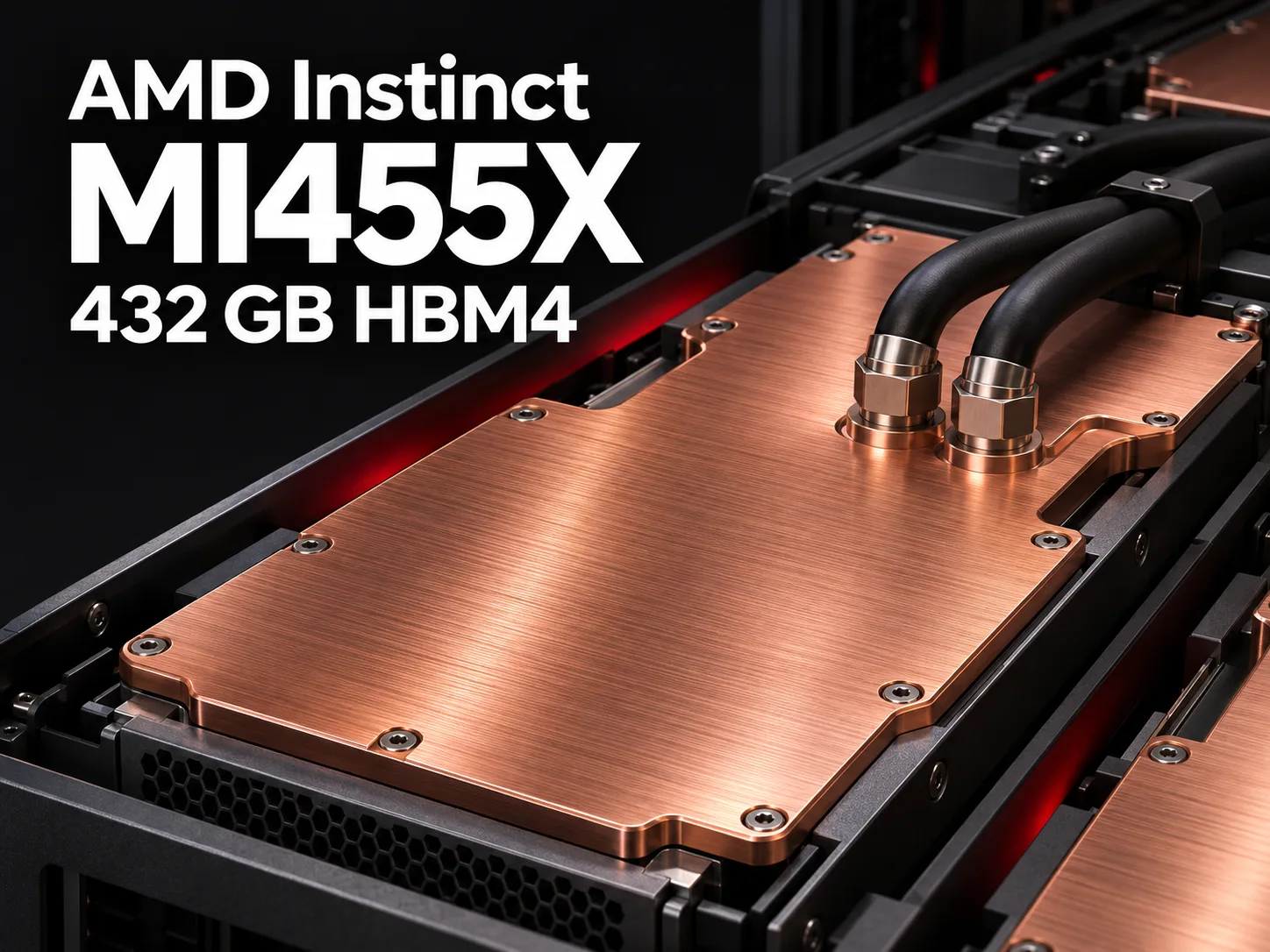
AMD Instinct MI455X: 432 GB of HBM4 and the First DeepSeek-R1 Results
On July 23, 2026, AMD introduced the Instinct MI455X as part of Helios, a server rack for training and running neural networks. The MI455X is a module with direct liquid cooling. Each accelerator has 432 GB of HBM4 memory, while the full rack with 72 GPUs provides a total capacity of approximately 31 TB.
In November, AMD reported that the Helios system achieved 21,333 tokens/s on DeepSeek-R1, calculated per MI455X. On November 12, the company compared this figure with NVIDIA Vera Rubin's result and claimed an advantage of up to 30%. Four days later, Nebius published a new Vera Rubin result on the same model-more than 22,000 tokens/s per GPU on average.
How the MI455X Differs from the MI450X
Both accelerators for Helios are based on the CDNA 5 architecture. AMD specifies the same peak memory bandwidth for both: 23.3 TB/s. Their peak compute figures also match, including 40.3 PFLOPS in the MXFP4 format. The main difference between the models is how much data fits in each GPU's local memory.
| Accelerator | HBM4 memory per GPU | Number of HBM4 stacks |
|---|---|---|
| AMD Instinct MI455X | 432 GB | 12 |
| AMD Instinct MI450X | 288 GB | 8 |
The additional 144 GB is especially useful when the model's weights are just slightly too large for the memory of a single accelerator. If the entire copy can fit on an MI455X, the server can process requests without exchanging intermediate results between GPUs. Another way to use the extra memory is to allocate more space for the cache used by long conversations.
Does DeepSeek-R1 Fit in 432 GB?
The main DeepSeek-R1 model contains approximately 671 billion parameters without the additional token-prediction module. When generating a single token, the model uses about 37 billion parameters, but it may select different experts for the next token. Loading the entire model requires the weights of all experts.
- With ideal packing at four bits per parameter, the weights occupy approximately 335.5 GB (312.5 GiB). This is the theoretical minimum without metadata.
- In MXFP4, each group of 32 values has a shared scale byte. Storing all parameters in this format increases the calculated size to 356.5 GB (332 GiB).
- For a single request with a context of 131,072 tokens, DeepSeek-R1's compact MLA cache in BF16 requires an additional approximately 9.2 GB. This estimate is based on the model configuration and does not account for working buffers or program overhead.
According to these calculations, the four-bit weights fit in the nominal memory of a single MI455X and exceed the capacity of a single MI450X. How many long requests an MI455X can serve simultaneously depends on the actual format of the weights and cache. AMD has not disclosed enough details about its configuration to connect the result of 21,333 tokens/s with placing the model on a single GPU.
DeepSeek-R1 on the MI455X, MI355X, and NVIDIA Vera Rubin
In the MLPerf Inference Offline scenario, the system receives all requests at once. The test measures the aggregate generation rate across all requests. In the last column, public MLPerf results show the system rate divided by the number of accelerators. For the MI455X, the per-GPU figure was reported by AMD itself.
| System | Offline result source | Number of GPUs | Tokens/s per system | Tokens/s per GPU |
|---|---|---|---|---|
| AMD Helios, Instinct MI455X | AMD lab, November | Not specified | - | 21,333 |
| NVIDIA Vera Rubin NVL72 | MLPerf v6.1, September, Preview | 72 | 1,183,327 | 16,435 |
| Nebius, NVIDIA Vera Rubin NVL72 | MLPerf v6.1, November, Available | 72 | 1,586,667 | 22,037 |
| Crusoe, AMD Instinct MI355X | MLPerf v6.1, September | 512 | 2,901,950 | 5,668 |
For its comparison, AMD used the September Vera Rubin result. Relative to that result, the MI455X figure is indeed approximately 30% higher. In Nebius's November publication, the average per Rubin was already 3.3% higher than AMD's figure. Both differences apply to specific systems. The MI455X result came from an internal test that was not validated by MLCommons. AMD did not specify the number of accelerators or the computational precision.
For an interactive service, another question remains: how many requests the system can handle under a response-time limit. In the Server scenario, Nebius's November rack achieved 1,752,403 tokens/s. For the MI455X, AMD's November announcement included only Offline results, so the response latency of the two systems cannot be compared based on these publications.
What Tasks Is the MI455X For?
The clearest use case for the MI455X is a model that is too large to fit comfortably in 288 GB per GPU. The additional memory may reduce the number of accelerators needed for one model copy or allow the server to handle more long conversations simultaneously. If the same workload fits on the MI450X, the larger model has no stated advantage in HBM4 bandwidth. In that case, the choice depends on the measured speed and the cost of the complete configuration for the required context length and acceptable time to first token.
GPU Comparison
Compare Instinct MI455X with other GPUs
Basic
Memory Specifications
Display and Media
Theoretical Performance
AI Features
Interconnect and Scalability
Miscellaneous
Benchmarks
Compared to Other GPU
Share in social media
Or Link To Us
<a href="https://cputronic.com/gpu/amd-instinct-mi455x" target="_blank">AMD Instinct MI455X</a>