Unisoc T606

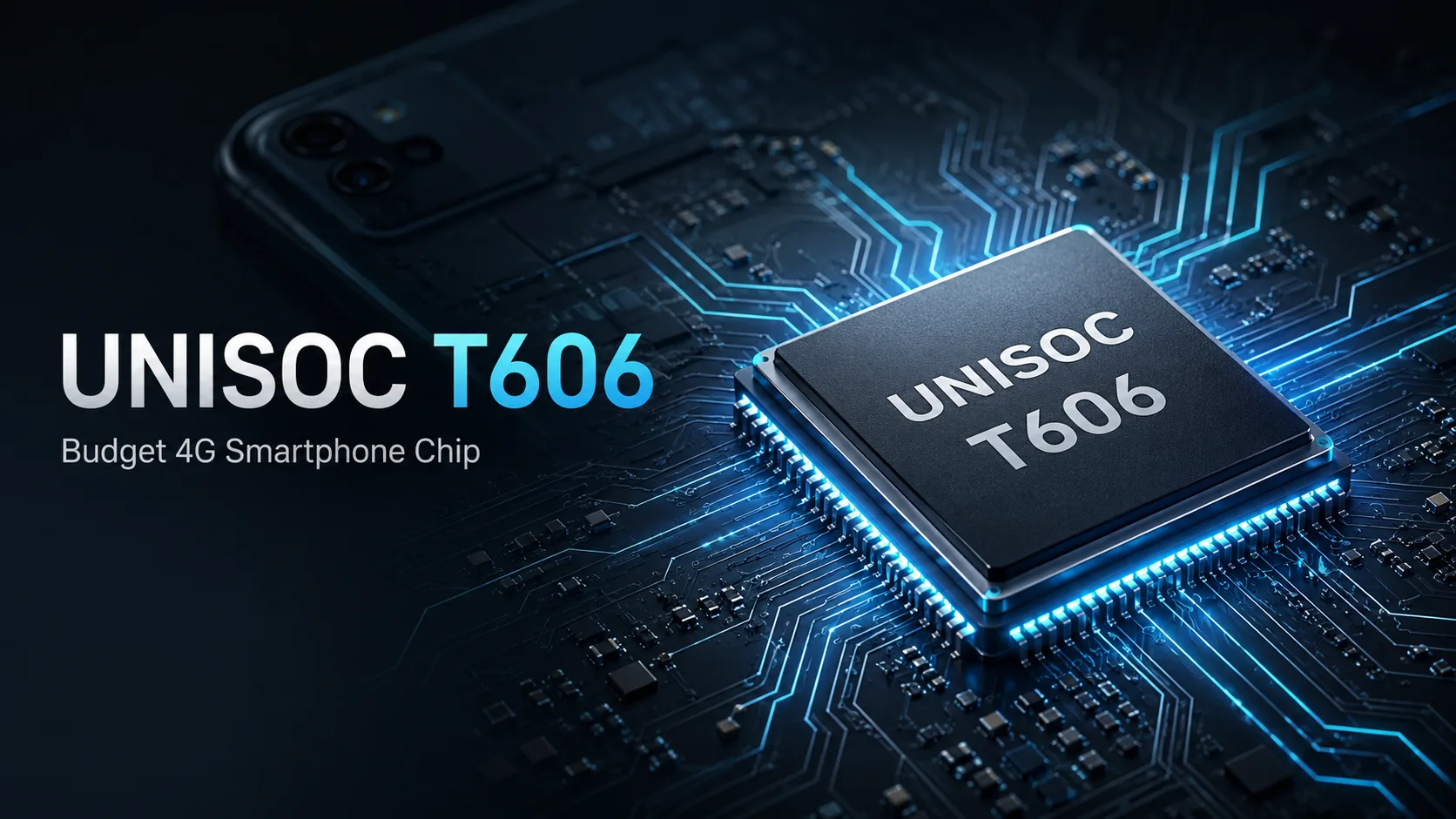
Unisoc T606: Overview of a Budget Processor for Low-Cost Smartphones
Unisoc T606 is the baseline for a cheap 4G smartphone. It is faster than older platforms with Cortex-A53, but in a real device, performance quickly gets limited by weak graphics, RAM capacity, storage, and heavy user interfaces.
The purpose of the T606 isn't high speed, but the ability to run basic applications without constant delays: messaging apps, browsers, YouTube, maps, banking applications, and simple games.
In brief: The T606 is only suitable for very inexpensive phones, ideally with 4-6 GB of RAM and not the slowest storage.
Why the T606 is Still in Use
The T606 remains on the market not due to speed. Manufacturers need an inexpensive 4G chip that can still handle modern Android at a basic level.
It features two Cortex-A75 cores, Mali-G57 MP1 graphics, LPDDR4X support, and the ability to use UFS storage. For the ultra-budget segment, this is sufficient to prevent the smartphone from falling to the level of older platforms with Cortex-A53.
As a result, the T606 can be found in budget models from Motorola, Nokia, Samsung, Tecno, Infinix, and other brands. This chip is designed for devices where price, battery life, and simple use cases are prioritized.
CPU: Better than Old Ultra-Budget, but No Headroom
The CPU includes 2 Cortex-A75 cores and 6 Cortex-A55 cores with clock speeds up to 1.6 GHz.
The two Cortex-A75 cores are the main advantage of the T606 when compared to the old ultra-budget. Compared to chips with Cortex-A53, this provides quicker application launches and fewer interface delays.
The limitations are clear: a clock speed of up to 1.6 GHz and an old 12nm manufacturing process. In heavy content feeds, browsers with many tabs, and frequent app switching, delays and background task reloads appear.
The T606 isn't designed for prolonged heavy loads and doesn't make the smartphone feel fast. It keeps the device above the level of older ultra-budget platforms but doesn't provide room for several years of use.
Graphics: The Main Limiting Factor
Mali-G57 appears more modern than older budget GPUs, but the T606 uses an MP1 configuration. This is the minimal variant with a single graphics core. Therefore, the main limitation of the T606 is the graphics, not the CPU.
For interfacing, video, simple arcade games, and less demanding games, this is sufficient. However, heavy 3D games quickly hit the wall of low GPU performance.
PUBG Mobile, World of Tanks Blitz, and similar games are only playable on low settings. In Genshin Impact and other demanding 3D projects, you will face not only FPS drops but also long load times, freezes, and heating.
For gaming, it's better to look at Helio G85/G88, Snapdragon 680, or newer 6nm platforms.
Memory and Storage Are More Important than the Chip Name
Smartphones with the T606 can differ significantly in speed. The variation is usually in RAM capacity, storage type, and UI.
The acceptable minimum is:
- 4 GB RAM - the lower boundary;
- 6 GB RAM - noticeably better;
- UFS storage - a significant advantage;
- 2-3 GB RAM and eMMC - only for the cheapest models.
"Virtual RAM" does not solve the problem. It doesn't replace real RAM and doesn't make the processor faster. On slow eMMC, such a feature hardly helps.
The best option for the T606 is a smartphone with 4-6 GB of RAM, UFS storage, and a lightweight UI. The worst is 2-3 GB of RAM, eMMC, and an overloaded system.
Camera, Video, and Connectivity
In terms of camera and video, the T606 remains a basic chip. It's not a platform for camera phones.
Typical offerings:
- Video up to 1080p;
- No 4K support;
- Simple photo processing;
- Weak night photography in most models;
- Regular 4G LTE without 5G.
For daytime budget photos, this is sufficient. A fast camera, good night photography, and advanced photo processing are not typical of the T606.
Benchmarks and Real Experiences
In tests, the Unisoc T606 falls to the lower end of the budget segment.
Approximate results:
| Test | Unisoc T606 |
|---|---|
| Geekbench 6 Single-Core | about 370-400 |
| Geekbench 6 Multi-Core | about 1300-1400 |
| AnTuTu | about 300-340K |
This is the level of a smartphone for calls, browsing, video, and basic apps. The CPU still handles basic tasks, but the graphics and overall performance headroom are limited.
A T606 with 6 GB of RAM and fast storage remains an acceptable budget device. A T606 with 3 GB of RAM and eMMC will experience more frequent slowdowns when launching apps and switching tasks, even though the SoC is the same.
What to Compare With
The Unisoc T606 is noticeably better than older ultra-budget platforms like the Unisoc SC9863A and weaker solutions with only Cortex-A53 cores. In such comparisons, it opens apps faster and operates more stably in the Android interface.
However, it already falls short against stronger budget chips.
Helio G80/G85/G88 are usually faster in games.
Snapdragon 680 is better in energy efficiency due to the 6nm process.
Newer 6nm budget chips are preferable if the prices are close.
The T606 should not be chosen as a powerful chip. It is justified if the smartphone is cheap and does not skimp on RAM, storage, and display.
Should You Get a Smartphone with Unisoc T606?
A smartphone with the Unisoc T606 makes sense for calls, messaging, browsing, YouTube, maps, and simple applications. The optimal configuration is 4-6 GB of RAM and fast storage.
For gaming, active multitasking, camera use, and longevity over 3-4 years, the T606 is too weak. Versions with 2-3 GB of RAM are best avoided if, for similar prices, there are Helio G85/G88, Snapdragon 680, or newer 6nm chips available.
Conclusion
The Unisoc T606 represents the baseline for a cheap 4G smartphone. It performs better than older platforms with Cortex-A53 but quickly hits limits due to the Mali-G57 MP1, the 12nm manufacturing process, and the phone's configuration.
It makes sense to consider it only in a budget model with 4-6 GB of RAM and ideally a UFS storage. The worst option would be 2-3 GB of RAM and eMMC, where delays will already be noticeable in basic tasks.
SOC Comparison
Compare T606 with other SOCs
Basic
GPU Specifications
Connectivity
Memory Specifications
Miscellaneous
Benchmarks
Phones with T606




Tablets with T606

Comparison of Devices with T606
Compared to Other SoC
Related SoC Comparisons


Share in social media
Or Link To Us
<a href="https://cputronic.com/en/soc/unisoc-t606" target="_blank">Unisoc T606</a>