Qualcomm Snapdragon 7s Gen 2

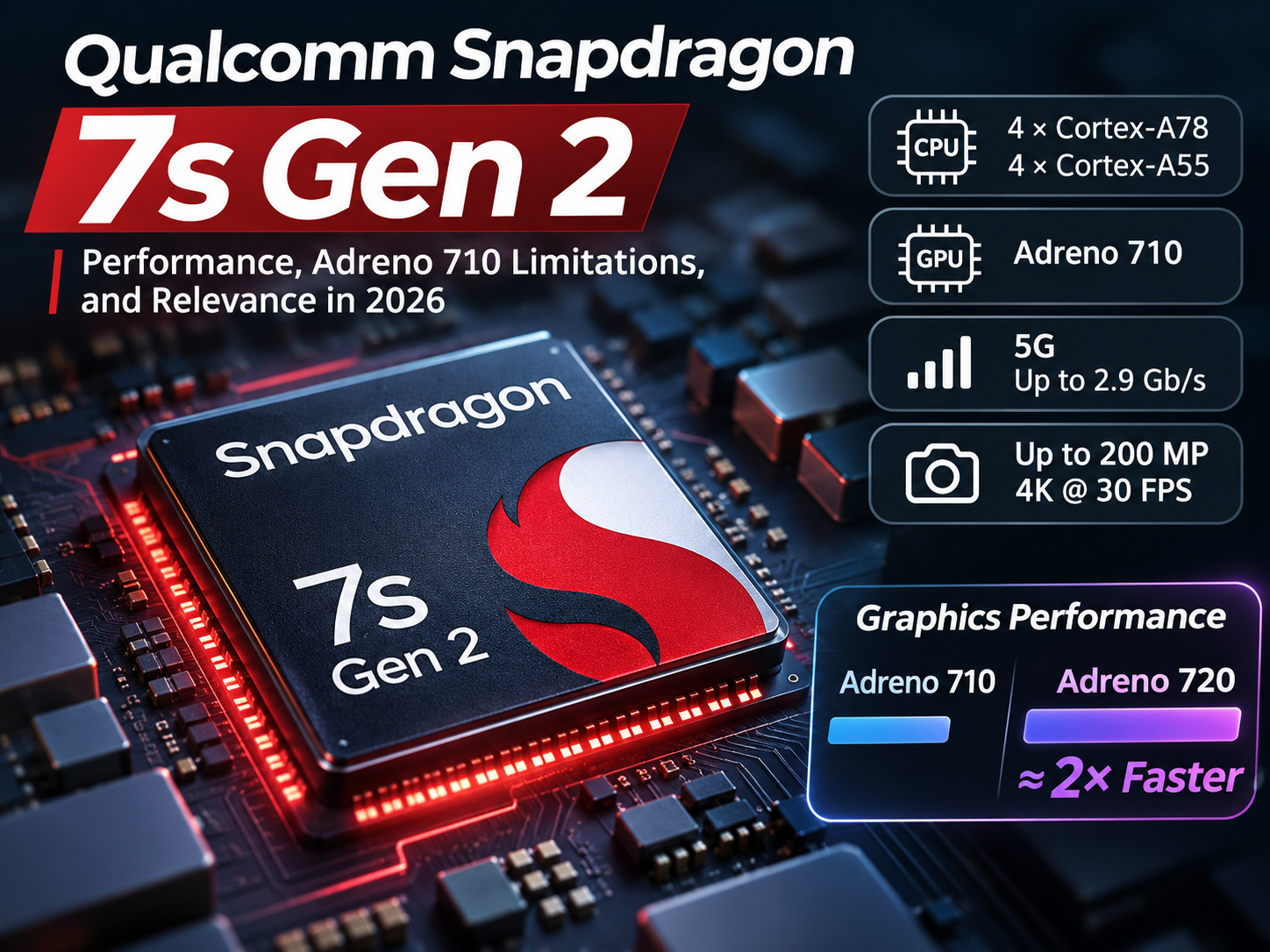
Qualcomm Snapdragon 7s Gen 2: Performance, Adreno 710 Limitations, and Relevance in 2026
Qualcomm Snapdragon 7s Gen 2 is a mid-range mobile processor introduced in September 2023. It is used in the Redmi Note 13 Pro 5G, POCO X6, Realme 12 Pro+, the European version of the Motorola Edge 50 Fusion, as well as the Redmi Pad Pro and POCO Pad tablets.
Despite belonging to the Snapdragon 7 series, the chip is architecturally close to the Snapdragon 6 Gen 1: both platforms use Cortex-A78 and Cortex-A55 CPU cores, along with the Adreno 710 GPU.
Architecture and Differences from Snapdragon 7 Gen 3
Snapdragon 7s Gen 2 (SM7435-AB) is manufactured by Samsung using a 4 nm process. The processor combines four performance cores and four efficiency cores.
| Specification | Snapdragon 7s Gen 2 | Snapdragon 7 Gen 3 |
|---|---|---|
| Announcement | September 2023 | November 2023 |
| Foundry | Samsung | TSMC |
| Performance cores | 4 × Cortex-A78, 2.4 GHz | 1 × Cortex-A715, 2.63 GHz + 3 × Cortex-A715, 2.4 GHz |
| Efficiency cores | 4 × Cortex-A55, 1.95 GHz | 4 × Cortex-A510, 1.8 GHz |
| GPU | Adreno 710 | Adreno 720 |
| Modem | Snapdragon X62 | Snapdragon X63 |
| 5G download speed | Up to 2.9 Gb/s | Up to 5 Gb/s |
Both platforms have eight CPU cores and are manufactured using process technologies in the 4 nm class. However, the Snapdragon 7 Gen 3 uses newer CPU cores and a significantly more powerful GPU.
Snapdragon 7s Gen 2 supports LPDDR4X and LPDDR5 memory, as well as UFS 2.2 and UFS 3.1 storage. The platform’s capabilities are not implemented in every device: for example, the Redmi Note 13 Pro 5G is equipped with LPDDR4X memory and UFS 2.2 storage.
Benchmark Performance
Test results for smartphones and tablets based on different mobile platforms:
| Device | Processor | Geekbench 6 Single | Geekbench 6 Multi | AnTuTu 10 |
|---|---|---|---|---|
| Honor Magic6 Lite | Snapdragon 6 Gen 1 | 940 | 2 776 | 504 020 |
| Redmi Note 13 Pro 5G | Snapdragon 7s Gen 2 | 1 029 | 2 955 | 566 071 |
| Motorola Edge 50 Fusion (EU) | Snapdragon 7s Gen 2 | 998 | 2 813 | 571 043 |
| Redmi Pad Pro 5G | Snapdragon 7s Gen 2 | 1 007 | 2 616 | 612 145 |
| Realme 12 Pro+ | Snapdragon 7s Gen 2 | 922 | 2 793 | 665 728 |
| Motorola Edge 50 Pro | Snapdragon 7 Gen 3 | 1 147 | 3 129 | 767 395 |
| POCO X6 Pro | Dimensity 8300-Ultra | 1 424 | 4 547 | 1 465 265 |
In some regions, the Motorola Edge 50 Fusion is equipped with the Snapdragon 6 Gen 1. The table shows results for the European version with the Snapdragon 7s Gen 2.
The four Snapdragon 7s Gen 2 devices score between 566,000 and 666,000 points in AnTuTu 10. The spread is approximately 18%. Unlike the Geekbench CPU tests, AnTuTu evaluates overall system performance, including the GPU, memory, and storage.
Compared with the Honor Magic6 Lite, the Snapdragon 7s Gen 2 devices range from 2% slower to 9.5% faster in the single-core test, and from 6% slower to 6.4% faster in the multi-core test. A higher maximum CPU clock speed does not guarantee an advantage in every device.
The Motorola Edge 50 Pro with the Snapdragon 7 Gen 3 is approximately 15% ahead of the Edge 50 Fusion in the Geekbench 6 single-core test, 11% ahead in the multi-core test, and 34% ahead in AnTuTu 10.
The POCO X6 Pro’s AnTuTu 10 result with the Dimensity 8300-Ultra is approximately 2.6 times higher than that of the Redmi Note 13 Pro 5G. Its advantage in the Geekbench 6 multi-core test is approximately 54%.
Graphics and Gaming Performance
The Adreno 710 supports Vulkan 1.3, OpenGL ES 3.2, and OpenCL 2.0 FP.
Reference graphics benchmark results:
| Graphics test | Adreno 710 | Adreno 720 |
|---|---|---|
| 3DMark Wild Life Extreme | 792 | 1 596 |
| 3DMark Steel Nomad Light | 254 | 490 |
| Geekbench 6 GPU Vulkan | 2 116 | 3 980 |
Depending on the test, the Adreno 720’s advantage ranges from 88% to 102%. These figures were not obtained by directly testing two smartphones under identical conditions.
Gaming test results for the Motorola Edge 50 Fusion and Edge 50 Pro, conducted in 2024:
| Game and settings | Edge 50 Fusion, average FPS | Edge 50 Pro, average FPS |
|---|---|---|
| Genshin Impact, Lowest | 43.8 | 59.4 |
| Genshin Impact, Highest | 44.0 | 51.6 |
| PUBG Mobile, Smooth | 59.6 | 59.0 |
| PUBG Mobile, HD | 59.6 | 59.7 |
In Genshin Impact, the Snapdragon 7 Gen 3 model delivers a higher frame rate at both the lowest and highest graphics settings.
The Edge 50 Fusion’s maximum frame rate was 45-46 FPS, indicating a likely FPS limit. Lowering the graphics quality in this test did not increase the average frame rate, while in some scenes it fell to 23-25 FPS.
In PUBG Mobile, both smartphones maintained around 60 FPS. The advantage of the more powerful GPU depends on the game’s requirements and the available frame-rate modes.
Subsequent game and firmware updates may have changed these results.
Heat and Performance Stability
Under sustained load, the Motorola Edge 50 Fusion’s maximum surface temperature reached 45.9 °C at an ambient temperature of 19 °C.
Graphics performance stability in stress tests:
- 3DMark Wild Life Stress Test: 99.6%.
- 3DMark Wild Life Extreme Stress Test: 99.3%.
The difference between the maximum and minimum results in both tests was less than 1%. At the same time, the device’s surface temperature may cause discomfort during extended gaming.
These measurements describe a specific smartphone and its cooling system.
Cameras, Multimedia, and Connectivity
The integrated 12-bit Qualcomm Spectra image signal processor supports cameras with resolutions of up to 200 MP and video recording in 4K at 30 FPS.
The Snapdragon X62 modem supports 5G, while the FastConnect 6700 controller provides support for Wi-Fi 6E and Bluetooth 5.2.
Wireless connectivity capabilities depend on how the platform is implemented. For example, the Motorola Edge 50 Fusion and Moto G67 Power 5G are limited to Wi-Fi 5.
Comparison with Snapdragon 7s Gen 3 and Gen 4
In August 2024, Qualcomm introduced the Snapdragon 7s Gen 3, and in August 2025, the Snapdragon 7s Gen 4 was released. Both platforms use newer Cortex-A720 and Cortex-A520 cores, as well as the Adreno 810 GPU.
Snapdragon 7s Gen 2 continued to be used after its successors were released. One such device was the Motorola Moto G67 Power 5G, introduced in 2025.
Average AnTuTu 11 results for the devices:
| Device | Processor | AnTuTu 11 |
|---|---|---|
| Motorola Moto G67 Power 5G | Snapdragon 7s Gen 2 | 848 362 |
| Nothing Phone (3a) Pro | Snapdragon 7s Gen 3 | 1 063 102 |
| Redmi Note 15 Pro+ 5G | Snapdragon 7s Gen 4 | 1 024 234 |
The Snapdragon 7s Gen 3 and Gen 4 devices are approximately 25% and 21% ahead of the Moto G67 Power, respectively.
The Nothing Phone (3a) Pro’s higher score does not mean that the Snapdragon 7s Gen 3 is faster than the Gen 4 in every task: the final score depends on the smartphone’s configuration.
AnTuTu 10 and AnTuTu 11 use different test suites and scoring scales, so the results of these versions cannot be compared directly.
Advantages and Disadvantages
Advantages:
- Sufficient performance for everyday applications.
- LPDDR5 and UFS 3.1 support at the platform level.
- 5G and Wi-Fi 6E support.
- 4K video recording at 30 FPS.
Disadvantages:
- Lower performance than later generations of Snapdragon 7s.
- Limited performance in demanding games.
- No support for 4K video recording at 60 FPS.
Relevance and Prices in 2026
Snapdragon 7s Gen 2 is suitable for web browsing, social networks, messaging, navigation, and video playback. If a smartphone handles the required tasks adequately, there is no need to replace it solely because of its processor.
Approximate smartphone prices in different markets in autumn 2026:
| Smartphone | Processor | From |
|---|---|---|
| Redmi Note 13 Pro 5G | Snapdragon 7s Gen 2 | $180 |
| POCO X6 Pro | Dimensity 8300-Ultra | $260 |
| Redmi Note 15 Pro+ 5G | Snapdragon 7s Gen 4 | $310 |
| Nothing Phone (3a) Pro | Snapdragon 7s Gen 3 | $360 |
At around $180, the Redmi Note 13 Pro 5G remains a suitable option for everyday use. The POCO X6 Pro is more appealing in terms of gaming performance, while the Redmi Note 15 Pro+ 5G offers a more modern hardware platform.
Conclusion
In 2026, Qualcomm Snapdragon 7s Gen 2 belongs to the lower end of the mid-range segment. Buying a device based on this platform is justified primarily when the price is low.
At a comparable price, smartphones with the Snapdragon 7s Gen 3 or Gen 4 are preferable. If demanding games are the priority, it is worth considering devices with a more powerful GPU, such as those based on the Dimensity 8300-Ultra.
SOC Comparison
Compare Snapdragon 7s Gen 2 with other SOCs
Basic
4x 1.95 GHz – Cortex-A55
GPU Specifications
Connectivity
Memory Specifications
Miscellaneous
Benchmarks
Phones with Snapdragon 7s Gen 2












Tablets with Snapdragon 7s Gen 2


Comparison of Devices with Snapdragon 7s Gen 2
Compared to Other SoC
Related SoC Comparisons


Share in social media
Or Link To Us
<a href="https://cputronic.com/en/soc/qualcomm-snapdragon-7s-gen-2" target="_blank">Qualcomm Snapdragon 7s Gen 2</a>