MediaTek Dimensity 7400
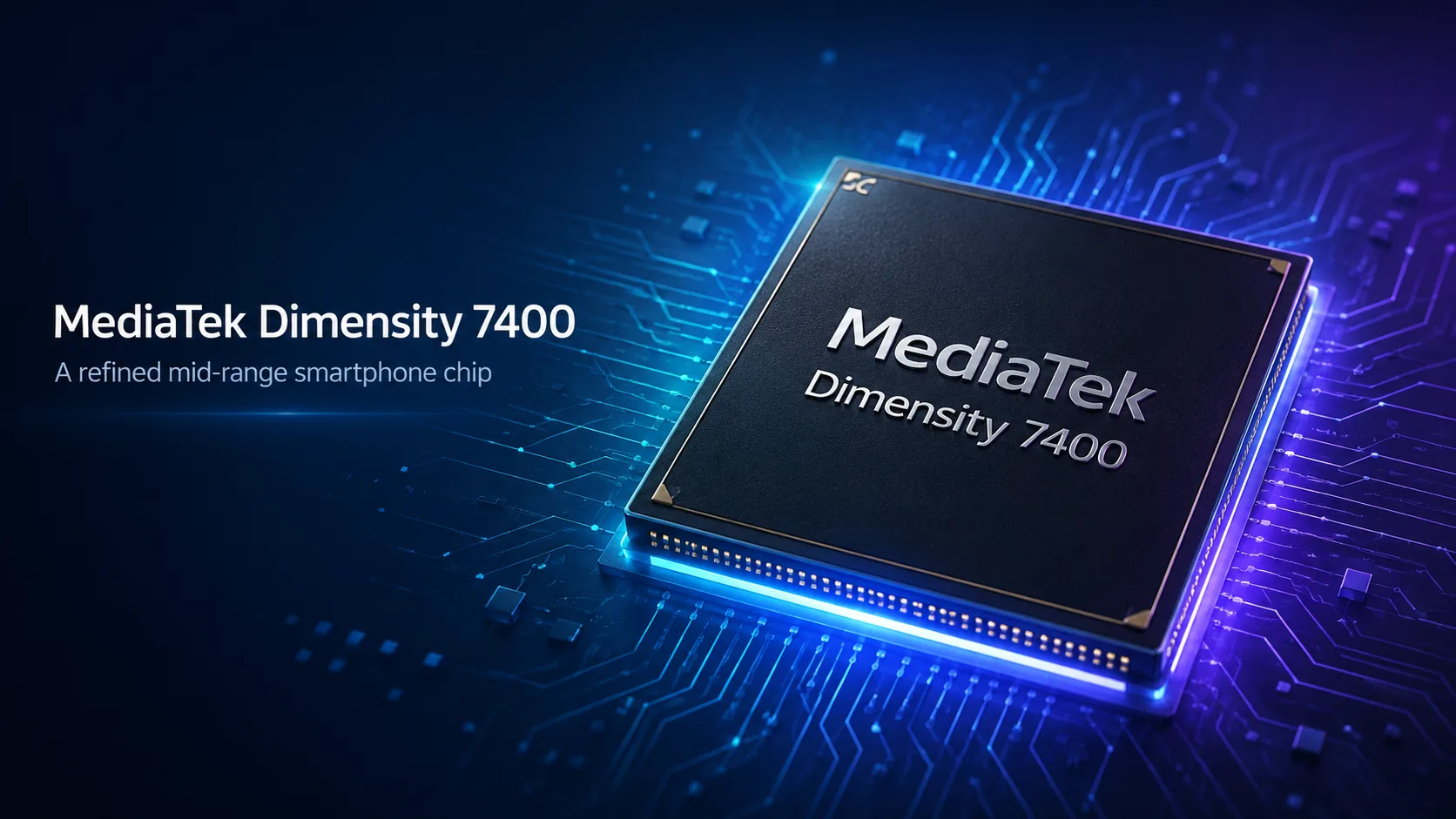
MediaTek Dimensity 7400: extending the life of the successful Dimensity 7300
MediaTek Dimensity 7400 is not a full generational shift, but rather an upgraded version of the Dimensity 7300. The company maintained the previous configuration of the CPU, graphics, neural processing unit, ISP, and modem, limiting itself to minor frequency increases and software improvements. This approach has allowed the well-tuned platform to remain relevant in mid-range smartphones.
What has changed compared to Dimensity 7300
| Characteristic | Dimensity 7400 | Dimensity 7300 |
|---|---|---|
| Performance Cores | 4 × Cortex-A78, up to 2.6 GHz | 4 × Cortex-A78, up to 2.5 GHz |
| Efficiency Cores | 4 × Cortex-A55, up to 2.0 GHz | 4 × Cortex-A55, up to 2.0 GHz |
| Graphics | Mali-G615 MC2 | Mali-G615 MC2 |
| Neural Processing Unit | NPU 655 | NPU 655 |
| Max 5G Speed | 3.27 Gbps | 3.27 Gbps |
| Wi-Fi and Bluetooth | Wi-Fi 6E, Bluetooth 5.4 | Wi-Fi 6E, Bluetooth 5.4 |
| Storage | UFS 2.2 or UFS 3.1 | UFS 3.1 |
The main hardware change is an extra 100 MHz for the four performance cores. All other key blocks remain the same. MediaTek claims an increase in overall performance and acceleration of AI tasks, but this has been achieved without moving to new CPU cores or a different graphics architecture.
Support for UFS 2.2 allows for the release of cheaper devices, but this is not always an advantage for consumers. A smartphone with the Dimensity 7400 and a slower storage might run applications and install updates slower than a model with the Dimensity 7300 and UFS 3.1.
Performance in Real Smartphones
The Dimensity 7400 uses four performance cores Cortex-A78, so it handles multitasking, photo processing, and frequent app switching confidently. The difference between specific devices depends on firmware, RAM, storage, and cooling.
| Smartphone | AnTuTu | Geekbench 6 Single-Core | Geekbench 6 Multi-Core | Burnout |
|---|---|---|---|---|
| Realme Narzo 80 Pro | 711,323 | 1,045 | 2,928 | 60.7% |
| Motorola Edge 60 Fusion | 692,185 | 1,050 | 3,050 | 59.5% |
| iQOO Z10R | 666,321 | 1,038 | 2,988 | 62.3% |
The results were obtained by the 91mobiles editorial team. Burnout shows what portion of the maximum performance the smartphone maintains under prolonged load: the higher the percentage, the weaker the influence of heat and throttling.
In Geekbench 6, all three devices score around 1,040-1,050 points in single-core and approximately 2,930-3,050 points in multi-core mode. The difference is minimal, so the configuration of a specific smartphone does not change the overall performance class of the platform.
In AnTuTu, the spread reaches around 7%. The complex test takes into account not only the CPU and GPU but also the RAM, storage, and software settings. Therefore, its result cannot be considered a characteristic of a single processor.
Under prolonged load, smartphones maintain around 60% of peak performance. This is not an outstanding result, but there are no significant differences between the tested models.
The Main Competitor - Snapdragon 7s Gen 3
The closest competitor to the Dimensity 7400 among Qualcomm platforms is the Snapdragon 7s Gen 3. Both processors are manufactured on a 4nm process and are found in smartphones of comparable value. However, Qualcomm uses more modern CPU cores, while MediaTek continues to rely on Cortex-A78 and Cortex-A55.
For a direct comparison, the Realme Narzo 80 Pro and iQOO Z10 are suitable. Both smartphones were released in the Indian market in spring 2025 in base configurations of 8/128 GB. The Realme was priced at around $235, while the iQOO was priced at about $255, excluding temporary discounts.
| Test | Dimensity 7400 | Snapdragon 7s Gen 3 | Snapdragon Advantage |
|---|---|---|---|
| AnTuTu | 711,323 | 804,936 | 13% |
| Geekbench 6 Single-Core | 1,045 | 1,168 | 12% |
| Geekbench 6 Multi-Core | 2,928 | 3,223 | 10% |
| Burnout | 60.7% | 68.3% | 7.6 p.p. |
The Snapdragon 7s Gen 3 is about 10-13% faster and maintains better performance under prolonged load. The Qualcomm advantage corresponds to the price difference between the smartphones: the iQOO Z10 was about 9% more expensive than the Realme Narzo 80 Pro.
This is not a rout for the Dimensity 7400. The more expensive model with Snapdragon offers proportionally higher performance. However, at the same price, the Snapdragon 7s Gen 3 looks more appealing.
Gaming: Graphics Remains the Main Limitation
The Mali-G615 MC2 has not changed compared to the Dimensity 7300. The software optimizations of HyperEngine and MAGT 3.0 help manage energy consumption and maintain a steadier frame rate, but do not compensate for the limited GPU configuration.
In tests, demanding games like Genshin Impact and BGMI ran on medium settings at around 30 frames per second on the iQOO Z10R. In 90 FPS mode for BGMI, the smartphone delivered about 75 frames, while Call of Duty: Mobile achieved more than 50 FPS.
For online games and less demanding projects, the power is sufficient. However, in heavy games, you will need to lower graphics quality, especially if the manufacturer has cut costs on cooling.
Cameras and Multimedia
The Dimensity 7400 supports cameras up to 200 MP, electronic stabilization, and 4K HDR recording at 30 frames per second. The sensor resolution alone does not determine photo quality: optics, sensor size, and the algorithms of the specific manufacturer matter more.
The platform can work with Full HD+ displays up to 144 Hz. Hardware decoding is claimed for H.264, HEVC, and VP9, but there is no support for AV1 in the official specifications.
Connectivity and Memory
The built-in modem supports 5G Sub-6 GHz with download speeds up to 3.27 Gbps, two 5G SIMs, and VoNR. Wi-Fi 6E and Bluetooth 5.4 are also included.
When choosing a smartphone, it is crucial to check the specifications of the device itself. Support for Wi-Fi 6E and UFS 3.1 at the processor level does not necessarily mean that the manufacturer has installed the corresponding modules. The Dimensity 7400 lacks satellite communication: GPS, Galileo, and BeiDou are solely for navigation.
Conclusion
The Dimensity 7400 demonstrates not the weakness of a new platform, but the success of an older one. MediaTek has retained the architecture of the Dimensity 7300, slightly increased the frequency, and extended its life for another model cycle. For mid-range smartphones, the performance is still adequate, but the comparison with Snapdragon 7s Gen 3 shows that the reservoir of Cortex-A78 and Cortex-A55 cores is almost exhausted.
At the same price, the Snapdragon 7s Gen 3 is preferable: it is approximately 10-13% faster and better at maintaining performance under load. The Dimensity 7400 becomes more reasonable if the smartphone based on it is about 10-15% cheaper.
When comparing models on Dimensity 7300 and Dimensity 7400, it is more important to compare storage, cooling, display, and cameras. The new index itself guarantees almost nothing.
SOC Comparison
Compare Dimensity 7400 with other SOCs
Basic
GPU Specifications
Connectivity
Memory Specifications
Miscellaneous
Benchmarks
Phones with Dimensity 7400










Tablets with Dimensity 7400
Comparison of Devices with Dimensity 7400
Compared to Other SoC
Related SoC Comparisons



Share in social media
Or Link To Us
<a href="https://cputronic.com/en/soc/mediatek-dimensity-7400" target="_blank">MediaTek Dimensity 7400</a>