MediaTek Dimensity 7500
vs
Qualcomm Snapdragon 7 Gen 3

SoC Comparison Result
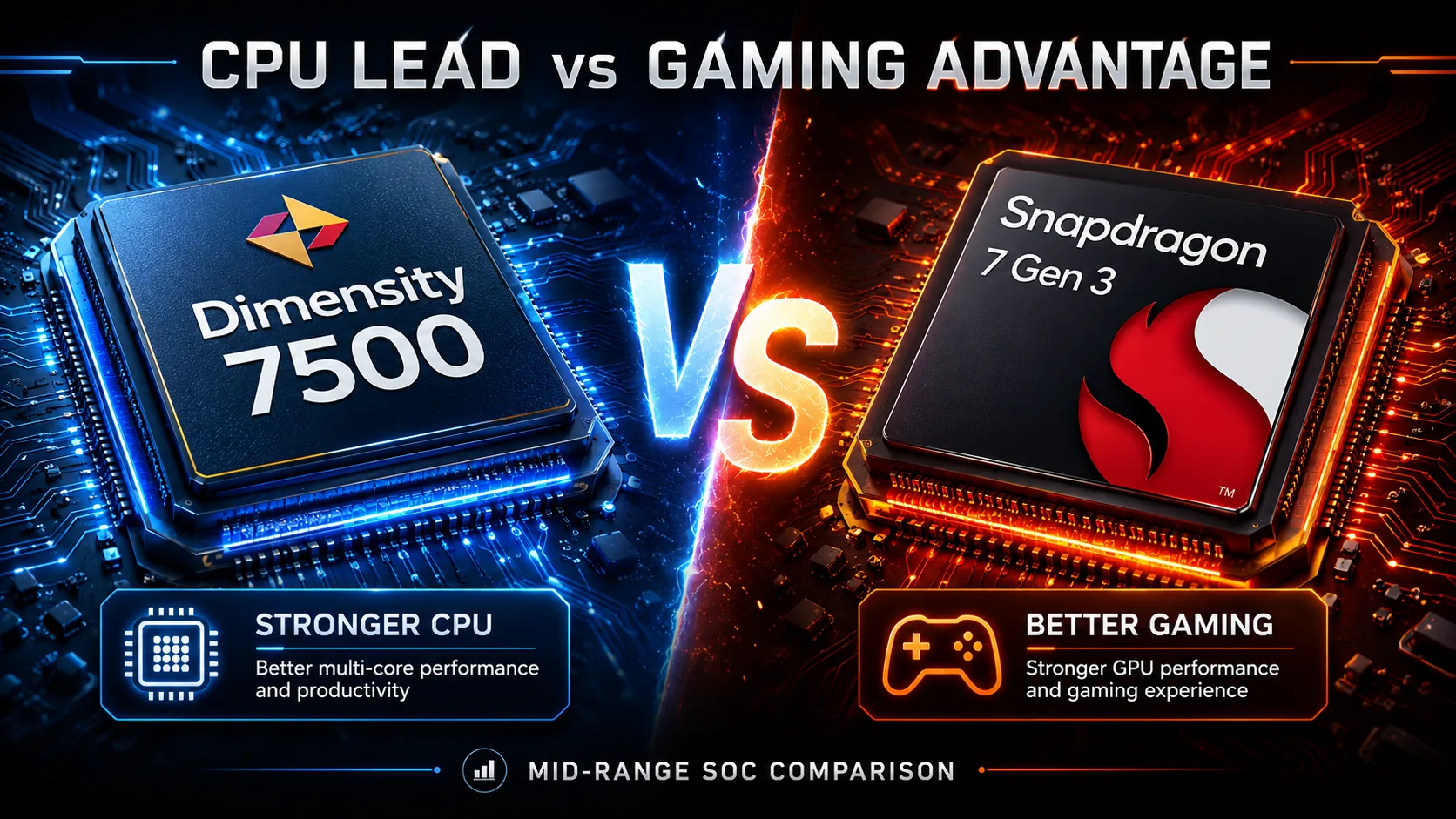
Dimensity 7500 vs Snapdragon 7 Gen 3: MediaTek is Faster in CPU, Qualcomm Excels in Gaming
The Dimensity 7500 is significantly newer than the Snapdragon 7 Gen 3 and is faster in terms of CPU performance. However, the situation is reversed in graphics: the Adreno 720 from Qualcomm is noticeably stronger than the Mali-G625 MC2. Therefore, there is no clear winner here-Dimensity 7500 is more intriguing for CPU-intensive tasks, while the Snapdragon 7 Gen 3 is better suited for gaming.
Benchmarks in Smartphones
Results depend on cooling, firmware, memory, and power settings, so it's better to look at several devices simultaneously.
| Smartphone | Processor | Geekbench 6 Single | Geekbench 6 Multi | AnTuTu 11 | 3DMark Wild Life Extreme |
|---|---|---|---|---|---|
| vivo S60 Vitality Edition | Dimensity 7500 | 1243 | 3569 | - | - |
| iQOO Z11* | Dimensity 7500 Turbo | 1194 | 3271 | 1,107,516 | 1161 |
| Honor 400 | Snapdragon 7 Gen 3 | 1136 | 3107 | 1,087,525 | 1479 |
| Motorola Edge 50 Pro | Snapdragon 7 Gen 3 | 1156 | 3130 | approximately 1,090,000 | 1483 |
| OnePlus Nord CE4 | Snapdragon 7 Gen 3 | 1019 | 2891 | approximately 1,050,000 | 1473 |
*Dimensity 7500 Turbo is a customized version of the base Dimensity 7500 with the same core CPU and GPU specifications. Such versions from MediaTek usually differ in platform settings and specific smartphone optimizations rather than significant overclocking of the chip. Therefore, the iQOO Z11 can be used as an additional reference but not as a direct test of the standard Dimensity 7500.
Currently, there are few independent tests for the standard Dimensity 7500. The Snapdragon 7 Gen 3 has been in use longer, so its results are supported by a broader sample of smartphones.
CPU: Dimensity 7500 is Faster
In practical device results, the Dimensity 7500 scores around 1240 points in Geekbench 6 for single-core and 3570 in multi-core mode. Smartphones with the Snapdragon 7 Gen 3 typically show about 1100-1160 points in Single Core and 2900-3130 in Multi Core.
In optimal implementations, the Snapdragon can score higher, but the overall trend remains: the Dimensity 7500 is faster in CPU tasks, especially in multi-threaded workloads.
The Dimensity 7500 uses newer Arm C1 Pro and C1 Nano cores instead of the Cortex-A715 and Cortex-A510 used by Snapdragon 7 Gen 3. This architectural upgrade has indeed provided a noticeable boost.
The advantage of MediaTek is especially beneficial in heavy multitasking, data processing, and applications that effectively utilize multiple cores.
GPU: Snapdragon Takes the Lead
The situation changes in graphics.
Smartphones with the Snapdragon 7 Gen 3 consistently score around 1470-1480 points in 3DMark Wild Life Extreme. The Honor 400 scores approximately 1479, the Motorola Edge 50 Pro scores 1483, and the OnePlus Nord CE4 scores 1473.
The iQOO Z11 with the Dimensity 7500 Turbo shows around 1160 points.
The difference amounts to about 25-30% in favor of Snapdragon. For mid-range chips, this is already a significant gap.
The Adreno 720 is better suited for demanding mobile games. Under the same settings, the Snapdragon 7 Gen 3 often delivers higher FPS or allows for better graphics quality.
The Dimensity 7500 handles most mobile games well, but its GPU headroom is noticeably lower. In the heaviest projects, settings will need to be reduced sooner.
Platform Capabilities
The platforms are very similar in terms of memory and wireless interfaces.
| Feature | Dimensity 7500 | Snapdragon 7 Gen 3 |
|---|---|---|
| Memory | LPDDR5 | LPDDR5 |
| Storage | UFS 3.1 | UFS 3.1 |
| Wi-Fi | Wi-Fi 6E | Wi-Fi 6E |
| Bluetooth | Bluetooth 5.4 | Bluetooth 5.4 |
| Video Recording | up to 4K 30 FPS | up to 4K 60 FPS |
| 5G, Download | up to 5.2 Gbps | up to 5.0 Gbps |
The most notable advantage of Snapdragon is 4K video recording at 60 FPS. The Dimensity 7500 is limited to 4K30.
MediaTek is slightly ahead in claimed 5G speed-5.2 versus 5.0 Gbps. In practice, the difference is too small to influence the choice of smartphone.
Both platforms support LPDDR5, UFS 3.1, Wi-Fi 6E, and Bluetooth 5.4. A specific smartphone may use slower memory, storage, or not implement some SoC capabilities.
In terms of AI, the Dimensity 7500 appears to be more modern thanks to its newer NPU 850, but direct comparison with the Hexagon NPU of the Snapdragon 7 Gen 3 is still challenging. There are not enough independent tests, and the percentages claimed by manufacturers are calculated using different methodologies.
Smartphone Prices
The age of the Snapdragon 7 Gen 3 works in its favor here. Smartphones based on this chip have already seen significant price drops.
The Honor 400 with Snapdragon 7 Gen 3 in the 8/512 GB version can be found for about €349.
The vivo S60 Vitality Edition with Dimensity 7500 started around €370 for 8/256 GB based on its Chinese price. The iQOO Z11 with Dimensity 7500 Turbo in the 8/256 GB version costs around €400 based on its Indian price.
These are different markets, configurations, and sales conditions, so the numbers cannot be directly compared. However, the trend is revealing: the newer Dimensity 7500 does not guarantee a lower price for now.
If a smartphone with the Snapdragon 7 Gen 3 is priced the same or lower, its advantages in graphics become particularly significant. The Dimensity 7500 is more appealing when CPU performance is more important, or a specific smartphone offers better features for the price.
What to Choose
The Dimensity 7500 should be chosen for its superior CPU performance. The new Arm C1 cores allow it to significantly outperform the Snapdragon 7 Gen 3 in CPU tasks.
For gaming, the Snapdragon 7 Gen 3 is preferable. The Adreno 720 is about 25-30% faster in Wild Life Extreme, and such a gap has practical implications.
In terms of memory, storage, and wireless interfaces, the platforms are almost on par. Snapdragon additionally wins in 4K60 video recording, while Dimensity has a slight edge in maximum 5G speed.
If the prices are close, the choice depends on the task: Dimensity 7500 is for faster CPU, Snapdragon 7 Gen 3 is for stronger graphics. If the Snapdragon smartphone is even cheaper, its position becomes noticeably stronger.
Advantages
- Newer Launch Date: May 2026 (May 2026 vs November 2023)
- Higher Frequency: 2630 MHz (Up to 2.6GHz vs 2630 MHz)
Basic
3x 2.4 GHz – Cortex-A715
4x 1.8 GHz – Cortex-A510
GPU Specifications
Connectivity
Memory Specifications
Miscellaneous
Benchmarks
Related SoC Comparisons




Share in social media
Or Link To Us
<a href="https://cputronic.com/en/soc/compare/mediatek-dimensity-7500-vs-qualcomm-snapdragon-7-gen-3" target="_blank">MediaTek Dimensity 7500 vs Qualcomm Snapdragon 7 Gen 3</a>