MediaTek Dimensity 7500
vs
Qualcomm Snapdragon 7s Gen 3

SoC Comparison Result
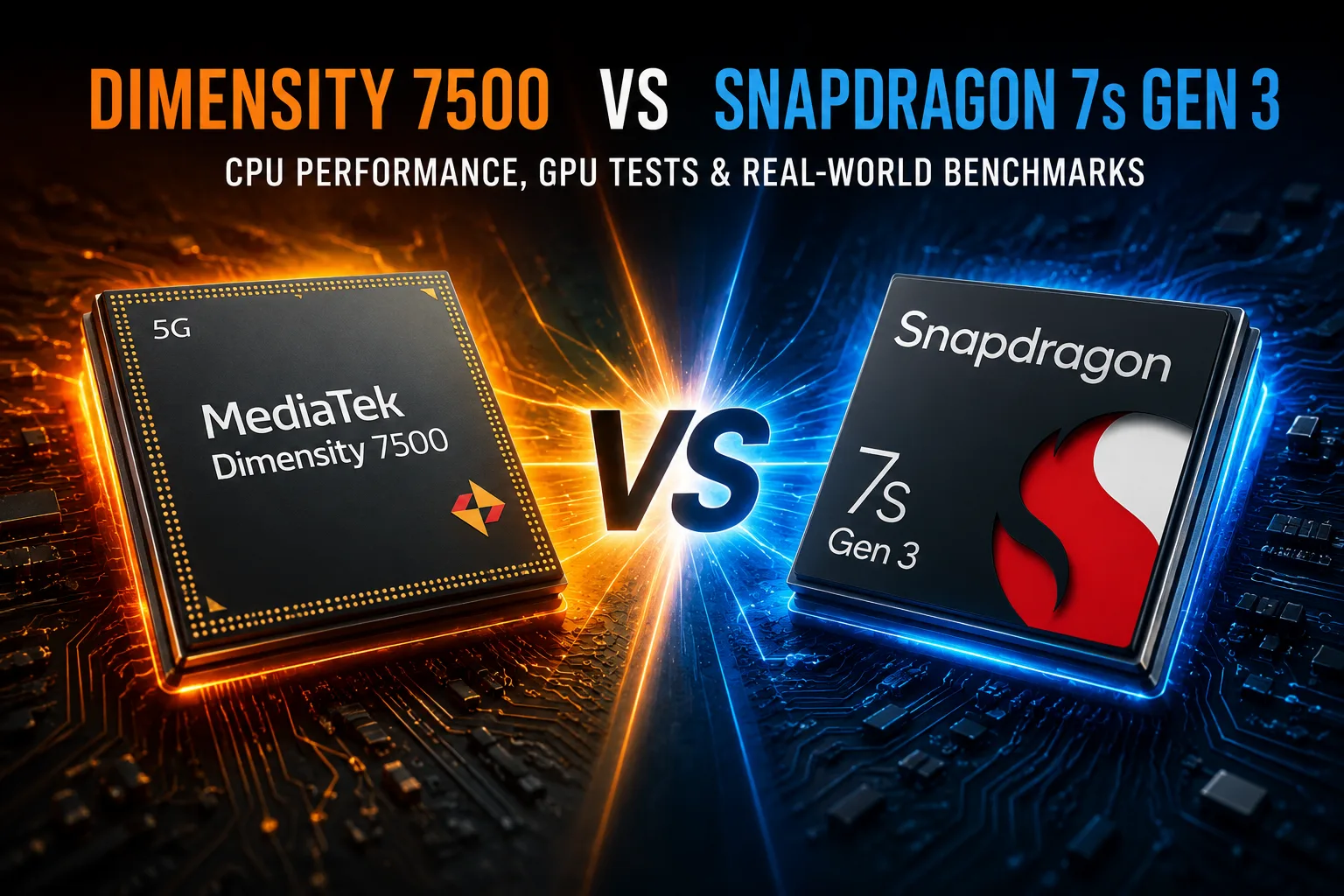
Dimensity 7500 vs Snapdragon 7s Gen 3: MediaTek is faster in CPU, but what about graphics?
The Dimensity 7500 noticeably outperforms the Snapdragon 7s Gen 3 in CPU performance. The vivo S60 Vitality Edition scores 1243/3569 points in Geekbench 6, compared to approximately 1100-1180/3000-3350 for smartphones powered by Snapdragon. In terms of GPU, such a clear advantage is not present, but early tests of the Dimensity 7500 Turbo suggest that the Mali-G625 MC2 could be faster than the Adreno 810 in 3DMark.
The advantage of MediaTek begins with the CPU configuration. The Dimensity 7500 uses four Arm C1 Pro cores clocked at up to 2.6 GHz and four C1 Nano cores up to 2.0 GHz. The Snapdragon 7s Gen 3, on the other hand, has four Cortex-A720 cores, with one running at 2.5 GHz and three at 2.4 GHz, along with four Cortex-A520 cores up to 1.8 GHz. Both platforms are manufactured using a 4nm process.
Key Differences
| Specification | MediaTek Dimensity 7500 | Qualcomm Snapdragon 7s Gen 3 |
|---|---|---|
| CPU | 4 x Arm C1 Pro + 4 x Arm C1 Nano | 4 x Cortex-A720 + 4 x Cortex-A520 |
| Max Frequency | 2.6 GHz | 2.5 GHz |
| GPU | Mali-G625 MC2 | Adreno 810 |
| Process Technology | 4nm | 4nm |
| Max 5G Speed | Up to 5.2 Gbps | Up to 2.9 Gbps |
For other capabilities, the platforms are comparable. Both support LPDDR5, UFS 3.1, Wi-Fi 6E, Bluetooth 5.4, cameras up to 200 MP, and 4K video recording.
MediaTek claims a higher 5G speed of up to 5.2 Gbps compared to 2.9 Gbps. In practice, this difference is seldom noticeable, as the actual mobile internet speed usually runs into network limitations before reaching the modem's capabilities.
Benchmarks in Smartphones
The standard Dimensity 7500 has few published results so far, so to assess GPU performance, the iQOO Z11 with the Dimensity 7500 Turbo is included. This is a sibling version of the chip with the same graphics, but its results cannot be directly attributed to the standard Dimensity 7500.
| Smartphone | Processor | Geekbench 6 Single | Geekbench 6 Multi | AnTuTu 11 | 3DMark Steel Nomad Light |
|---|---|---|---|---|---|
| vivo S60 Vitality Edition | Dimensity 7500 | 1243 | 3569 | - | - |
| iQOO Z11 (India)* | Dimensity 7500 Turbo | 1089 | 3276 | 1 099 769 | 464 |
| Nothing Phone (3a) Pro | Snapdragon 7s Gen 3 | 1182 | 3357 | 1 063 109 | 380 |
| Realme 14 Pro Plus 5G | Snapdragon 7s Gen 3 | 1107 | 2986 | 1 107 631 | 370 |
| Redmi Note 14 Pro Plus 5G | Snapdragon 7s Gen 3 | 1174 | 3157 | 1 001 783 | 362 |
- The Dimensity 7500 Turbo serves as an additional reference for graphical performance.
Even three smartphones on the Snapdragon 7s Gen 3 yield noticeably different results. The reason lies in cooling, memory, firmware, and power limitations of specific devices.
CPU: Dimensity 7500 Takes the Lead
The four C1 Pro cores in the Dimensity 7500 operate at frequencies up to 2.6 GHz. In the Snapdragon CPU, one Cortex-A720 reaches 2.5 GHz, while the other three run at 2.4 GHz. The energy-efficient cores of MediaTek also operate at a higher frequency - 2.0 GHz compared to 1.8 GHz.
This is reflected in the results of the vivo S60 Vitality Edition. Its score of 1243 in Geekbench 6 Single-Core exceeds the performance of selected smartphones with the Snapdragon 7s Gen 3 by approximately 5-12%. In Multi-Core, the difference is around 6-20%.
However, one should not expect a consistent 10-15% lead from each smartphone. The difference is harder to notice in the interface and regular applications, while MediaTek's advantage becomes more pronounced under prolonged multi-threaded loads.
GPU: Adreno 810 Does Not Provide Qualcomm an Advantage
The Snapdragon 7s Gen 3 features the Adreno 810, but existing tests do not indicate an advantage for Qualcomm.
The iQOO Z11 with the Dimensity 7500 Turbo scores 464 points in 3DMark Steel Nomad Light. The Nothing Phone (3a) Pro scores 380, Realme 14 Pro Plus scores 370, and the Redmi Note 14 Pro Plus 5G scores 362. In this sample, the iQOO Z11 outperforms Snapdragon devices by 22-28%.
In Wild Life Extreme, the gap is narrower. The iQOO Z11 shows about 1159 points, while the Nothing Phone (3a) and Phone (3a) Pro score around 1040-1060, which indicates a roughly 10% advantage.
For GPU metrics, results from the Dimensity 7500 Turbo are more readily available, so the conclusions remain preliminary. However, there are no grounds to assume that the Adreno 810 is inherently faster.
Both GPUs remain mid-range solutions rather than replacements for flagship graphics.
AnTuTu: Approximately One Million Points for Both
In AnTuTu 11, the difference virtually disappears. The iQOO Z11 with the Dimensity 7500 Turbo scores around 1.10 million points. The Realme 14 Pro Plus with the Snapdragon 7s Gen 3 shows roughly the same, the Nothing Phone (3a) Pro scores about 1.06 million, while the Redmi Note 14 Pro Plus scores approximately 1.00 million.
Identical scores of 1.1 million in AnTuTu do not imply identical CPU and GPU performance. The final outcome also depends on memory, storage, and system settings.
Energy Efficiency
From the specifications of the SoC alone, it is not possible to predict which smartphone will last longer. Both platforms are manufactured using a 4nm process, and power consumption depends not just on CPU architecture, but also on the screen, modem, frequencies, and manufacturer settings.
The Dimensity 7500 features a more recent CPU architecture, but that is insufficient to declare it more energy-efficient beforehand. Direct tests of energy consumption and battery life are needed for proper conclusions.
Both processors also have separate NPUs and support local AI functions. Comparisons of claimed performance boosts from manufacturers cannot be made directly due to differing methodologies, making the specific feature set of the smartphone more important.
What to Choose
If both options are priced the same, I would choose a smartphone with the Dimensity 7500. It is faster in CPU performance, and initial graphical tests do not show an advantage for the Snapdragon 7s Gen 3. The higher claimed 5G speed is an additional benefit for MediaTek, although it rarely makes a decisive difference in real networks.
The Snapdragon 7s Gen 3 has another argument - a much broader selection of available smartphones. The platform is used in the Nothing Phone (3a), Nothing Phone (3a) Pro, Realme 14 Pro Plus, Vivo T4, iQOO Z10, Redmi Note 14 Pro Plus 5G, and other models.
There is no reason to overpay for the Snapdragon 7s Gen 3 just for the Qualcomm name. If the Snapdragon model is cheaper or significantly better in terms of display, cameras, and battery, it's wiser to choose a smartphone based on its overall features rather than the processor alone.
Advantages
- Newer Launch Date: May 2026 (May 2026 vs August 2024)
- Higher Frequency: 2500 MHz (Up to 2.6GHz vs 2500 MHz)
Basic
3x 2.4 GHz – Kryo Gold
4x 1.8 GHz – Kryo Silver
GPU Specifications
Connectivity
Memory Specifications
Miscellaneous
Benchmarks
Related SoC Comparisons


Share in social media
Or Link To Us
<a href="https://cputronic.com/en/soc/compare/mediatek-dimensity-7500-vs-qualcomm-snapdragon-7s-gen-3" target="_blank">MediaTek Dimensity 7500 vs Qualcomm Snapdragon 7s Gen 3</a>