Intel Arc Pro B70
vs
AMD Radeon AI PRO R9700
GPU Comparison Result
Intel Arc Pro B70 vs AMD Radeon AI PRO R9700: 32 GB of Memory at Different Prices
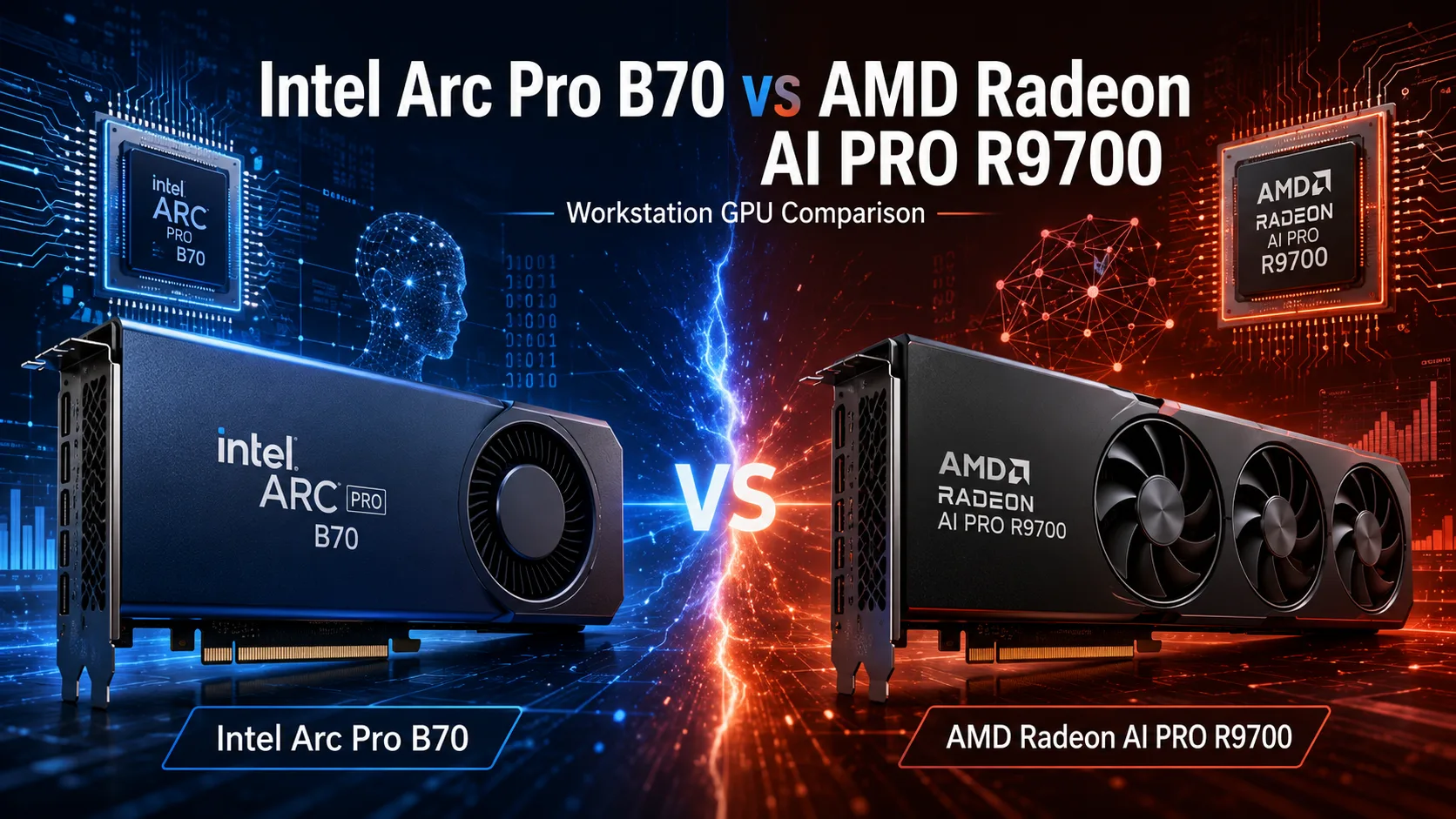
The Intel Arc Pro B70 and AMD Radeon AI PRO R9700 are designed for similar tasks: local neural network deployment, professional visualization, rendering, video processing, and engineering applications. Both cards feature 32 GB of GDDR6 memory, a 256-bit bus, and a dual-slot form factor, but the similarities end there. The Radeon offers significantly higher computational performance, while the Arc Pro focuses on pricing, moderate power consumption, and substantial memory capacity.
For buyers, the main question is not "which card is faster," but rather "is the additional power of AMD worth the higher price and power consumption?"
Key Differences
| Parameter | Intel Arc Pro B70 | AMD Radeon AI PRO R9700 |
|---|---|---|
| Architecture | Xe2 Battlemage | RDNA 4 |
| Video Memory | 32 GB GDDR6 | 32 GB GDDR6 |
| Memory Bus | 256 bits | 256 bits |
| Bandwidth | 608 GB/s | 640 GB/s |
| FP32 | 22.94 TFLOPS | 47.8 TFLOPS |
| INT8 | up to 367 TOPS | up to 383 TOPS |
| Power Consumption | 230 W | 300 W |
| Recommended Price | from $949 | $1299 |
In FP32 performance, the Radeon AI PRO R9700 outperforms the Arc Pro B70 by more than double. This is a significant difference for tasks that can utilize the card's computing units: GPU rendering, certain scientific calculations, processing large data sets, and professional visualization.
In INT8 operations, the figures are noticeably closer-383 vs. 367 TOPS. However, it is important to compare these numbers with caution. The actual speed of neural networks depends not only on peak performance but also on model support, quantization types, drivers, and software stacks. A card with a higher number of TOPS may not necessarily be faster in every AI application.
Why 32 GB is More Important than a Slight Difference in Bandwidth
The Radeon offers 640 GB/s compared to 608 GB/s for Intel. The advantage of AMD is about 5%, so by itself, it rarely becomes decisive. Much more important is that both cards come with 32 GB of video memory.
This capacity allows placing models on the GPU that already exceed 16 or 24 GB. This includes large language models in quantized formats, heavy image generators, large scenes in Blender, and high-resolution texture projects.
In local LLM deployment, the additional memory is used not only for model weights. It also hosts context and KV-cache. If the data exceeds the GPU's capacity, part of the workload shifts to RAM, significantly reducing generation speed. Therefore, in several scenarios, having 32 GB is more critical than differences in bandwidth of a few percent.
Where AMD's Advantage Will Be More Noticeable
The Radeon AI PRO R9700 appears stronger in tasks where maximum performance of a single graphics card is crucial:
- Rendering complex scenes;
- FP32 computational workloads;
- Processing large models via ROCm;
- Professional visualization;
- Projects where execution time is more important than power consumption.
The R9700 is also better suited for users already working with ROCm and who know that the required framework or application correctly supports AMD GPUs. In such cases, the high computational power of the card can provide a noticeable practical advantage.
However, ROCm remains an important aspect of the decision. It is worth checking the compatibility of the specific model, operating system, and libraries before purchase. Theoretical performance is useless if the application cannot effectively leverage the hardware.
What Intel Arc Pro B70 Offers
The main advantage of the Arc Pro B70 is its lower entry price. The card offers the same 32 GB of memory but costs about $350 less and consumes 70 W less.
The power consumption of 230 W simplifies the assembly of a workstation. It reduces requirements for the power supply, cooling, and case ventilation. This difference becomes even more significant when installing multiple graphics cards: four B70s theoretically require 280 W less than four R9700s.
Intel is particularly interesting for the following scenarios:
- Local inference of language models;
- Image generation;
- Video editing and encoding;
- Workstations with multiple GPUs;
- Projects utilizing OpenVINO or oneAPI;
- Systems where price and memory capacity matter more than maximum FP32 speed.
The Arc Pro B70 also has a strong multimedia component and hardware support for modern codecs. For video editing, transcoding, and AV1 workflows, this can be more beneficial than AMD's computational power advantage.
Which Card to Choose
The AMD Radeon AI PRO R9700 should be chosen when maximum performance from a single card is needed, and the software reliably works with ROCm. It significantly outperforms in FP32 and is better suited for heavy computational and rendering loads.
The Intel Arc Pro B70 is more rational for local inference and workstations with a limited budget. It offers 32 GB of memory, comparable stated INT8 performance, lower power consumption, and a lower price. Its actual value will depend on the support for the required models and applications.
The final distinction is simple: the Radeon AI PRO R9700 is purchased for speed, while the Arc Pro B70 is chosen for accessible 32 GB of memory. AMD appears stronger as a universal computing accelerator, but Intel may be more advantageous where the primary limitation is memory capacity rather than peak performance.
Advantages
- Newer Launch Date: March 2026 (March 2026 vs July 2025)
- Higher Boost Clock: 2920 MHz (2800 MHz vs 2920 MHz)
- Higher Bandwidth: 644.6GB/s (608.0GB/s vs 644.6GB/s)
Basic
Memory Specifications
Display and Media
3x DisplayPort 2.1
Theoretical Performance
Miscellaneous
Benchmarks
Related GPU Comparisons


Share in social media
Or Link To Us
<a href="https://cputronic.com/en/gpu/compare/intel-arc-pro-b70-vs-amd-radeon-ai-pro-r9700" target="_blank">Intel Arc Pro B70 vs AMD Radeon AI PRO R9700</a>