Intel Xeon 6736P

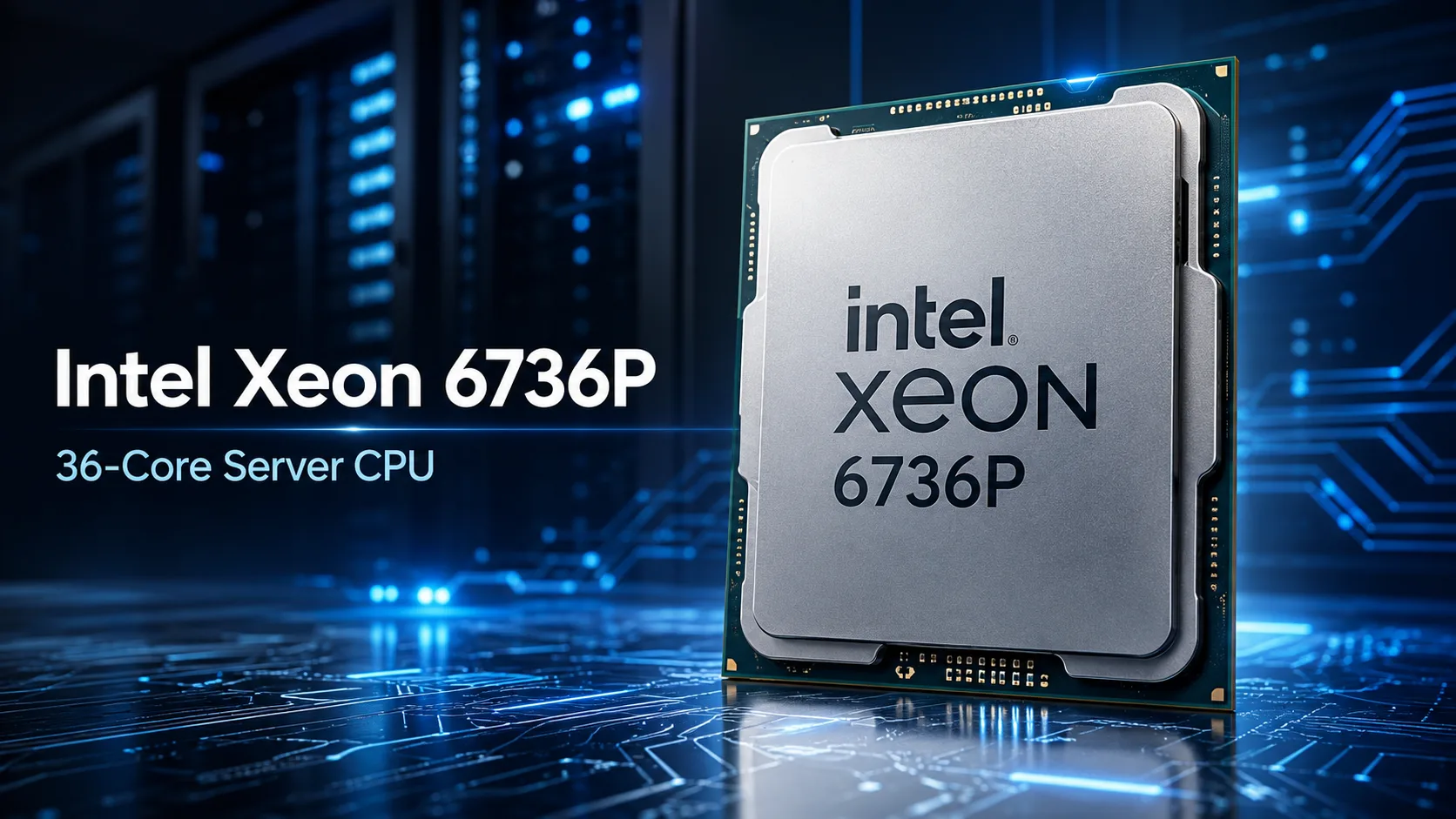
Intel Xeon 6736P: Benchmark Results and Servers with a 36-Core Processor
The Intel Xeon 6736P is a 36-core server processor from the Granite Rapids family, supporting 72 threads, with a clock speed of up to 4.1 GHz and a TDP of 205 W. It is designed for use in single- and dual-socket servers, optimized for virtualization, databases, enterprise applications, and other workloads where not only the number of cores matters but also the performance of individual threads.
Benchmark Results of Servers with Intel Xeon 6736P
The table below presents the SPEC CPU 2017 results for production servers. In all configurations, two Xeon 6736P processors are installed-totaling 72 cores and 144 threads.
SPECint_rate2017 measures system throughput on integer tasks, while SPECfp_rate2017 measures floating-point computations. These results represent an entire dual-socket server, not just a single processor.
| Server | CPU Configuration | SPECint_rate2017 Base | SPECfp_rate2017 Base |
|---|---|---|---|
| xFusion FusionServer 1288 V8 | 2 × Xeon 6736P | 778 | 997 |
| KAYTUS KR2280V3 | 2 × Xeon 6736P | 757 | 968 |
| HPE ProLiant Compute DL380 Gen12 | 2 × Xeon 6736P | 750 | 975 |
| HPE ProLiant Compute DL360 Gen12 | 2 × Xeon 6736P | 748 | 964 |
| Lenovo ThinkSystem SR630 V4 | 2 × Xeon 6736P | 735 | 934 |
The difference between the fastest and slowest server is about 6%. Since all systems have the same processors, variations result from memory configuration, BIOS settings, power profiles, cooling, and the software environment used.
For server platforms, this is a typical situation: the CPU name defines only part of the final performance. A server with fully populated memory channels and a well-configured power mode can outperform another system with the same processors but less optimal configuration.
Performance and Clock Speeds
The base frequency of the Xeon 6736P is 2.0 GHz; however, under load, the processor can operate significantly faster. The maximum Turbo Boost frequency reaches 4.1 GHz, and the stated frequency under full-core load is up to 3.4 GHz.
The processor also supports Intel Speed Select Technology. Depending on the server and firmware, the administrator can choose a profile focused on compute density or higher frequency. Therefore, the behavior of the Xeon 6736P in a real system depends not only on cooling but also on the settings provided by the server manufacturer.
In terms of core count, this model is positioned in the middle of the Xeon 6 family. It lags behind higher-end processors in overall compute density but maintains higher frequencies than many configurations with 64 or more cores.
This is particularly important for mixed workloads. Virtual machines, application servers, and databases rarely load all cores evenly; some threads run in parallel, while others are sensitive to a single core's speed and memory latencies.
Dual-Socket Configuration
A system with two Xeon 6736P processors achieves 72 physical cores, 144 threads, and a total CPU TDP of 410 W. According to the SPEC CPU 2017 results, such servers show good scalability and are suitable for tasks that can distribute workloads between two sockets.
However, a dual-socket system requires proper NUMA configuration. The operating system, hypervisor, and applications need to account for which processor the memory is connected to. Frequent access to memory from the second socket increases latencies and can degrade performance, even with high overall bandwidth.
As a result, for some databases and applications, a single more powerful processor may be more efficient than two less powerful ones. Two Xeon 6736P processors are justified where the workload truly utilizes a large number of threads and the memory capacity of both sockets.
Memory and Device Connectivity
The Xeon 6736P supports eight channels of DDR5 ECC memory per processor. In a dual-socket server, 16 channels are available, but to achieve maximum bandwidth, memory modules must be evenly distributed between the processors and channels.
Partial channel utilization is particularly noticeable in analytics, modeling, rendering, and other tasks that heavily engage with large datasets. In such scenarios, saving on the number of memory modules can restrict performance more significantly than the difference between adjacent CPU models.
A large number of PCI Express 5.0 lanes allows for the connection of NVMe drives, high-speed network cards, and compute accelerators. This makes the Xeon 6736P suitable not only for general-purpose servers but also for storage systems, network infrastructure, and nodes with multiple GPUs.
Suitable Use Cases for Intel Xeon 6736P
The Xeon 6736P is aimed at virtualization, enterprise databases, application servers, software-defined storage, and mid-density computing clusters.
The model is particularly interesting for software licensed by the number of cores. In such systems, purchasing a processor with 64-86 cores increases not just hardware costs but also licensing expenses. A configuration with 36 faster cores may provide a better balance of performance and total cost of ownership.
For maximizing the number of virtual machines on a single server, higher-end Xeon 6 processors with more cores may be more advantageous. For applications sensitive to single-thread speeds, it is advisable to consider models with fewer cores and higher base frequencies.
The Xeon 6736P occupies an intermediate position: it allows for building a dual-socket server with 72 cores without moving to processors with TDPs of 300-350 W and without overpaying for cores that may remain underloaded.
CPU Comparison
Compare Xeon 6736P with other CPUs
Basic
CPU Specifications
Memory Specifications
AI Specifications
Interfaces and Ports
Miscellaneous
Benchmarks
Compared to Other CPU
Share in social media
Or Link To Us
<a href="https://cputronic.com/en/cpu/intel-xeon-6736p" target="_blank">Intel Xeon 6736P</a>