Intel Xeon 6724P

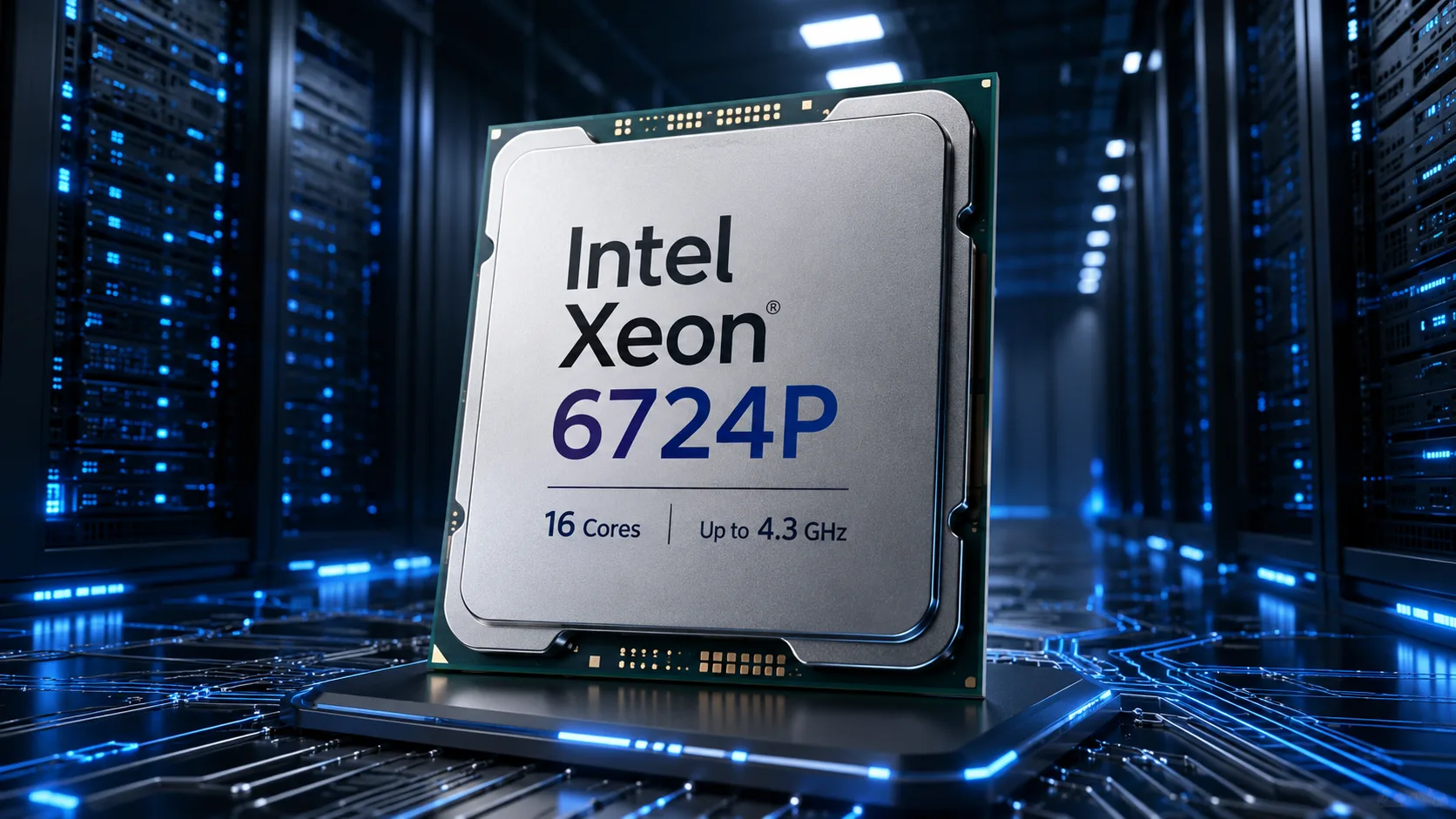
Intel Xeon 6724P: Tests and Servers with 16 Fast Cores
The Intel Xeon 6724P is an expensive 16-core server processor that cannot be evaluated merely by the number of cores. It operates at a frequency of up to 4.3 GHz and is designed for applications sensitive to single-thread speed, latency, and core licensing costs. For mass virtualization and rendering, there are more multi-core Xeon options available, but in some enterprise systems, additional cores only increase expenses.
Results of Intel Xeon 6724P in Server Systems
The table below presents the results from SPECrate 2017 Integer Base. This test evaluates the overall throughput of the system in a set of integer workloads: the higher the score, the more parallel work the server can perform.
| Server | Processors | Cores / Threads | Memory | SPECrate 2017 Integer Base |
|---|---|---|---|---|
| Dell PowerEdge R570 | 1 × Xeon 6724P | 16 / 32 | 256 GB DDR5-6400 | 204 |
| Dell PowerEdge R670 | 2 × Xeon 6724P | 32 / 64 | 512 GB DDR5-6400 | 402 |
| Lenovo ThinkSystem SR630 V4 | 2 × Xeon 6724P | 32 / 64 | 512 GB DDR5-6400 | 402 |
| xFusion FusionServer 2288 V8 | 2 × Xeon 6724P | 32 / 64 | 512 GB DDR5-6400 | 418 |
The single-socket Dell PowerEdge R570 scores 204 points, while the two systems with dual Xeon 6724P processors score 402 points each. The transition from one processor to two increases the score by approximately 97%, indicating a scaling close to linear.
The xFusion FusionServer 2288 V8 scores 418 points, outperforming the dual-socket configurations from Dell and Lenovo by about 4%. The results are influenced by memory configuration, platform settings, software environment, and testing parameters. Therefore, these figures are useful for assessing performance and scaling levels, but are not suitable for direct rankings of server manufacturers.
Why a Server Processor Has Only 16 Cores
In the context of Xeon processors with dozens of cores, the model 6724P may seem unusual. However, its purpose is not to provide maximum multi-threaded performance for a single socket. The main focus is on high frequency: the processor can boost up to 4.3 GHz, and the stated frequency when all cores are loaded reaches 4.2 GHz.
This is crucial for transactional databases, financial systems, and other enterprise software, where performance depends on the speed of individual threads or where licensing costs are based on the number of cores. In such environments, 16 fast cores may prove to be more advantageous than 48 slower ones, especially if the cost of software licenses significantly exceeds the price of the server itself.
For cloud hosting, dense virtualization, rendering, and mass container launches, the logic is the opposite. There, the total number of cores is more important, which means the Xeon 6724P will lag behind models with higher multi-threaded performance per socket.
Platform and Expansion Capabilities
The Xeon 6724P supports eight-channel DDR5-6400 memory, up to 4 TB of RAM per processor, and 88 PCI Express 5.0 lanes. This resource set significantly expands the connectivity options for NVMe drives, network adapters, and computational accelerators compared to desktop platforms.
The processor is also designed for multi-socket systems and supports Intel server accelerators for encryption, compression, and data movement. It is the platform capabilities, rather than just the 16 computational cores, that distinguish the Xeon 6724P from regular Core and Ryzen processors with a comparable number of threads.
Power Consumption and Pricing
The nominal TDP of the Xeon 6724P is 210 W. The high frequency under sustained load poses serious cooling requirements, especially in dual-socket systems. The total TDP of two processors reaches 420 W, and the overall power consumption of a server with memory, storage, and network controllers will be significantly higher.
The suggested price for the Xeon 6724P is $4,057. When calculated per core, the model appears expensive; however, this comparison offers little insight into its intended use. The buyer pays for high frequency, multi-socket operation, large memory capacity, 88 PCIe 5.0 lanes, and the platform's server functions.
Conclusion
The Intel Xeon 6724P is designed for systems where the performance of each core is critical, and increasing the number of cores raises licensing costs. SPEC results demonstrate nearly linear scaling in dual-socket servers, but for virtualization, rendering, and other well-parallelizable tasks, models with a higher number of cores are more advantageous.
It’s a niche processor whose value is determined not by the number of threads, but by the specific software environment and licensing costs.
CPU Comparison
Compare Xeon 6724P with other CPUs
Basic
CPU Specifications
Memory Specifications
AI Specifications
Interfaces and Ports
Miscellaneous
Benchmarks
Compared to Other CPU
Share in social media
Or Link To Us
<a href="https://cputronic.com/en/cpu/intel-xeon-6724p" target="_blank">Intel Xeon 6724P</a>