Intel Pentium G620

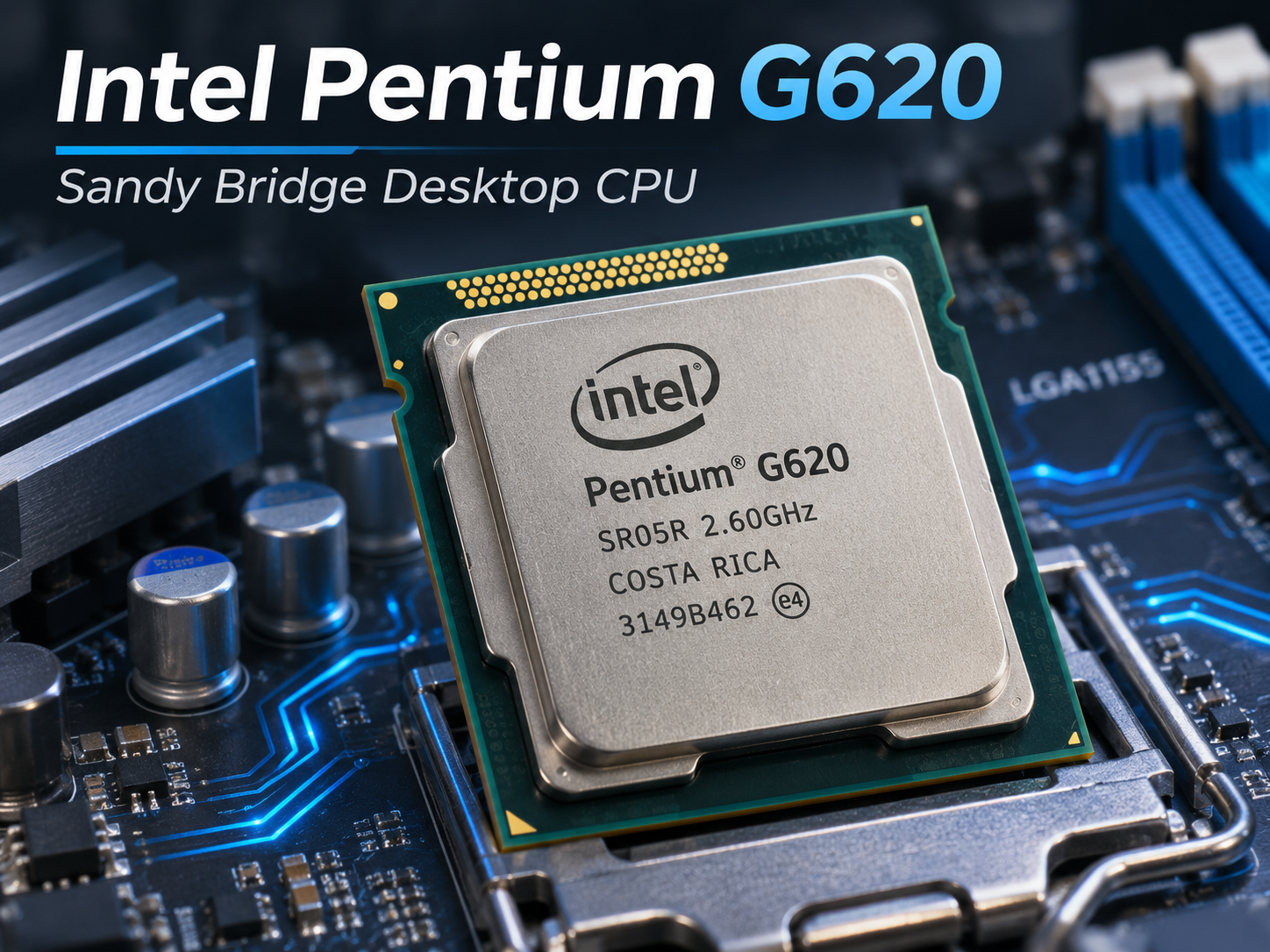
Intel Pentium G620: Specifications, Performance, and Relevance in 2026
Intel Pentium G620 is a dual-core desktop processor based on the Sandy Bridge architecture, released in the second quarter of 2011. The model features two processing threads, a clock speed of 2.6 GHz, 3 MB of L3 cache, and integrated Intel HD Graphics. The processor is manufactured using a 32 nm process, uses the LGA 1155 socket, and has a TDP of 65 W.
The Pentium G620 was intended for inexpensive home and office computers. The Sandy Bridge architecture delivered strong single-core performance for its time, but the lack of Hyper-Threading and Turbo Boost limited the processor's capabilities. In 2026, the G620 is primarily suitable for simple tasks and maintaining older systems.
Differences from Other Sandy Bridge Processors
| Specification | Pentium G620 | Pentium G630 | Pentium G840 | Core i3-2100 |
|---|---|---|---|---|
| Clock speed | 2.6 GHz | 2.7 GHz | 2.8 GHz | 3.1 GHz |
| Cores / threads | 2 / 2 | 2 / 2 | 2 / 2 | 2 / 4 |
| Memory | DDR3-1066 | DDR3-1066 | DDR3-1333 | DDR3-1333 |
| Hyper-Threading | No | No | No | Yes |
All four processors use the LGA 1155 socket and have 3 MB of L3 cache. The Pentium G630 differs from the G620 by having a 100 MHz higher clock speed. The G840 operates at 2.8 GHz and supports faster DDR3-1333 memory.
The Core i3-2100 additionally features Hyper-Threading, allowing it to process four software threads on two physical cores. Combined with its higher clock speed, this gives it an advantage in applications capable of using multiple threads.
Architecture and Specifications
The Pentium G620 contains two Sandy Bridge cores, with 256 KB of L2 cache per core and a shared 3 MB L3 cache. Its maximum stock clock speed is 2.6 GHz. Intel SpeedStep can reduce the clock speed and voltage under light loads, but Turbo Boost is not available on this model.
The processor multiplier is locked upward. Overclocking by increasing the base clock is possible on some motherboards, but its potential is limited.
The dual-channel memory controller officially supports DDR3-1066 with a maximum bandwidth of 17 GB/s. The stated maximum amount of RAM is 32 GB, although actual capabilities also depend on the motherboard.
The processor supports 64-bit operating systems, SSE4.1 and SSE4.2 instructions, and Intel VT-x hardware virtualization. However, it lacks AVX, AVX2, and AES-NI. This limits compatibility with some modern software and reduces the efficiency of certain computations, including encryption.
Benchmark Performance
Four Intel processors based on the Sandy Bridge architecture were selected for comparison. The Geekbench 6 results provide an indication of performance under single-core loads and when using all available threads.
| Processor | Geekbench 6 Single-Core | Geekbench 6 Multi-Core |
|---|---|---|
| Pentium G620 | 476 | 712 |
| Pentium G630 | 526 | 841 |
| Pentium G840 | 544 | 879 |
| Pentium G850 | 562 | 921 |
| Core i3-2100 | 530 | 1006 |
In the single-core Geekbench 6 test, the Pentium G630 outperforms the G620 by approximately 11%, the G840 by 14%, and the G850 by 18%. The differences between the results are more noticeable than might be expected based solely on the processors' stock clock speeds.
In the multi-threaded test, the G630 scores 18% more than the G620, even though its clock speed is only 3.8% higher. This gap cannot be considered a typical performance increase when replacing one processor with another. Geekbench Browser results are based on user measurements taken with different memory configurations, operating systems, and hardware settings.
The Core i3-2100 outperforms the G620 by approximately 41% in Multi-Core. This advantage is due to its higher clock speed and support for Hyper-Threading. In programs that use multiple threads, the difference between these processors can be substantial, but its size depends on the specific workload.
Gaming Performance
The gaming capabilities of the Pentium G620 can be assessed using testing from around the time of its release. The tests used an Inno3D GeForce GTX 460 graphics card with increased clock speeds of 800/1600/4000 MHz. For the LGA 1155 processors, an MSI H67MA-E45 motherboard with 4 GB of RAM was used.
| Processor | Battlefield: Bad Company 2, FPS | GTA: Episodes from Liberty City, FPS |
|---|---|---|
| Pentium G620 | 42.9 | 30.5 |
| Celeron G540 | 41.0 | 27.2 |
| Athlon II X3 435 | 44.0 | 32.1 |
| Athlon II X2 255 | 36.8 | 26.6 |
Average frame rate at a resolution of 1680 × 1050. Battlefield: Bad Company 2 was tested using high graphics settings, while GTA was tested using maximum settings. The graphics card was the same in all configurations, but the platforms and memory settings differed.
In Battlefield: Bad Company 2, the Pentium G620 produces 42.9 FPS, slightly outperforming the Celeron G540 and Athlon II X2 255. The triple-core Athlon II X3 435 is faster, but the difference is less than 3%.
In GTA: Episodes from Liberty City, the G620 outperforms the Celeron G540 by approximately 12%. At the same time, the Athlon II X3 435 produces a result that is 5% higher.
These measurements demonstrate the competitiveness of the Sandy Bridge architecture in games from the early 2010s. However, the results apply to specific test configurations and do not allow the performance of modern games to be assessed directly.
There are not enough verified comparable results for these processors at a resolution of 1920 × 1080. There is also no reliable Pentium G620 result in 3DMark Time Spy using a suitable discrete graphics card, so providing an estimated figure instead of a measured result would be inappropriate.
Integrated Intel HD Graphics
The Pentium G620 is equipped with an integrated Intel HD Graphics core from the Sandy Bridge generation. It contains six execution units and operates at clock speeds ranging from 850 to 1100 MHz.
The graphics adapter is primarily intended for displaying images, operating-system interface use, and playback of supported video formats. Its performance is insufficient for demanding games.
The integrated graphics supports DirectX 10.1, but not DirectX 11 or 12. Intel Quick Sync Video hardware encoding is not available on the Pentium G620. Hardware decoding of modern AV1 and HEVC formats is also absent.
A discrete graphics card is preferable for older games, but it does not eliminate the limitations of the dual-core CPU.
Power Consumption and Cooling
The Pentium G620 has a thermal design power of 65 W. This is a specification used when selecting a cooling system, not an indicator of constant power consumption.
In 2011 testing, a system with the G620 consumed approximately as much power as a configuration with the Celeron G540. Under gaming loads, its power consumption was lower than that of some test systems based on the Athlon II X3. However, the measurements covered the entire computer, so the results depended on more than just the processor.
For stock operation, the G620 is adequately cooled by a standard Intel cooler for LGA 1155 in good working order. When using an older system, it is worth checking the condition of the fan, thermal paste, and the motherboard's power delivery system.
Relevance in 2026
The Pentium G620 can still be used for a limited range of tasks:
- Working with text documents and small spreadsheets.
- Running older software.
- Using undemanding local applications.
- Playing older games with a compatible discrete graphics card.
- Restoring computers based on the LGA 1155 platform.
Installing an SSD and increasing the amount of RAM to 8 GB can improve system responsiveness. However, two processing threads remain a serious limitation for modern browsers, resource-intensive websites, and running multiple applications simultaneously.
Compatibility with new software is an additional problem. The Pentium G620 is not included in the list of officially supported processors for Windows 11, and the lack of AVX prevents some modern programs from running.
If the existing LGA 1155 platform needs to be retained, installing a Core i5-2400, Core i5-2500, or Core i7-2600 may be a more rational upgrade. Their four physical cores provide an advantage under multi-threaded workloads. Before replacing the processor, compatibility with the motherboard and the installed BIOS version must be verified.
Conclusion
The Intel Pentium G620 was a competitive budget processor for its generation. The Sandy Bridge architecture provided good single-core performance, while the integrated graphics made it possible to build inexpensive computers without a discrete graphics card.
In 2026, the G620's capabilities are limited by its two processing threads, 2.6 GHz clock speed, and lack of modern instructions. The processor remains suitable for simple tasks and older software, but its performance is no longer sufficient for a primary work computer.
If the LGA 1155 platform is being retained, upgrading to a quad-core Core i5 or Core i7 makes more practical sense than replacing the G620 with a slightly faster Pentium from the same generation.
CPU Comparison
Compare Pentium G620 with other CPUs
Basic
CPU Specifications
Memory Specifications
GPU Specifications
Miscellaneous
Benchmarks
Compared to Other CPU


Share in social media
Or Link To Us
<a href="https://cputronic.com/en/cpu/intel-pentium-g620" target="_blank">Intel Pentium G620</a>