Intel Core i3-6100U

Intel Core i3-6100U
Intel Core i3-6100U processor review

Intel Core i3-6100U in 2026: What Two Skylake Cores Can Still Do

The Intel Core i3-6100U is a dual-core Skylake mobile processor released in 2015. It can still handle documents, web browsing, and basic everyday tasks, but its two cores limit multitasking. Another problem in 2026 is the lack of official Windows 11 support.

Architecture and Specifications

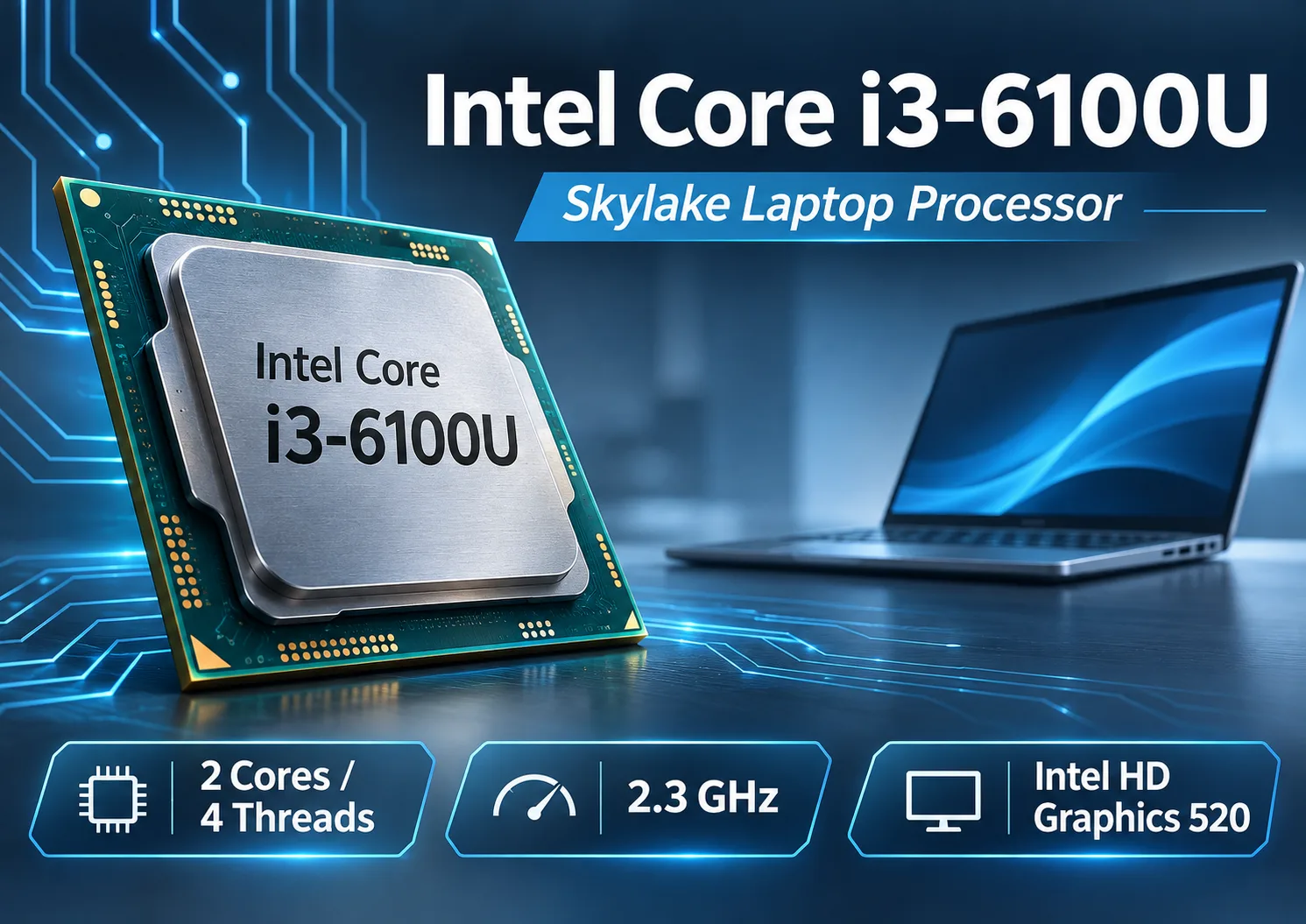
The Core i3-6100U is manufactured on a 14 nm process and has 2 cores with Hyper-Threading support, allowing it to handle 4 threads. Its clock speed is 2.3 GHz. It does not support Turbo Boost, so the processor cannot increase its clock speed during short-term workloads. Its L3 cache capacity is 3 MB.

The nominal TDP is 15 W. In cTDP-down mode, it can be reduced to 7.5 W, while the base clock speed drops to 800 MHz. This reduces power consumption and heat output but also lowers performance.

The processor supports dual-channel DDR4-2133, LPDDR3-1866, and DDR3L-1600 memory with a capacity of up to 32 GB. Maximum memory bandwidth is 34.1 GB/s. It also supports PCIe 3.0, AVX2, AES-NI, and VT-x/VT-d hardware virtualization.

The chip uses an FCBGA1356 package and is soldered to the motherboard. It cannot be replaced with a more powerful model using the usual procedure.

Intel HD Graphics 520 Integrated Graphics

The integrated HD Graphics 520 uses 24 execution units (EUs) and operates at between 300 and 1000 MHz. It has no dedicated video memory-the graphics core uses system RAM, making a dual-channel memory configuration especially beneficial.

The graphics core supports DirectX 12, OpenGL 4.5, and connection of up to three displays. DisplayPort supports output of up to 4096 × 2304 at 60 Hz, while HDMI supports up to 4096 × 2304 at 24 Hz. The available resolutions depend on the ports provided by the specific laptop.

The HD Graphics 520 has modest gaming capabilities. Even games from the mid-2010s often require minimum settings and reduced resolution.

Device Game Resolution, settings FPS
Dell Latitude 14 3470, Core i3-6100U Dirt Rally 1024 × 768, Ultra Low 62.3
Dell Latitude 14 3470, Core i3-6100U Total War: Rome II 1024 × 768, Low 25.4
Dell Latitude 14 3470, Core i3-6100U Rise of the Tomb Raider 1024 × 768, Lowest 7

The results were obtained on a Dell Latitude 14 3470 with 4 GB of DDR3L-1600 memory in single-channel mode. Installing a second memory module may improve integrated graphics performance.

The difference between the games is substantial. Dirt Rally averages 62.3 FPS at minimum settings, while Total War: Rome II reaches only 25.4 FPS. With a result of 7 FPS, Rise of the Tomb Raider is practically unplayable. The graphics core is still sufficient for older and relatively undemanding games, but it is not suitable for modern, demanding titles.

The situation is more favorable for video playback. Quick Sync accelerates the processing of common formats, including H.264. 1080p video usually plays without problems, but some 4K HEVC 10-bit files and VP9 video may place increased load on the processor because of hardware decoding limitations.

Performance and Comparison with Competitors

The Core i3-6100U is slower even than the higher-end Core i5-6200U from the same generation. Both processors have two cores and four threads, but the Core i5 can increase its clock speed to 2.8 GHz thanks to Turbo Boost.

The gap with later models is significantly larger.

Processor Cores / threads PassMark Single Thread PassMark CPU Mark
Core i3-6100U 2 / 4 1310 2613
Core i5-6200U 2 / 4 1535 2994
Ryzen 3 3200U 2 / 4 1759 3698
Core i5-8250U 4 / 8 1868 5778

The PassMark figures are based on average results from user tests and may change as the database is updated.

In the overall PassMark CPU Mark result, the quad-core Core i5-8250U is approximately 2.2 times faster. The difference is especially noticeable when extracting archives, processing files, and running multiple applications in parallel.

The Ryzen 3 3200U outperforms the i3-6100U by approximately 41%, despite also having two cores and four threads.

In Geekbench 6, the Core i3-6100U scores around 750 points in single-threaded mode and 1500 in multi-threaded mode. Delays may occur when a browser, video conferencing, and office applications are running simultaneously.

Suitable Tasks in 2026

A laptop with a Core i3-6100U can still be used for basic everyday work. An SSD and at least 8 GB of RAM are recommended. With 4 GB of memory and an HDD, even ordinary web browsing may be accompanied by noticeable delays.

The processor is suitable for:

  • Office documents, email, and PDFs.
  • Web browsing with a small number of open tabs.
  • Video calls and remote learning.
  • Watching 1080p video in common formats.
  • Older games and simple applications.

The main problems arise when opening heavy web pages, using many tabs, and running several programs simultaneously. Performance is no longer sufficient for modern games, video editing, batch processing of high-resolution photos, and large projects in an IDE.

Operating System Limitations

The Core i3-6100U is not officially supported by Windows 11. It is possible to install the operating system using workarounds, but Microsoft does not guarantee full compatibility or the delivery of updates on such hardware.

Standard support for Windows 10 ended on October 14, 2025. The Extended Security Updates (ESU) program allows security updates to continue on devices that meet the requirements, but it does not include new features or regular technical support.

For continued use of the laptop, Linux Mint XFCE, Xubuntu, or other relatively lightweight Linux distributions may be considered. They make it possible to use a supported operating system without replacing the computer, although they do not remove the hardware limitations.

Is a Laptop with a Core i3-6100U Worth Buying?

In 2026, the Core i3-6100U makes sense primarily in very inexpensive used laptops. Its capabilities are still sufficient for documents, email, and basic web browsing if the laptop has an SSD and 8 GB of RAM.

At a comparable price, a laptop with a Core i5-8250U is preferable. It is more than twice as fast in the overall PassMark CPU Mark result and officially supports Windows 11 when the other system requirements are met.

The Core i3-6100U should be considered only with a minimal budget and modest performance requirements. For a primary work laptop, it is better to choose a more modern platform.

CPU Comparison

Compare Core i3-6100U with other CPUs

Please select CPU from the dropdown list.

Basic

Label Name
Intel
Platform
Mobile
Launch Date
July 2015
Model Name
The Intel processor number is just one of several factors - along with processor brand, system configurations, and system-level benchmarks - to be considered when choosing the right processor for your computing needs.
i3-6100U
Code Name
SkyLake

CPU Specifications

Total Cores
Cores is a hardware term that describes the number of independent central processing units in a single computing component (die or chip).
2
Total Threads
Where applicable, Intel® Hyper-Threading Technology is only available on Performance-cores.
4
Basic Frequency
2.30 GHz
Intel Virtualization Technology (VT-x)
Intel® Virtualization Technology (VT-x) allows one hardware platform to function as multiple “virtual” platforms. It offers improved manageability by limiting downtime and maintaining productivity by isolating computing activities into separate partitions.
Yes
Intel Virtualization Technology for Directed I/O (VT-d)
Intel® Virtualization Technology for Directed I/O (VT-d) continues from the existing support for IA-32 (VT-x) and Itanium® processor (VT-i) virtualization adding new support for I/O-device virtualization. Intel VT-d can help end users improve security and reliability of the systems and also improve performance of I/O devices in virtualized environments.
Yes
Instruction Set Extensions
Intel® SSE4.1, Intel® SSE4.2, Intel® AVX2
Enhanced Intel SpeedStep Technology
Enhanced Intel SpeedStep® Technology is an advanced means of enabling high performance while meeting the power-conservation needs of mobile systems. Conventional Intel SpeedStep® Technology switches both voltage and frequency in tandem between high and low levels in response to processor load. Enhanced Intel SpeedStep® Technology builds upon that architecture using design strategies such as Separation between Voltage and Frequency Changes, and Clock Partitioning and Recovery.
Yes
Intel Hyper-Threading Technology
Intel® Hyper-Threading Technology (Intel® HT Technology) delivers two processing threads per physical core. Highly threaded applications can get more work done in parallel, completing tasks sooner.
Yes
Intel Turbo Boost Technology
Intel® Turbo Boost Technology dynamically increases the processor's frequency as needed by taking advantage of thermal and power headroom to give you a burst of speed when you need it, and increased energy efficiency when you don’t.
No
Cache
CPU Cache is an area of fast memory located on the processor. Intel® Smart Cache refers to the architecture that allows all cores to dynamically share access to the last level cache.
3 MB Intel® Smart Cache
CPU Socket
The socket is the component that provides the mechanical and electrical connections between the processor and motherboard.
FCBGA1356
Intel AES New Instructions
Intel® AES New Instructions (Intel® AES-NI) are a set of instructions that enable fast and secure data encryption and decryption. AES-NI are valuable for a wide range of cryptographic applications, for example: applications that perform bulk encryption/decryption, authentication, random number generation, and authenticated encryption.
Yes
Technology
Lithography refers to the semiconductor technology used to manufacture an integrated circuit, and is reported in nanometer (nm), indicative of the size of features built on the semiconductor.
14 nm
TDP
15 W
Max. Operating Temperature
Junction Temperature is the maximum temperature allowed at the processor die.
100°C
PCI Express Version
PCI Express Revision is the supported version of the PCI Express standard. Peripheral Component Interconnect Express (or PCIe) is a high-speed serial computer expansion bus standard for attaching hardware devices to a computer. The different PCI Express versions support different data rates.
3.0
Max Number of PCI Express Lanes
A PCI Express (PCIe) lane consists of two differential signaling pairs, one for receiving data, one for transmitting data, and is the basic unit of the PCIe bus. Max # of PCI Express Lanes is the total number of supported lanes.
12
Instruction Set
An instruction set refers to the basic set of commands and instructions that a microprocessor understands and can carry out. The value shown represents which Intel’s instruction set this processor is compatible with.
64-bit
Intel 64
Intel® 64 architecture delivers 64-bit computing on server, workstation, desktop and mobile platforms when combined with supporting software.¹ Intel 64 architecture improves performance by allowing systems to address more than 4 GB of both virtual and physical memory.
Yes
Intel VT-x with Extended Page Tables (EPT)
Intel® VT-x with Extended Page Tables (EPT), also known as Second Level Address Translation (SLAT), provides acceleration for memory intensive virtualized applications. Extended Page Tables in Intel® Virtualization Technology platforms reduces the memory and power overhead costs and increases battery life through hardware optimization of page table management.
Yes
PCI Express Configurations
PCI Express (PCIe) Configurations describe the available PCIe lane configurations that can be used to link to PCIe devices.
1x4 | 2x2 | 1x2+2x1 and 4x1

Memory Specifications

Memory Type
Intel® processors come in four different types: Single Channel, Dual Channel, Triple Channel, and Flex Mode. Maximum supported memory speed may be lower when populating multiple DIMMs per channel on products that support multiple memory channels.
DDR4-2133 | LPDDR3-1866 | DDR3L-1600
Max Memory Size
Max memory size refers to the maximum memory capacity supported by the processor.
32 GB
Memory Channels
The number of memory channels refers to the bandwidth operation for real world application.
2
Bus Speed
4 GT/s
Max Memory Bandwidth
Max Memory bandwidth is the maximum rate at which data can be read from or stored into a semiconductor memory by the processor (in GB/s).
34.1 GB/s
ECC Memory Support
ECC Memory Supported indicates processor support for Error-Correcting Code memory. ECC memory is a type of system memory that can detect and correct common kinds of internal data corruption. Note that ECC memory support requires both processor and chipset support.
No
Intel Flex Memory Access
Yes

GPU Specifications

Integrated Graphics Model
An integrated GPU refers to the graphics core that is integrated into the CPU processor. Leveraging the processor's powerful computational capabilities and intelligent power efficiency management, it delivers outstanding graphics performance and a smooth application experience at a lower power consumption.
Intel® HD Graphics 520
Graphics Base Frequency
Graphics Base frequency refers to the rated/guaranteed graphics render clock frequency in MHz.
300 MHz
Graphics Frequency
Graphics max dynamic frequency refers to the maximum opportunistic graphics render clock frequency (in MHz) that can be supported using Intel® HD Graphics with Dynamic Frequency feature.
1.00 GHz
4K Support
Yes | at 60Hz
Graphics Video Max Memory
32 GB
DirectX Support
DirectX* Support indicates support for a specific version of Microsoft’s collection of APIs (Application Programming Interfaces) for handling multimedia compute tasks.
12
Max Resolution (DP)
Max Resolution (DP) is the maximum resolution supported by the processor via the DP interface (24bits per pixel & 60Hz). System or device display resolution is dependent on multiple system design factors; actual resolution may be lower on your system.
4096x2304@60Hz
Max Resolution (eDP - Integrated Flat Panel)
Max Resolution (Integrated Flat Panel) is the maximum resolution supported by the processor for a device with an integrated flat panel (24bits per pixel & 60Hz). System or device display resolution is dependent on multiple system design factors; actual resolution may be lower on your device.
4096x2304@60Hz
Max Resolution (HDMI)
Max Resolution (HDMI) is the maximum resolution supported by the processor via the HDMI interface (24bits per pixel & 60Hz). System or device display resolution is dependent on multiple system design factors; actual resolution may be lower on your system.
4096x2304@24Hz
Number of Displays Supported
3
Graphics Output
Graphics Output defines the interfaces available to communicate with display devices.
eDP/DP/HDMI/DVI
Intel Clear Video HD Technology
Intel® Clear Video HD Technology, like its predecessor, Intel® Clear Video Technology, is a suite of image decode and processing technologies built into the integrated processor graphics that improve video playback, delivering cleaner, sharper images, more natural, accurate, and vivid colors, and a clear and stable video picture. Intel® Clear Video HD Technology adds video quality enhancements for richer color and more realistic skin tones.
Yes
Intel Clear Video Technology
Yes
Intel InTru 3D Technology
Yes
OpenGL Support
OpenGL (Open Graphics Library) is a cross-language, multi-platform API (Application Programming Interface) for rendering 2D and 3D vector graphics.
4.5
Intel Quick Sync Video
Intel® Quick Sync Video delivers fast conversion of video for portable media players, online sharing, and video editing and authoring.
Yes

Miscellaneous

Execute Disable Bit
Execute Disable Bit is a hardware-based security feature that can reduce exposure to viruses and malicious-code attacks and prevent harmful software from executing and propagating on the server or network.
Yes
Intel OS Guard
Yes

Benchmarks

Geekbench 6
Single Core Score
747
Geekbench 6
Multi Core Score
1531
Geekbench 5
Single Core Score
538
Geekbench 5
Multi Core Score
1195
Passmark CPU
Single Core Score
1333
Passmark CPU
Multi Core Score
2639

Compared to Other CPU

Geekbench 6 Single Core
867 +16.1%
808 +8.2%
694 -7.1%
650 -13%
Geekbench 6 Multi Core
1839 +20.1%
1698 +10.9%
1236 -19.3%
Geekbench 5 Single Core
577 +7.2%
559 +3.9%
523 -2.8%
508 -5.6%
Geekbench 5 Multi Core
1362 +14%
1276 +6.8%
1102 -7.8%
1049 -12.2%
Passmark CPU Single Core
1403 +5.3%
1377 +3.3%
1289 -3.3%
1239 -7.1%
Passmark CPU Multi Core
2960 +12.2%
2825 +7%
2445 -7.4%
2289 -13.3%