Intel Core 9 273PQE

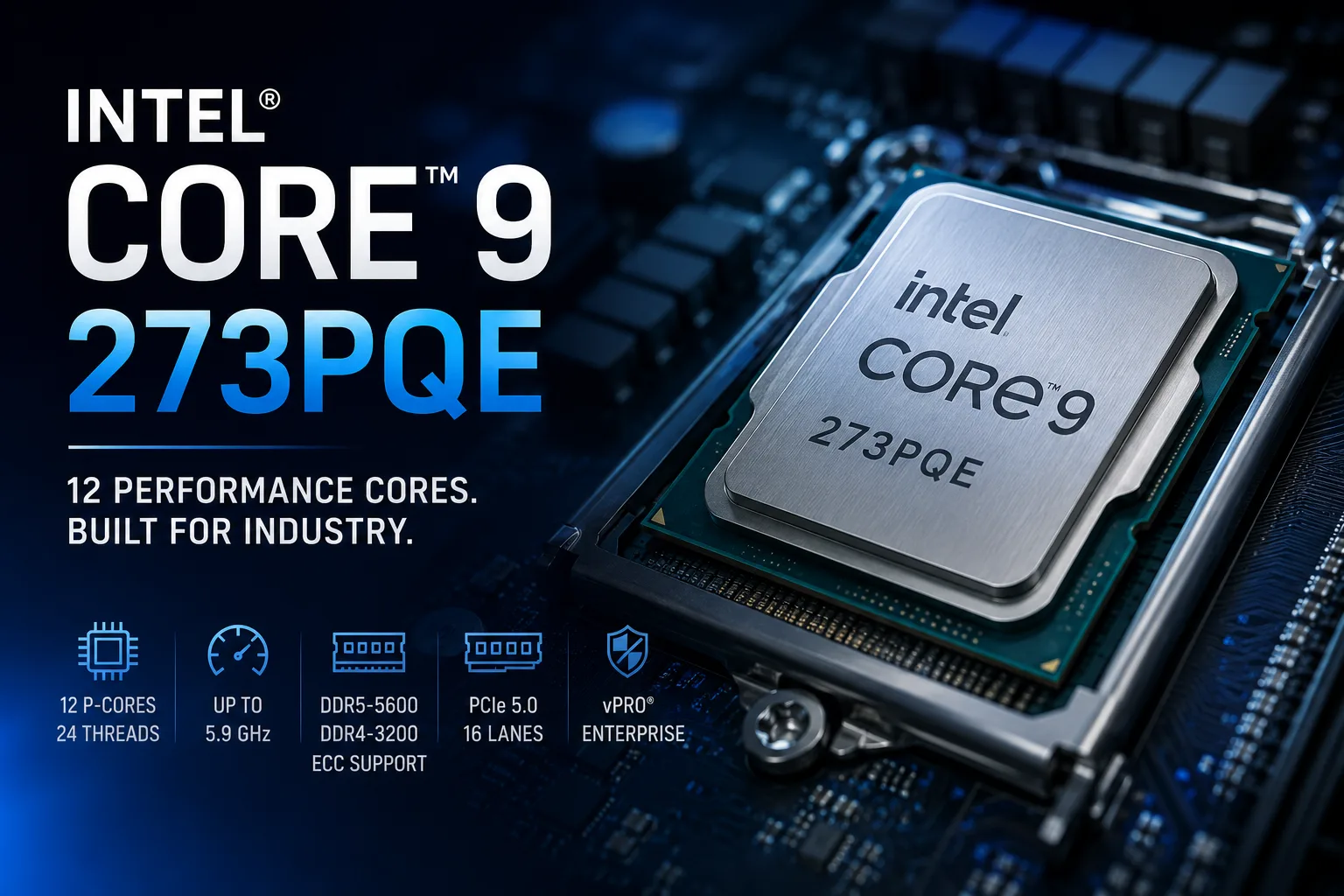
Intel Core 9 273PQE: Why Intel Released a 12-Core Processor Without E-Cores
The Intel Core 9 273PQE is notably different from the usual desktop processors from the company. It features 12 performance cores, 24 threads, and no energy-efficient cores. This is not a replacement for the Core i9-14900K or a new flagship gaming model, but rather a specialized Bartlett Lake model for industrial computers, edge servers, and latency-sensitive systems.
The main feature of the 273PQE is its homogeneous architecture. All physical cores are of the same type, eliminating the need for software to distribute load between performance cores and energy-efficient blocks.
Why the Processor Has Only P-Cores
The Core i9-14900K uses eight P-cores and sixteen E-cores. This configuration provides high total multi-threaded performance, but the behavior of different types of cores varies significantly.
The Core 9 273PQE is simpler: twelve identical P-cores support Hyper-Threading and create 24 logical threads. This simplifies task assignment to specific cores, the configuration of virtual machines, and the distribution of computing resources across multiple processes.
For a typical home computer, the hybrid scheme has not been a serious issue for some time. Modern operating systems can send demanding applications to P-cores and background tasks to E-cores. However, in industrial equipment, telecommunications systems, and programmable controllers, consistency in operation times can be just as crucial as average speed.
The 273PQE is designed for such scenarios. Its advantage lies not necessarily in higher performance but in a simpler and more predictable core configuration.
What Does the 5.9 GHz Frequency Mean?
The Core 9 273PQE is manufactured using the Intel 7 process and features 36 MB of Intel Smart Cache. The base frequency is 3.4 GHz, while the maximum stated frequency reaches up to 5.9 GHz.
However, 5.9 GHz is a Thermal Velocity Boost value, available only under suitable thermal and power conditions. The Turbo Boost Max 3.0 frequency reaches 5.7 GHz, and the standard maximum turbo mode for P-cores is limited to 5.5 GHz.
Therefore, it is incorrect to perceive 5.9 GHz as a constant frequency for all twelve cores. For sustained workloads, the frequency under full load is more important. According to Intel, all P-cores can operate at a frequency of up to 5.3 GHz, although the actual outcome will depend on motherboard settings, power limits, and cooling solutions.
The processor’s base power is 125 W. Intel does not specify the maximum turbo power in its public specifications, so system cooling requirements cannot be assessed solely based on the Processor Base Power value. A high-performance cooler and a case with adequate heat dissipation will be necessary for prolonged loads.
Core 9 273PQE vs. Core i9-14900K
Both models feature the same L3 cache size and similar maximum frequencies, but their internal configurations differ fundamentally.
| Characteristic | Core 9 273PQE | Core i9-14900K |
|---|---|---|
| P-cores | 12 | 8 |
| E-cores | 0 | 16 |
| Total Cores | 12 | 24 |
| Threads | 24 | 32 |
| L3 Cache | 36 MB | 36 MB |
| Maximum Frequency | 5.9 GHz | 6.0 GHz |
| Base Power | 125 W | 125 W |
The Core i9-14900K is likely to remain faster in tasks that can effectively utilize all its cores: mass encoding, batch rendering, and other well-parallelizable computations. It has more physical cores and more logical threads.
The Core 9 273PQE focuses on something else. Twelve identical P-cores simplify resource allocation for virtual machines, containers, and latency-sensitive processes. This does not guarantee superiority over the 14900K, but it can simplify the setup of specialized systems.
For gaming, additional P-cores do not provide an automatic advantage. Most projects are not able to fully load twelve performance cores, and the architecture of the cores themselves remains similar to Raptor Lake. Therefore, one should not expect a significant increase in frame rates simply by eliminating E-cores.
There are still few independent tests of the Core 9 273PQE, so direct conclusions about its performance must primarily be based on core configuration and official specifications.
LGA1700 Does Not Guarantee Compatibility with Older Boards
The processor uses the FCLGA1700 socket, features a DMI 4.0 controller, and provides 20 PCI Express lanes: 16 PCIe 5.0 lanes for a discrete accelerator and four PCIe 4.0 lanes for a storage device or another peripheral.
Physically, it is compatible with the same socket as Alder Lake, Raptor Lake, and Raptor Lake Refresh. However, this does not mean that the processor will work on any Z690 or Z790 board.
Intel indicates compatibility for the Core 9 273PQE with several LGA1700 chipsets, including H610, H610E, and W680. In practice, compatible BIOS and microcode are required, and manufacturers of retail motherboards may not add support for specialized OEM models at all.
Therefore, it is not advisable to consider the 273PQE a simple upgrade for an existing home computer. The processor is primarily designed for ready-made industrial systems and specialized motherboards.
DDR4 and ECC Support
The memory controller supports DDR5-5600 and DDR4-3200, two channels, and up to 192 GB of RAM. ECC support has also been stated.
Maintaining DDR4 support may seem strange for a 2026 processor, but this is a logical solution for the industrial segment. It is essential for equipment manufacturers to be able to upgrade the computing part without needing to redesign the board completely and recertify the entire system.
For new workstations, DDR5-5600 is preferable: twelve P-cores place a significant load on the memory subsystem. DDR4 remains an option for projects where compatibility and a long lifecycle are more important than maximum bandwidth.
The support for ECC also emphasizes the intended use of the processor. In gaming computers, it is usually unnecessary, but in servers, data storage systems, and industrial equipment, memory error correction can be more critical than a modest performance gain.
Integrated Graphics UHD Graphics 770
The Core 9 273PQE is equipped with Intel UHD Graphics 770, featuring 32 execution units and a frequency of up to 1.65 GHz. The integrated graphics supports multiple displays, hardware video decoding, and Intel Quick Sync Video.
Its performance is insufficient for modern gaming. The primary use cases are operating interface output, diagnostic monitoring, video surveillance, and hardware processing of media streams without the need for a discrete graphics card.
The processor does not feature a separate NPU. For running AI models using the CPU, Intel DL Boost instructions are available, and some workloads can be offloaded to the integrated or discrete graphics. However, in terms of energy efficiency for local AI tasks, the 273PQE lags behind modern Core Ultra processors with a dedicated neural block.
Three Versions of Bartlett Lake with 12 P-Cores
The Core 9 273PQE is at the top of the lineup of homogeneous 12-core models. Below it are the Core 9 273PE with a base power of 65 W and Core 9 273PTE with a limit of 45 W.
| Model | Base Power | Base Frequency | Maximum Frequency | All Cores Frequency |
|---|---|---|---|---|
| Core 9 273PQE | 125 W | 3.4 GHz | 5.9 GHz | up to 5.3 GHz |
| Core 9 273PE | 65 W | 2.3 GHz | 5.7 GHz | up to 5.2 GHz |
| Core 9 273PTE | 45 W | 1.4 GHz | 5.5 GHz | up to 4.6 GHz |
The gap in maximum frequency between the 125 W and 65 W versions is small. The main advantage of the 273PQE should manifest under prolonged loads when the higher power limit allows for sustaining high frequencies for longer.
The Core 9 273PE appears more rational for compact workstations, while the 273PTE is aimed at systems with particularly stringent cooling and power consumption limits.
Conclusion
The Intel Core 9 273PQE is interesting not for its record frequency or a return to older desktop architecture. Its main feature is twelve identical performance cores with Hyper-Threading.
For a typical gaming computer, the processor is too specialized. It is supplied through OEM channels, requires confirmed BIOS support, and does not promise a clear advantage over more affordable desktop models.
However, in industrial workstations, edge servers, machine vision systems, and virtualized controllers, the homogeneous configuration can simplify resource allocation and application setup. The Core 9 273PQE is not a universal flagship but a rare processor for scenarios where architectural predictability is more important than the maximum number of cores.
CPU Comparison
Compare Core 9 273PQE with other CPUs
Basic
CPU Specifications
Memory Specifications
GPU Specifications
Interfaces and Ports
Benchmarks
Compared to Other CPU
Share in social media
Or Link To Us
<a href="https://cputronic.com/en/cpu/intel-core-9-273pqe" target="_blank">Intel Core 9 273PQE</a>