Intel Core 5 330

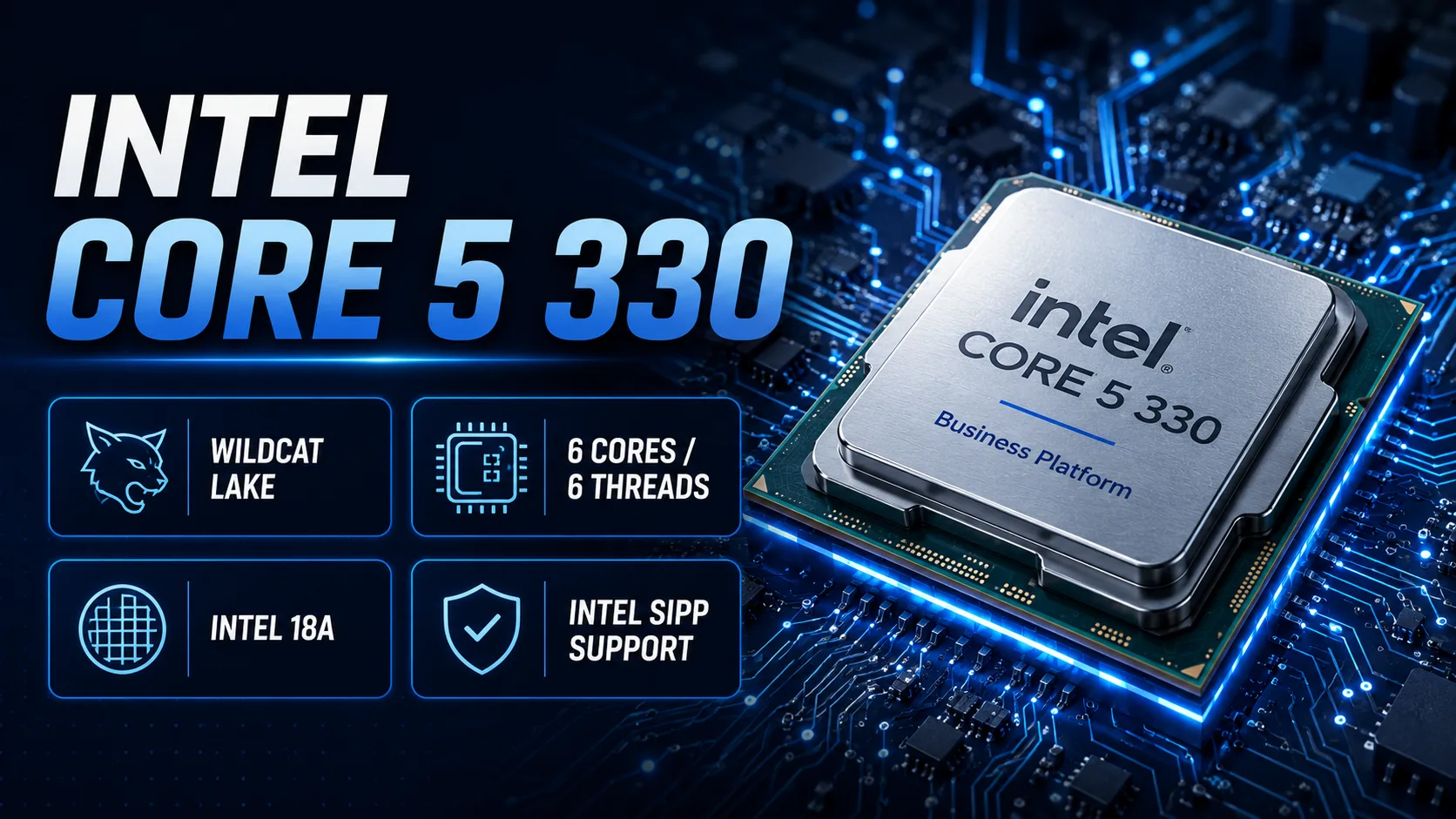
Intel Core 5 330: Core 5 320 with Intel SIPP Support
The Intel Core 5 330 is a mobile processor from the Wildcat Lake family designed for mass business and corporate laptops. In terms of computing capabilities, it fully replicates the Core 5 320: two performance cores, four energy-efficient LP cores, six threads, the same frequencies, graphics, and NPU. The main difference is the support for Intel's Stable IT Platform Program, which is intended for companies that procure and service large fleets of computers.
How Core 5 330 Differs from Neighboring Models
| Processor | Cores and Threads | P-Core Frequency | Graphics | NPU | Intel SIPP |
|---|---|---|---|---|---|
| Intel Core 5 315 | 6 / 6 | up to 4.4 GHz | 2 Xe-cores, up to 2.3 GHz | 15 TOPS | No |
| Intel Core 5 320 | 6 / 6 | up to 4.6 GHz | 2 Xe-cores, up to 2.5 GHz | 16 TOPS | No |
| Intel Core 5 330 | 6 / 6 | up to 4.6 GHz | 2 Xe-cores, up to 2.5 GHz | 16 TOPS | Yes |
The Core 5 330 and Core 5 320 share the same number of cores, frequencies, cache, power range, memory controller, integrated graphics, and NPU performance. There should be no noticeable difference between them in regular applications.
The Core 5 315 differs in P-core frequency, which is lowered from 4.6 to 4.4 GHz, and graphics frequency, which is 2.3 instead of 2.5 GHz. In practice, the advantage of the higher-end models is not substantial, so the processor number should not be the main criterion when choosing a laptop.
What Intel SIPP Support Provides
The Intel Stable IT Platform Program is designed for organizations that require compatible computers with the same configuration over an extended period. For platforms that meet the eligibility criteria, the program ensures the stability of key Intel components-processor, Ethernet, Wi-Fi, and Thunderbolt-for a minimum of 15 months or until the next generation is released.
This simplifies the deployment of a unified operating system image and reduces the amount of retesting for new batches of computers. However, the presence of the Core 5 330 does not guarantee that the entire laptop will meet SIPP requirements: the other components of the platform must also be part of the supported configuration.
The Core 5 330 does not support Intel Active Management Technology. Therefore, it cannot be considered a complete replacement for vPro Enterprise processors with enhanced remote management capabilities. The main advantage here is the stability of compatible components, rather than the ability to administer a powered-off or non-booting computer.
Two P-Cores and Four LP E-Cores
The Core 5 330 is manufactured using Intel's 18A process technology. The processor features two performance cores (Cougar Cove) with frequencies up to 4.6 GHz and four energy-efficient LP E-cores (Darkmont) that can boost to 3.4 GHz.
Hyper-Threading is not supported, so the six physical cores execute only six threads. The third-level cache size is 6 MB.
The base power of the processor is 15 W, with a maximum turbo power of 35 W and a minimum guaranteed power of 10 W. The actual performance of the laptop will depend on sustained power limits, cooling, and firmware settings.
The Core 5 330 handles short workloads well, where single-core speed is crucial. However, in rendering, heavy compilation, video editing, and virtual machines, it will noticeably lag behind modern processors with 12 or more threads.
Core 5 330 Benchmark Results
There are currently few independent tests of serial laptops. In Geekbench 6, a system identified as G-WCLU01 with 8 GB of RAM was discovered. This is likely a testing or pre-production platform, so one run cannot be considered an average result for all devices with the Core 5 330.
| Device | RAM | Geekbench 6, Single Core | Geekbench 6, All Cores |
|---|---|---|---|
| G-WCLU01 | 8 GB | 2555 | 7301 |
The single-core result closely matches the Core 5 320, as expected given the identical architecture and maximum frequency of 4.6 GHz. The result of 7301 points aligns with the limited six-thread configuration; however, one run is insufficient to assess the behavior of production laptops under sustained load.
In PassMark, the Core 5 330 scores about 15,477 points in the overall CPU Mark and 4,071 points in the single-thread rating.
| Processor | PassMark CPU Mark | Single-thread Rating |
|---|---|---|
| Intel Core 5 320 | 15,353 | 4,051 |
| Intel Core 5 330 | 15,477 | 4,071 |
The formal advantage of the Core 5 330 is less than 1%. Since the specifications of the processors are identical, the difference can be attributed to the configurations of the tested devices and the small sample size, rather than an advantage of the Core 5 330 model itself.
The PassMark values are provided as of the time of writing and may change as new results emerge.
Comparison with AMD Ryzen 5 PRO 230
The external corporate competitor to the Core 5 330 is the AMD Ryzen 5 PRO 230. This AMD processor also has six physical cores but, thanks to SMT, can handle 12 threads. It features a 16 MB L3 cache, dual-channel memory controller, and integrated Radeon 760M graphics.
According to PassMark results, the Ryzen 5 PRO 230 is approximately 19% faster than the Core 5 330 in overall CPU Mark. Meanwhile, Wildcat Lake shows about a 14% higher single-thread rating.
| Processor | Cores and Threads | Strength |
|---|---|---|
| Intel Core 5 330 | 6 / 6 | Single-core speed, SIPP support |
| AMD Ryzen 5 PRO 230 | 6 / 12 | Multi-threaded performance and larger graphics |
Intel is better suited for applications sensitive to single-thread speed. AMD appears preferable for rendering, compiling, and other tasks that can load all cores. The ultimate ratio will depend on the cooling and power limits of the specific laptop.
Single-channel Memory Limits Graphics
The Core 5 330 supports up to 64 GB of DDR5-6400 or LPDDR5X-7467 memory. The memory controller has only one channel-this is a limitation of the processor itself, not the laptop manufacturer.
The integrated Intel Graphics includes two Xe-cores with frequencies up to 2.5 GHz. It supports DirectX 12, Quick Sync, hardware encoding and decoding of AV1, as well as simultaneous operation with three displays.
The graphics handle image output and video processing but the two Xe-cores and single-channel memory sharply limit its gaming performance. The Radeon 760M in the Ryzen 5 PRO 230 has more compute units and benefits from dual-channel memory.
The integrated NPU can reach up to 16 TOPS. It can accelerate compatible local AI functions and camera effects but does not meet the requirements for Copilot+ PC, which requires an NPU with a performance of at least 40 TOPS.
In Which Laptops is the Core 5 330 Found
The corporate positioning of the processor is evident in the first announced devices:
- Lenovo ThinkPad E14 Gen 8;
- Lenovo ThinkPad E16 Gen 4;
- HP EliteBook 6 G2i 16;
- HP ProBook 4 G2i 14;
- HP 200 G2i 16.
Lenovo offers the Core 5 330 alongside regular Core 5 315 and Core 5 320 models, as well as more powerful Core Ultra processors. At HP, the processor is primarily used in business lines, where platform predictability may be more important than minor differences in frequencies.
There are currently insufficient public CPU benchmarks for these production laptops. Transferring the performance metrics of the test platform or consumer models with the Core 5 320 without additional measurements would be inappropriate.
Conclusion
The Intel Core 5 330 is a version of the Core 5 320 designed for platforms with SIPP support. With identical frequencies, graphics, and power limits, there should be no significant performance difference between them, as confirmed by early PassMark results.
For corporate procurement, the Core 5 330 makes sense due to the stability of the compatible components of the platform. For home users, SIPP offers little benefit, so it is more sensible to choose a cheaper laptop with the same specifications.
For heavy multi-threaded tasks, the Ryzen 5 PRO 230 appears stronger due to its 12 threads. The advantage of the Core 5 330 lies in its high single-core speed and the ability to use it in corporate configurations that meet Intel's SIPP requirements.
CPU Comparison
Compare Core 5 330 with other CPUs
Basic
CPU Specifications
Memory Specifications
Up to DDR5 6400 MT/s
GPU Specifications
AI Specifications
Interfaces and Ports
Miscellaneous
Benchmarks
Compared to Other CPU




Share in social media
Or Link To Us
<a href="https://cputronic.com/en/cpu/intel-core-5-330" target="_blank">Intel Core 5 330</a>