Intel Arc G3 Extreme

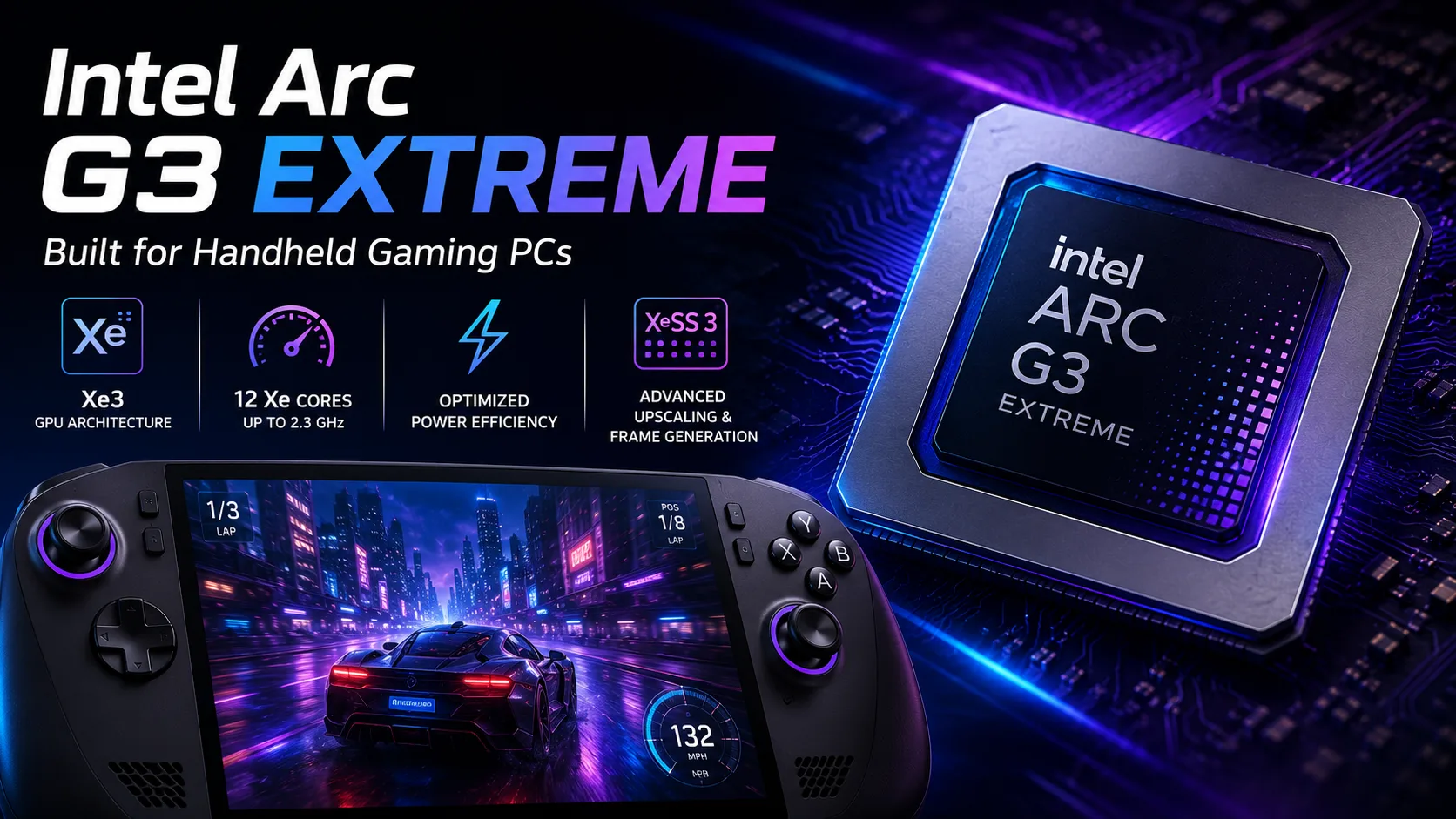
Intel Arc G3 Extreme: Xe3 vs Ryzen Z2 Extreme
AMD has been releasing specialized Ryzen Z processors for portable gaming PCs for several generations now. Intel, until now, has entered this segment with regular laptop Core Ultra chips: the first MSI Claw used Meteor Lake, while the next generation switched to Lunar Lake.
The Arc G3 Extreme changes the approach. It is Intel's first flagship processor for which the core configuration, integrated graphics, and power management are specifically designed for the portable gaming format. Instead of a universal mobile CPU, the company has prepared a separate platform directly aimed at AMD's Ryzen Z2 Extreme.
The processor features two performance P-cores, eight E-cores, and four low-power LP E-cores. The main focus is not on maximum CPU performance but on the integrated Arc B390 graphics with 12 Xe3 cores.
How Arc G3 Extreme Differs from Regular G3
| Specification | Intel Arc G3 Extreme | Intel Arc G3 |
|---|---|---|
| Maximum CPU Frequency | 4.7 GHz | 4.6 GHz |
| Integrated Graphics | Intel Arc B390 | Intel Arc B370 |
| Xe3 Graphic Cores | 12 | 10 |
| Maximum GPU Frequency | 2.3 GHz | 2.2 GHz |
The CPU configuration, cache size, and base power are the same for both models. The main difference with the Extreme model is the larger graphics capabilities. The regular G3 has 16.7% fewer Xe cores and a slightly lower maximum GPU frequency.
This does not mean there will be the same gap in gaming. The actual difference will depend on power limits, memory speed, cooling, and the settings of the specific device.
Why the Flagship Only Has Two P-Cores
For a regular high-performance laptop, two P-cores would seem odd. However, in a portable gaming PC, the CPU and GPU share a common power limit. The more power the CPU consumes, the less remains for the integrated graphics.
Intel refers to this kind of configuration as "right-sized compute." The P-cores handle the most latency-sensitive gaming workloads, E-cores take care of the remaining multithreaded tasks, and LP E-cores manage background processes and power-saving modes.
This setup is not ideal for rendering, compiling, or other lengthy CPU-heavy tasks. The goal of the Arc G3 Extreme is different: to provide sufficient CPU speed while leaving more headroom in the overall power limit for the Arc B390.
Arc B390 and LPDDR5X Memory
The integrated Arc B390 graphics feature 12 Xe3 cores operating at up to 2.3 GHz, hardware ray tracing, and support for DirectX 12 Ultimate.
It does not have its own video memory, meaning performance relies on the bandwidth of the shared RAM. The Arc G3 Extreme supports LPDDR5X-8533, which is particularly important for gaming at high resolutions and with large textures.
In practice, the outcome will depend on the implementation of the specific device. Even the same processor can yield different results depending on power limits, memory temperatures, and cooling capabilities.
XeSS 3 and Precompiled Shaders
XeSS 3 includes image scaling, frame generation, and Xe Low Latency technology. For a portable device, the scaling is especially beneficial: a game can be rendered at a reduced internal resolution and then upscaled to the screen resolution.
Frame generation increases displayed FPS but does not replace base performance. At low initial frame rates, control latency and possible graphical artifacts remain. Therefore, it is more accurate to first evaluate the Arc G3 Extreme without generation and then consider the results with XeSS.
Intel also claims support for new games with drivers at launch. For specific projects, the company plans to offer precompiled shaders aimed at reducing stutters during initial startup and gaming.
Benchmarks in Specific Devices
The Arc G3 Extreme has been most thoroughly tested in the MSI Claw 8 EX AI+. For comparison, results from the ASUS ROG Xbox Ally X and Lenovo Legion Go 2 on AMD Ryzen Z2 Extreme are shown below.
Both MSI Claw and ASUS were tested at a power limit of 35 Watts. The results pertain to finished devices, so some differences may depend not just on the processor but also on memory, cooling, and firmware settings.
| Device | Processor | Mode | 3DMark Steel Nomad Light | Cyberpunk 2077, 1080p Ultra | Baldur’s Gate 3, 1080p Ultra | Strange Brigade, 1080p Ultra |
|---|---|---|---|---|---|---|
| MSI Claw 8 EX AI+ | Intel Arc G3 Extreme | 35 W | 5,897 | 46.7 FPS | 49.5 FPS | 96.8 FPS |
| ASUS ROG Xbox Ally X | AMD Ryzen Z2 Extreme | 35 W | 3,331 | 28.0 FPS | 32.5 FPS | 58.8 FPS |
| Lenovo Legion Go 2 | AMD Ryzen Z2 Extreme | profile mode | 3,319 | 25.1 FPS | 30.7 FPS | 56.4 FPS |
In this sample, the MSI Claw significantly outperformed the ASUS ROG Xbox Ally X. The advantage is about 67% in Cyberpunk 2077, 52% in Baldur’s Gate 3, and 65% in Strange Brigade. In Steel Nomad Light, the score is higher by approximately 77%.
This does not mean that the Arc G3 Extreme will outperform the Ryzen Z2 Extreme by 50-70% in every game. The sample is limited, and specific projects may perform better on AMD architecture or be more dependent on drivers.
Nevertheless, the results indicate that the Arc B390 is noticeably superior to previous integrated solutions from Intel and can confidently compete with AMD’s flagship graphics for portable PCs.
What Happens When Power is Reduced
For a handheld device, peak performance at 35 W is less important than behavior at 15-25 W. It is here that choices must be made between FPS, heat, fan noise, and battery life.
In tests by ComputerBase, the Arc G3 Extreme maintained its advantage under the same power constraints. At 17 W, the Intel system scored a relative performance index of 72-73 points compared to 53-54 for the Ryzen Z2 Extreme.
Moreover, the MSI Claw at 17 W in this limited sample was faster than the ROG Xbox Ally X at 35 W. This is one of the most interesting results for the platform: the Arc B390 demonstrates a high level not only in peak mode but also when power consumption is reduced.
However, definitive conclusions will require a broader sampling of games and tests from other devices.
First Devices and High Price
The first mass-produced device with comprehensive independent tests is the MSI Claw 8 EX AI+. In addition, the Arc G3 Extreme is announced for the Acer Predator Atlas 8 and several ONEXPLAYER models.
For now, the main drawback of the platform is not performance, but price. The MSI Claw 8 EX AI+ costs around $1,799. At that price, one could already buy a full-fledged gaming laptop with discrete graphics that will be significantly faster in demanding games.
Of course, a laptop cannot replace a portable device in terms of size and convenience, but MSI’s price seriously limits its audience. The success of the Arc G3 Extreme will depend on whether Acer and One-Netbook can offer more affordable models without significantly reducing power and cooling quality.
Conclusion
The Intel Arc G3 Extreme is not a rebranded laptop processor but the company's first standalone flagship platform for portable gaming PCs. Intel limited the CPU section to two P-cores and made the integrated Arc B390 graphics the main focus.
In initial tests, the MSI Claw system significantly surpassed the ASUS ROG Xbox Ally X with the Ryzen Z2 Extreme. The advantage was maintained even at reduced power levels, which is more important for a portable device than a single peak figure at 35 W.
However, this level is currently confirmed only with the expensive MSI Claw. The true evaluation of the Arc G3 Extreme can be made after the release of Acer and ONEXPLAYER devices with different power limits, cooling, and price.
CPU Comparison
Compare Arc G3 Extreme with other CPUs
Basic
CPU Specifications
x4 PCIe4 (1x4, 2x2, 4x1)
x4 PCIe4 (1x4, 2x2, 4x1)
Memory Specifications
GPU Specifications
AI Specifications
Interfaces and Ports
Miscellaneous
Benchmarks
Compared to Other CPU
Related CPU Comparisons


Share in social media
Or Link To Us
<a href="https://cputronic.com/en/cpu/intel-arc-g3-extreme" target="_blank">Intel Arc G3 Extreme</a>