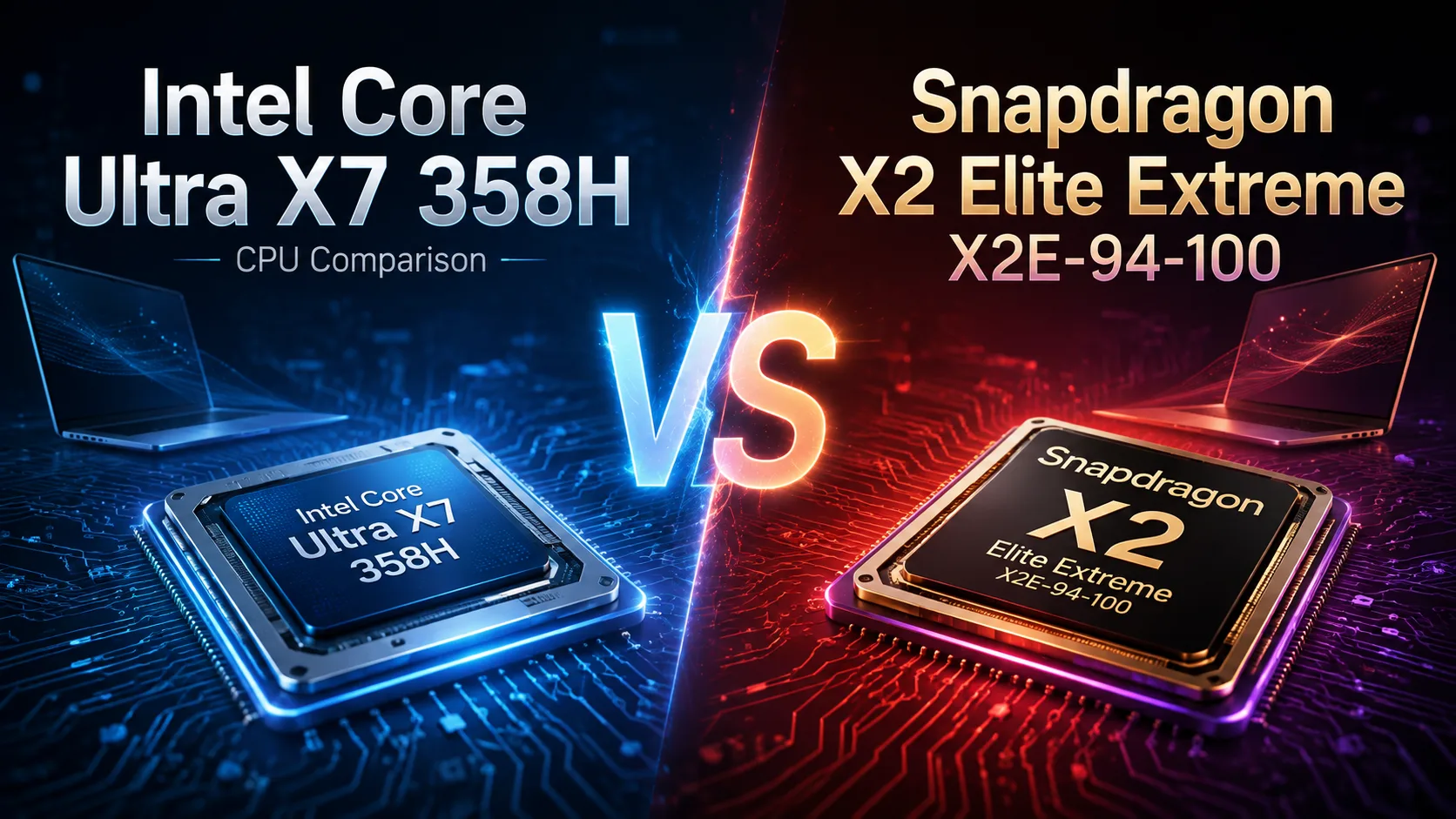
Intel Core Ultra X7 358H
vs
Qualcomm Snapdragon X2 Elite Extreme X2E-94-100
CPU Comparison Result
Intel Core Ultra X7 358H vs Snapdragon X2 Elite Extreme X2E-94-100: Snapdragon is Faster, Intel is More Versatile
The Intel Core Ultra X7 358H and the Snapdragon X2 Elite Extreme X2E-94-100 are aimed at powerful thin Windows laptops but are fundamentally different in architecture. Intel uses x86 with Arc B390 and has fewer compatibility issues. In contrast, Snapdragon employs ARM, which is noticeably faster in terms of CPU and offers an NPU with 80 TOPS.
In terms of pure CPU performance, Qualcomm is ahead by a significant margin. However, selecting a laptop is more complicated than that: the Core Ultra X7 358H is better suited for gaming, older Windows software, and scenarios where prior compatibility checks are impossible.
Key Differences
| Characteristic | Intel Core Ultra X7 358H | Qualcomm Snapdragon X2 Elite Extreme X2E-94-100 |
|---|---|---|
| Generation | Panther Lake / Core Ultra Series 3 | Snapdragon X2 Elite Extreme |
| CPU Architecture | x86-64, Cougar Cove + Darkmont | ARM64, Oryon 3rd Generation |
| Cores / Threads | 16 / 16 | 18 / 18 |
| Configuration | 4 P + 8 E + 4 LP E | 18 Oryon |
| Max Frequency | 4.8 GHz | 4.7 GHz |
| Cache | 18 MB | 53 MB |
| CPU Fabrication Process | Intel 18A | 3 nm |
| Memory | LPDDR5X-9600, up to 96 GB | LPDDR5X, up to 228 GB/s |
| Integrated Graphics | Intel Arc B390, 12 Xe Cores | Qualcomm Adreno X2-90 |
| GPU Frequency | Up to 2.5 GHz | Up to 1.85 GHz |
| NPU | 50 TOPS | 80 TOPS |
The Core Ultra X7 358H features 16 cores arranged in a 4P + 8E + 4 LP-E configuration with a frequency of up to 4.8 GHz. The integrated Arc B390 contains 12 Xe cores, while the NPU is rated at 50 TOPS.
The X2E-94-100 has 18 third-generation Oryon cores, a frequency of up to 4.7 GHz, 53 MB of cache, Adreno X2-90 graphics, and an NPU rated at 80 TOPS. Memory bandwidth reaches 228 GB/s.
Why Core Ultra X7 Differs from Regular Core Ultra 7
The Core Ultra X7 358H differs from standard Core Ultra 7 not just by its designation. In the Panther Lake lineup, the X models receive enhanced integrated graphics, with the X7 358H equipped with Arc B390 featuring 12 Xe cores.
The major hallmark of this processor is indeed the Arc B390, which is particularly interesting in thin laptops without a discrete graphics card.
Panther Lake significantly upgrades the CPU component. Intel has transitioned to P-cores (Cougar Cove) and E-cores (Darkmont), with the compute die produced using the Intel 18A fabrication process. The changes here go beyond a typical frequency and model refresh.
X2E-94-100 - Not the Fastest X2 Elite Extreme
X2 Elite Extreme is not yet a specific chip name: within the series, there are several versions. X2E-94-100 is positioned below the X2E-96-100.
Both processors use 18 Oryon cores, but the higher-end X2E-96-100 clocks up to 5.0 GHz, while the X2E-94-100 is limited to 4.7 GHz. Therefore, benchmarks of X2E-96-100 can give an inflated impression of the capabilities of X2E-94-100.
Confusion is quite possible: there are currently few laptops with Snapdragon X2, and the similar indices of X2E-94 and X2E-96 can easily be mistaken for one processor.
CPU Performance: Results from Specific Laptops
The performance of the Core Ultra X7 358H varies significantly from laptop to laptop, so it's essential to focus on specific models.
Currently, laptops with the X2E-94-100 are considerably fewer than those with the Core Ultra X7 358H. Results from X2E-88, X2E-90, and the faster X2E-96 are not included in the table.
| Laptop | Processor | Geekbench 6 Single | Geekbench 6 Multi |
|---|---|---|---|
| ASUS Zenbook A16 UX3607OA | Snapdragon X2 Elite Extreme X2E-94-100 | 3780 | 23 110 |
| Samsung Galaxy Book6 Pro | Core Ultra X7 358H | 2850 | 16 733 |
| Acer Swift 16 AI SF16-71T | Core Ultra X7 358H | 2818 | 15 395 |
| ASUS ExpertBook Ultra B9406CAA | Core Ultra X7 358H | 2744 | 15 742 |
In the comparison of the Zenbook A16 and Acer Swift 16 AI, Snapdragon is faster by approximately 34% in Single-Core and 50% in Multi-Core.
Even the Galaxy Book6 Pro with its best X7 358H score lags far behind Snapdragon, especially in multi-threaded scenarios.
Geekbench remains a synthetic benchmark, and here, different architectures-x86-64 and ARM64-are additionally compared. However, the discrepancy is too vast to attribute solely to the cooling or power limits of specific laptops. In terms of pure CPU performance, X2E-94-100 is significantly faster.
Integrated Graphics: Intel Makes a Comeback
The Core Ultra X7 358H features Arc B390 with 12 Xe cores, one of the standout features of the high-end Panther Lake.
The X2E-94-100 features an Adreno X2-90. While it is significantly faster than the first-generation Snapdragon X graphics, the Arc B390 still comes out ahead.
In 3DMark Steel Nomad Light, the ASUS ExpertBook Ultra with Arc B390 scored about 6153 points, while the ASUS Zenbook A16 with Adreno X2-90 scored around 5110. In this paired comparison, Intel is faster by approximately 20%.
Based on a single 3DMark score, one cannot judge all games, but the advantage of Arc B390 is evident here. Snapdragon's CPU advantage does not extend to graphics.
For gaming, Intel has another significant plus-its standard x86 platform and more mature Windows driver ecosystem. In contrast, with Snapdragon, the limitation may not be the speed of Adreno but the compatibility of specific games, anti-cheats, or APIs.
NPU: 80 vs 50 TOPS
The claimed performance of the NPU is as follows:
- Snapdragon X2E-94-100 - 80 TOPS;
- Core Ultra X7 358H - 50 TOPS.
Based on the claimed TOPS, Snapdragon has a 60% advantage.
However, a 60% advantage in TOPS does not equate to a 60% advantage in real-world AI tasks. Performance depends on the model, computation format, and specific NPU support. Intel can also leverage the Arc B390 for applications capable of AI computations through the GPU.
Battery Life: ARM No Longer Guarantees Victory
The first generation of Snapdragon X made battery life one of the main arguments for Windows on Arm. Panther Lake has significantly weakened this argument.
The Zenbook A16 with X2E-94-100 showcased around 17 hours and 43 minutes of video playback, whereas some laptops on Panther Lake exceed 20 hours.
This is not a direct comparison of processors, as display types, batteries, and power settings vary. However, ARM can no longer be automatically considered the more economical option.
Windows on Arm Has Improved, but x86 is Still Easier
The Snapdragon X2 can no longer be considered an experimental Windows platform. Browsers, Office, messengers, and many popular programs work fine, Windows 11 runs a large number of x86 applications via Prism, and the number of native ARM applications is increasing.
However, compatibility with x86 remains broader. Issues arise with certain games featuring anti-cheat systems, specialized programs, and hardware that requires specific drivers.
If the necessary programs and peripherals have been verified in advance, ARM does not pose significant problems. But for a "do-it-all" laptop, the Core Ultra X7 358H remains the more predictable choice: compatibility checks are usually unnecessary.
Conclusion: Snapdragon is Faster, Intel is More Versatile
In terms of pure CPU performance, the winner is the Snapdragon X2 Elite Extreme X2E-94-100. Its lead is especially pronounced in multi-threaded workloads.
The Core Ultra X7 358H excels in other areas: the Arc B390 is faster in graphics tests, while x86 is much simpler concerning compatibility.
If the primary programs have native ARM versions or work well through Prism, X2E-94-100 appears preferable: the CPU is significantly faster, and the NPU is more powerful.
If a laptop must work reliably with games, legacy software, and various peripherals without surprises, the Core Ultra X7 358H remains the more versatile option.
Qualcomm has already won the CPU race. The next challenge is to ensure that the advantages of ARM do not require customers to pre-check software, games, and hardware.
Advantages
- Newer Launch Date: December 2025 (December 2025 vs September 2025)
- More Total Cores: 18 (16 vs 18)
- Higher Technology: 3nm (Intel 18A vs 3nm)
Basic
CPU Specifications
Memory Specifications
GPU Specifications
AI Specifications
Connectivity
Interfaces and Ports
Miscellaneous
Benchmarks
Related CPU Comparisons



Share in social media
Or Link To Us
<a href="https://cputronic.com/en/cpu/compare/intel-core-ultra-x7-358h-vs-qualcomm-snapdragon-x2-elite-extreme-x2e-94-100" target="_blank">Intel Core Ultra X7 358H vs Qualcomm Snapdragon X2 Elite Extreme X2E-94-100</a>