Intel Core Ultra X7 358H
vs
Intel Core Ultra 7 356H
CPU Comparison Result
Intel Core Ultra X7 358H vs Core Ultra 7 356H: 100 MHz Difference in CPU and Huge Gap in Graphics
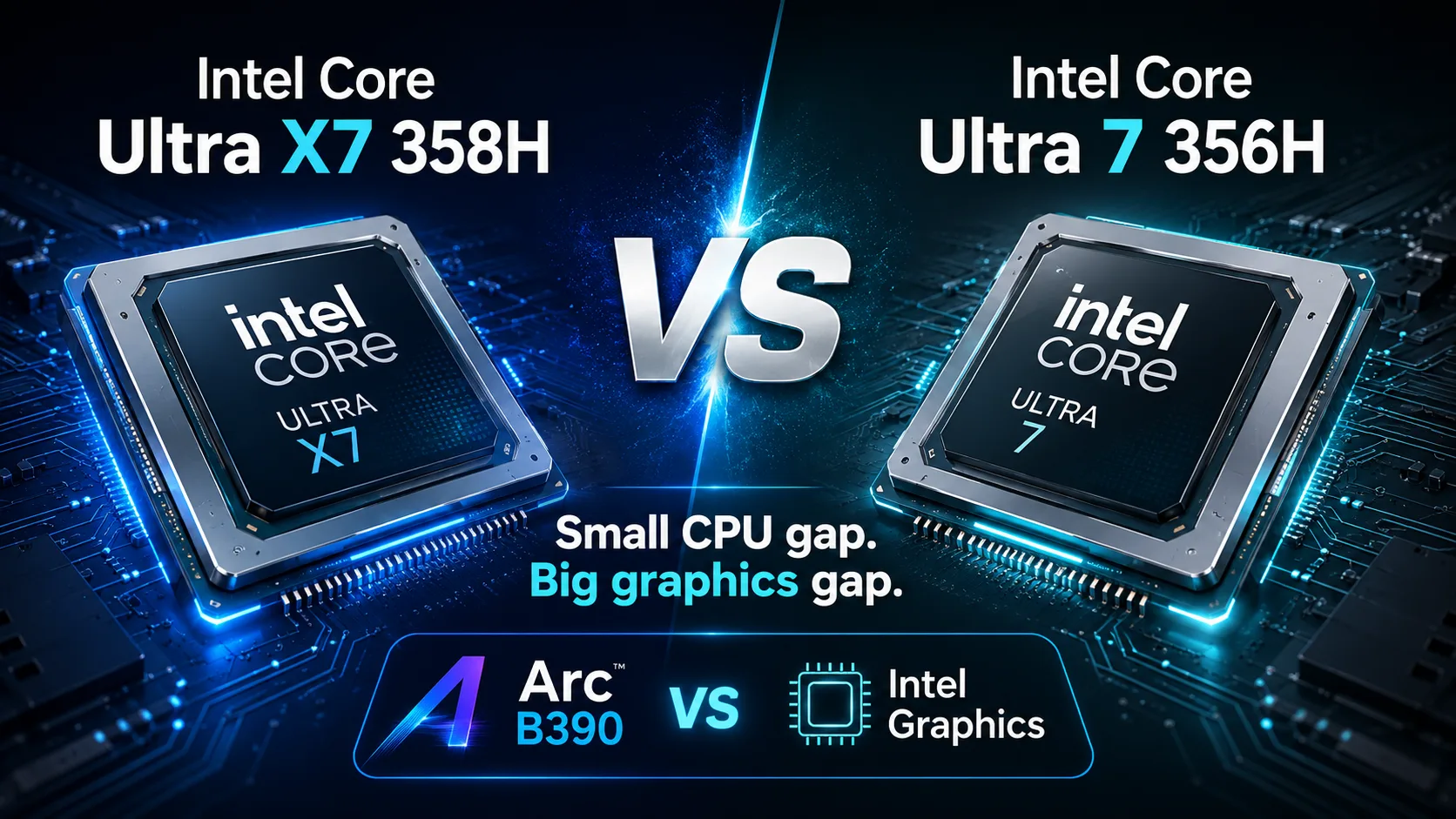
The Core Ultra X7 358H is technically older than the Core Ultra 7 356H, but they are separated by only 100 MHz in terms of CPU performance. Both Panther Lake processors feature 16 cores in a configuration of 4P + 8E + 4 LP-E, 18 MB of L3 cache, and a power limit of up to 80W. The clock frequency of the P-cores reaches 4.8 GHz in the X7 358H and 4.7 GHz in the 356H.
The main difference lies in the integrated graphics. The Core Ultra X7 358H is equipped with Arc B390 with 12 Xe-cores, while the Core Ultra 7 356H features Intel Graphics with four Xe-cores. In CPU benchmarks, the gap is small. In graphics performance, the situation is entirely different.
Key Differences
| Feature | Core Ultra X7 358H | Core Ultra 7 356H |
|---|---|---|
| Cores / Threads | 16 / 16 | 16 / 16 |
| Configuration | 4P + 8E + 4 LP-E | 4P + 8E + 4 LP-E |
| Max Turbo Frequency P-cores | 4.8 GHz | 4.7 GHz |
| L3 Cache | 18 MB | 18 MB |
| Base / Max Power | 25 / 80 W | 25 / 80 W |
| Integrated Graphics | Intel Arc B390 | Intel Graphics |
| Xe-cores GPU | 12 | 4 |
| GPU INT8 | 122 TOPS | 40 TOPS |
| NPU | 50 TOPS | 50 TOPS |
| Memory | LPDDR5X-9600 | LPDDR5X-8533, DDR5-7200 |
| Max Memory Capacity | 96 GB | 128 GB |
The CPU configuration, L3 cache size, and power limits are identical, with the X7 358H having a slight edge of just 100 MHz in maximum frequency.
The NPU in both processors is also the same - 50 TOPS. The X7 index does not imply higher performance of the neural processor. The main advantage of the X7 358H is the Arc B390.
CPU Performance in Real Laptops
For mobile processors, one cannot rely solely on average results. Power limits, cooling, and manufacturer settings can significantly impact performance, often more than the differences between adjacent CPUs.
| Processor | Laptop | Geekbench 6 Single-Core | Geekbench 6 Multi-Core |
|---|---|---|---|
| Core Ultra X7 358H | Dell XPS 14 (2026) | 2,890 | 16,745 |
| Core Ultra X7 358H | Dell XPS 16 (2026) | 2,839 | 16,975 |
| Core Ultra X7 358H | MSI Prestige 14 Flip AI+ | 2,864 | 16,633 |
| Core Ultra 7 356H | Samsung Galaxy Book6 Pro | 2,820 | 16,050 |
| Core Ultra 7 356H | Samsung Galaxy Book6 Ultra | 2,821 | 16,357 |
| Core Ultra 7 356H | HP OmniBook X 14 | 2,565 | 15,380 |
These results come from specific laptops, not fixed CPU specifications. Nonetheless, the gap between the 358H and 356H remains small.
The Dell XPS 16 with the X7 358H scores around 16,975 in Multi-Core, while the Galaxy Book6 Ultra with the 356H scores approximately 16,357. The difference is less than 4%. In Single-Core, it's even smaller.
The HP OmniBook X 14 demonstrates how much performance can depend on cooling and power limits. Its 356H significantly lags behind the Galaxy Book6 with the same CPU.
The additional 100 MHz yields only a slight increase. In most productivity tasks, distinguishing between the two processors without benchmarks may be challenging.
Arc B390 - The Main Advantage of the X7 358H
The Arc B390 in the Core Ultra X7 358H contains 12 Xe-cores, while the Core Ultra 7 356H has only four. The claimed INT8 performance also differs by about three times: 122 vs. 40 TOPS.
3DMark confirms the advantage of Arc B390.
| Processor and GPU | Device | 3DMark Time Spy Graphics |
|---|---|---|
| Core Ultra X7 358H, Arc B390 | MSI Prestige 14 Flip AI+ | ~6,980 |
| Core Ultra 7 356H, Intel Graphics | Samsung Galaxy Book6 Ultra | ~3,010 |
In Time Spy, the Arc B390 is more than twice as fast, which significantly impacts gaming performance.
Arc B390 allows for 1080p in modern games with moderate settings and provides GPU acceleration without a discrete graphics card. While it still trails behind modern GeForce RTX cards, among integrated GPUs, the Arc B390 stands out strongly.
Intel Graphics in the 356H is adequate for everyday tasks, multimedia, multiple monitors, and light gaming.
Laptops and Prices
The price of a laptop is not primarily determined by the processor. Models with the X7 358H range from about €1,800 to over €3,000.
| Processor | Laptop | Configuration | Price |
|---|---|---|---|
| Core Ultra X7 358H | MSI Prestige 14 Flip AI+ | 32 GB / 1 TB / OLED | ~€1,800 |
| Core Ultra X7 358H | Dell XPS 14 | 32 GB / 512 GB / 2K | ~€3,000 |
| Core Ultra X7 358H | Dell XPS 16 | 32 GB / 512 GB / 2K | ~€3,150 |
| Core Ultra 7 356H | Samsung Galaxy Book6 Pro 14 | 32 GB / 512 GB / OLED | ~€1,600 |
| Core Ultra 7 356H | HP OmniBook X 14 | 32 GB / 512 GB / OLED | ~€1,800 |
| Core Ultra 7 356H | Samsung Galaxy Book6 Ultra | 32 GB / 512 GB / RTX 5060 | ~€3,100 |
Prices vary by country and configuration. The X7 designation does not provide significant insight into a laptop's cost.
The MSI Prestige 14 Flip AI+ shows that the X7 358H can also be found in laptops for around €1,800, not just in premium models over €3,000. If the pricing is close, the Arc B390 makes the version with the X7 358H noticeably more appealing.
The Dell XPS 14 and XPS 16 are significantly more expensive, even though they use the same X7 358H. The price difference is determined by the display, materials, construction, and positioning of the series, rather than the processor itself.
The Galaxy Book6 Ultra with the 356H also costs over €3,000, but is equipped with a GeForce RTX 5060. With an RTX 5060, the difference between integrated GPUs becomes nearly irrelevant.
What to Choose
With a discrete graphics card, the main advantage of the X7 358H nearly vanishes. CPU performance in models is comparable, the NPU is the same, and the discrete graphics card handles the graphical load.
In this case, it's more important to assess the GPU, cooling, display, memory, and price. In such laptops, the Core Ultra 7 356H suffers very little compared to the X7 358H in CPU performance.
Without a discrete graphics card, the choice heavily leans towards the X7 358H. If two laptops are similar in other specifications and pricing, the Arc B390 becomes a significant advantage.
This discussion is no longer about a few percentage points in CPU performance, but rather a more than twofold advantage in Time Spy. Paying extra for the X7 358H is particularly warranted for its graphics.
If the price difference is in the hundreds of euros, the comparison should be made at the laptop level.
Conclusion
The X7 358H delivers only a small performance boost in terms of CPU, but the Arc B390 changes the nature of the comparison. Both processors feature the same number of cores and an identical NPU, and the differences between well-optimized implementations in Geekbench typically amount to a few percent.
Moreover, the Arc B390 is over twice as fast in graphics performance in Time Spy compared to the 356H. At similar prices for models without a separate graphics card, the X7 358H appears more favorable.
If a laptop already has a GeForce RTX card, the difference between the processors becomes secondary. Therefore, choosing between such models solely based on processor name is unwise: the price and capabilities stem from the entire laptop, not the X7 index.
Advantages
- Higher Performance-core Max Turbo Frequency: 4.8 GHz (4.8 GHz vs 4.7 GHz)
- Higher Technology: 2 nm (Intel 18A vs 2 nm)
- Newer Launch Date: January 2026 (December 2025 vs January 2026)
Basic
CPU Specifications
Memory Specifications
GPU Specifications
Interfaces and Ports
Benchmarks
Related CPU Comparisons





Share in social media
Or Link To Us
<a href="https://cputronic.com/en/cpu/compare/intel-core-ultra-x7-358h-vs-intel-core-ultra-7-356h" target="_blank">Intel Core Ultra X7 358H vs Intel Core Ultra 7 356H</a>