Intel Core 5 210H
vs
AMD Ryzen 5 150

CPU Comparison Result
Intel Core 5 210H vs AMD Ryzen 5 150: Which One to Choose for a Laptop or Mini-PC
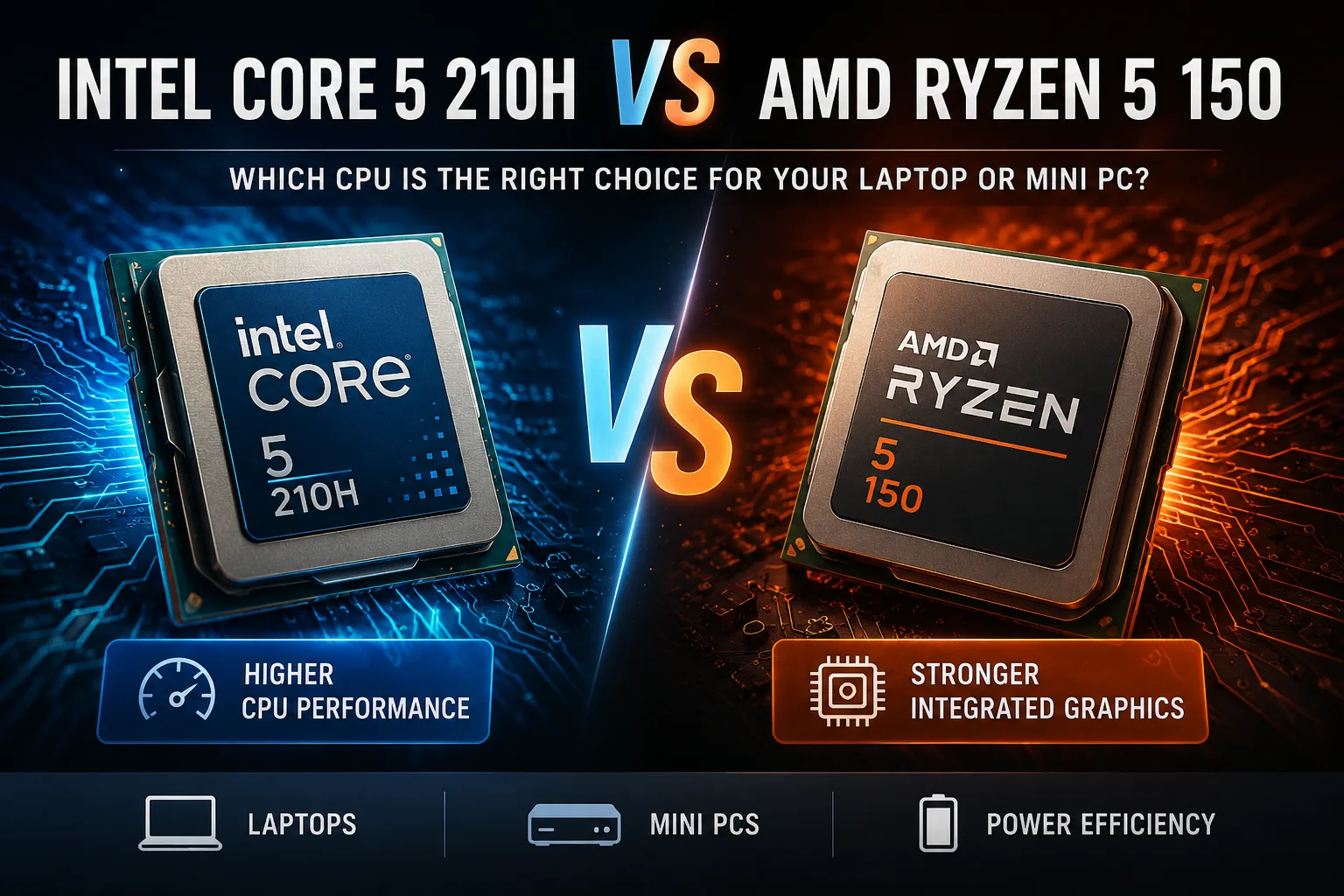
Intel Core 5 210H and AMD Ryzen 5 150 are two mid-range mobile processors, but with different focuses. Core 5 210H emphasizes higher CPU performance, hybrid architecture, and a high turbo mode. AMD Ryzen 5 150 offers a more balanced platform and significantly stronger integrated graphics with Radeon 660M.
The main question here is simple: Do you need maximum CPU performance or a more practical option without a discrete graphics card?
Quick Summary
Intel Core 5 210H is better suited for tasks where CPU power is crucial: office work with many tabs, compiling, photo processing, multitasking, educational, and work applications. It makes particular sense in laptops with good cooling and a mid-range discrete graphics card.
AMD Ryzen 5 150 is more interesting if the laptop or mini-PC is purchased without a discrete graphics card. Its CPU performance is slightly weaker, but the integrated Radeon 660M performs significantly better for light gaming, older projects, multimedia, and everyday graphics.
To put it simply: Core 5 210H is stronger as a CPU, while Ryzen 5 150 is more practical as an APU.
Key Differences
| Feature | Intel Core 5 210H | AMD Ryzen 5 150 |
|---|---|---|
| Main focus | higher CPU performance | stronger integrated graphics |
| Architecture | Raptor Lake | Zen 3+ |
| Core configuration | 4 performance + 4 efficiency cores | 6 identical Zen 3+ cores |
| Cores / Threads | 8 / 12 | 6 / 12 |
| Max frequency | up to 4.8 GHz | up to 4.55 GHz |
| L3 cache | 12 MB | 16 MB |
| Load behavior | may be faster but relies more on cooling | usually more predictable in compact systems |
| Turbo limit / cTDP | up to 115 W in Turbo | 35-54 W |
| Integrated graphics | Intel Graphics 48 EU | Radeon 660M |
| Gaming without discrete card | weaker | noticeably better |
| Memory | DDR5, DDR4, LPDDR5/x, LPDDR4x | DDR5 / LPDDR5 |
| Best scenario | laptop with good cooling and discrete GPU | laptop or mini-PC without discrete graphics |
The table clearly illustrates the main essence of the comparison: Core 5 210H focuses on CPU performance, while Ryzen 5 150 emphasizes a more balanced platform with strong integrated graphics. Therefore, the choice should not be based solely on CPU benchmarks, but on the type of device: whether there will be a discrete graphics card, how good the cooling is, and how important light gaming is without a separate GPU.
The Ryzen 5 150 is close in specifications to mobile Ryzen 5 based on Rembrandt / Rembrandt Refresh. This is not a new architecture, but still a successful platform for budget laptops and compact systems.
CPU Performance
In CPU tasks, the advantage often lies with Intel Core 5 210H. According to open benchmark databases, it is generally faster than Ryzen 5 150 in single-threaded loads and slightly ahead in multi-threaded tasks.
| Benchmark | Intel Core 5 210H | AMD Ryzen 5 150 | Difference |
|---|---|---|---|
| Geekbench 6 Single-Core | around 2400 | around 2000 | Intel is about 20% faster |
| Geekbench 6 Multi-Core | around 9500 | around 8450 | Intel is about 10-15% faster |
| PassMark CPU Mark | around 18,300 | around 17,800 | negligible difference |
Here, it's important not to overrate the dry numbers. In laptops, final performance heavily depends on cooling, power limits, and manufacturer settings. The Core 5 210H can be noticeably faster in a good case, but in a thin laptop with limited power, its advantage may diminish.
Ryzen 5 150 cannot be called weak either. Its 6 cores and 12 threads are sufficient for office work, browsing, studying, programming, basic editing, and most everyday tasks. However, if maximum CPU performance in this class is needed, Core 5 210H appears stronger.
Integrated Graphics
In graphics, the situation shifts in favor of AMD Ryzen 5 150. The Radeon 660M is significantly stronger than integrated Intel Graphics 48 EU in Core 5 210H. This is especially important if the device is purchased without a discrete graphics card.
The Radeon 660M is suitable for light online gaming, older projects, simple graphical tasks, interface acceleration, video, and basic editing. It doesn’t turn the Ryzen 5 150 into a gaming processor, but as integrated graphics, it looks much more convincing.
Approximate benchmark for 3DMark Time Spy Graphics:
| Integrated Graphics | Approximate Result |
|---|---|
| Radeon 660M | around 1500-1700 |
| Intel Graphics 48 EU | around 800-1000 |
However, Ryzen 5 150 has an important nuance: Radeon 660M heavily depends on memory. Fast dual-channel DDR5 or LPDDR5 is needed for normal performance. In single-channel mode or with slow memory, the advantage of AMD's integrated graphics may significantly decline.
Gaming
If the laptop will have a discrete graphics card, the advantage of Ryzen 5 150 in integrated graphics loses almost all significance. In this scenario, CPU performance, cooling, and the discrete GPU itself become more important. Here, Core 5 210H appears more desirable.
Without a discrete graphics card, Ryzen 5 150 is significantly more interesting: the Radeon 660M is better suited for light online games, older projects, and undemanding AAA games on low settings. This can include Dota 2, League of Legends, Minecraft, and other projects where stable base performance matters more than maximum graphics quality.
With CS2 and other modern heavy games, it’s best to be cautious: launching may not always be comfortable, and results will heavily depend on memory, resolution, cooling, and graphics settings.
Power Consumption and Cooling
Both processors belong to the powerful mobile class but behave differently.
Intel Core 5 210H can briefly consume significantly more power in turbo mode. Therefore, it benefits from good cooling. In a large laptop, this is a plus: the processor can maintain higher frequencies longer. In a thin case, this may turn into a downside: noise, heating, and quick frequency drop.
AMD Ryzen 5 150 appears more predictable. Its 35-54 W range is easier to cool, especially in compact laptops and mini-PCs. It won’t necessarily be cooler in any system, but overall requires less aggressive cooling for stable operation.
Which One to Choose
Choose Intel Core 5 210H if:
- maximum CPU performance is essential;
- the laptop is for work, study, coding, photo processing, office tasks, and multitasking;
- the device has a mid-range discrete graphics card;
- the case is not too thin and cooling is not compromised;
- games will run through a separate GPU rather than integrated graphics.
Choose AMD Ryzen 5 150 if:
- the laptop or mini-PC will be without a discrete graphics card;
- stronger integrated graphics are important;
- light gaming without a separate GPU is needed;
- you want a balanced system for everyday tasks;
- moderate power consumption and good battery life are essential;
- the price of the device with Ryzen is significantly lower.
Conclusion
Intel Core 5 210H is faster as a processor, making it sensible to choose for a laptop with good cooling and a mid-range discrete graphics card. In such a setup, integrated graphics are almost irrelevant, and Intel’s higher CPU performance shines in work tasks, games with a separate GPU, and multitasking.
AMD Ryzen 5 150 seems more interesting in a device without a discrete graphics card. Its CPU part is slightly weaker, but the Radeon 660M makes the laptop significantly more pleasant for light gaming, everyday graphics, and multimedia tasks. This processor particularly excels in a compact laptop or mini-PC, where balance, moderate power consumption, and decent integrated graphics without a separate GPU are essential.
If you need a laptop with a discrete graphics card, it's more logical to look towards Intel Core 5 210H. If a more autonomous and balanced laptop without separate graphics is needed, AMD Ryzen 5 150 might be the more practical choice.
Advantages
- More Total Cores: 8 (8 vs 6)
- Larger L3 Cache: 16 MB (12 MB shared vs 16 MB)
- Higher Technology: TSMC 6nm FinFET (10 nm vs TSMC 6nm FinFET)
- Newer Launch Date: October 2025 (December 2024 vs October 2025)
Basic
CPU Specifications
Memory Specifications
GPU Specifications
Interfaces and Ports
Miscellaneous
Benchmarks
Related CPU Comparisons





Share in social media
Or Link To Us
<a href="https://cputronic.com/en/cpu/compare/intel-core-5-210h-vs-amd-ryzen-5-150" target="_blank">Intel Core 5 210H vs AMD Ryzen 5 150</a>