AMD Ryzen AI 7 445
vs
Intel Core Ultra 7 258V


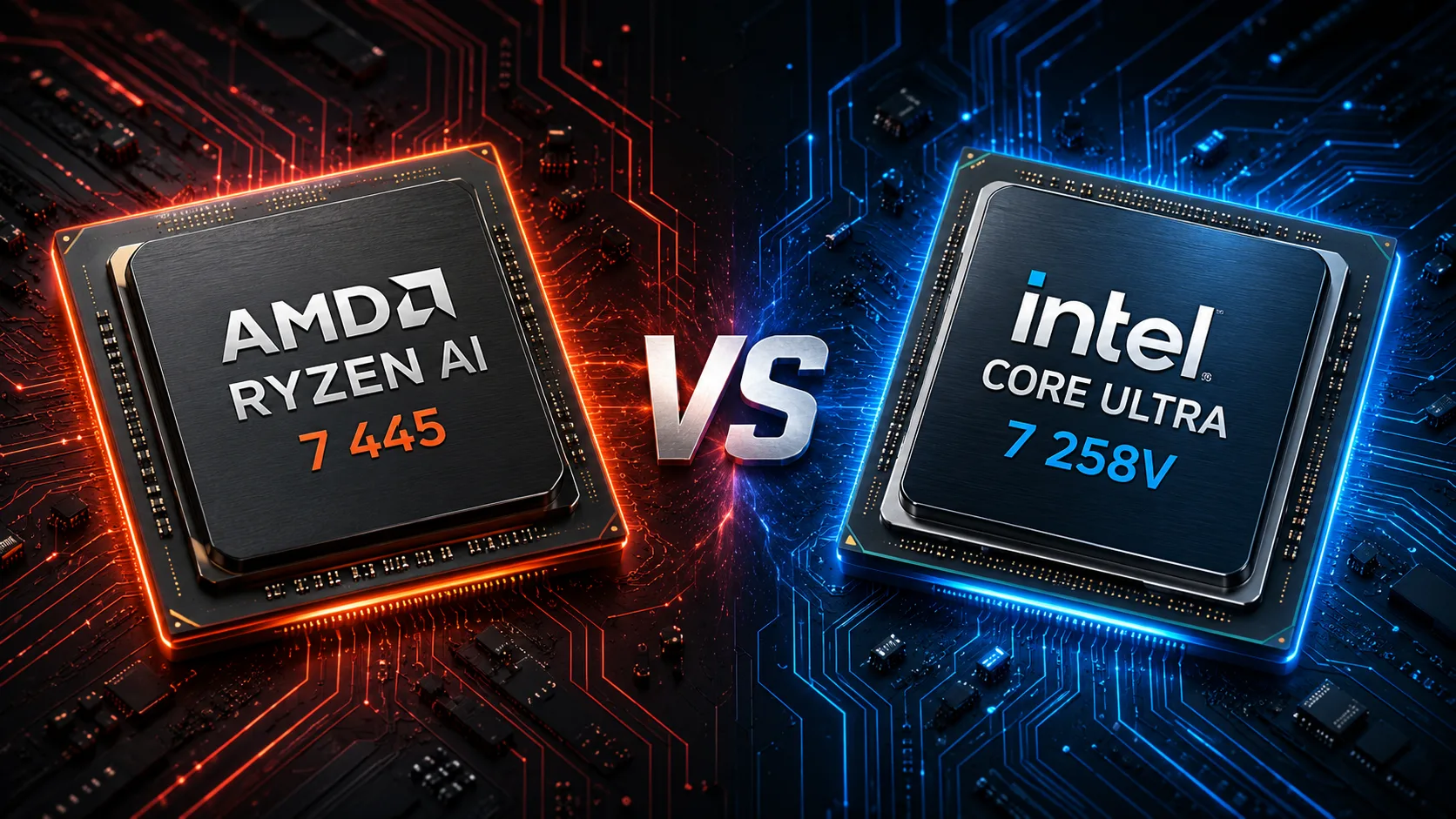
CPU Comparison Result
AMD Ryzen AI 7 445 vs Intel Core Ultra 7 258V: Threads vs Strong Integrated Graphics
The AMD Ryzen AI 7 445 and Intel Core Ultra 7 258V are designed for thin laptops with local AI acceleration, but they are aimed at different tasks. AMD offers 12 computational threads, a wide power range, and more flexible memory options. Intel counters with an efficient Lunar Lake platform, 32 GB of fast integrated memory, and significantly more powerful Arc 140V graphics.
Thus, the Core Ultra 7 258V appears stronger in a general-purpose laptop without a discrete graphics card. The Ryzen AI 7 445 is more interesting for work tasks that require a focus on threads, sustained loads, and memory capacity.
Key Differences
| Characteristic | AMD Ryzen AI 7 445 | Intel Core Ultra 7 258V |
|---|---|---|
| Cores / Threads | 6 / 12 | 8 / 8 |
| CPU Architecture | 2 × Zen 5 + 4 × Zen 5c | 4 × P-core + 4 × LP E-core |
| Max Clock Speed | 4.6 GHz | 4.8 GHz |
| L3 Cache | 8 MB | 12 MB |
| Base Power | 28 W | 17 W |
| Configurable Range | 15-54 W | Up to 37 W in turbo mode |
| Integrated Graphics | Radeon 840M | Arc 140V |
| NPU Performance | 50 TOPS | 47 TOPS |
| Memory | DDR5 / LPDDR5X, depends on laptop | 32 GB LPDDR5X-8533 |
| Maximum Capacity | Theoretically up to 256 GB | 32 GB |
Power consumption figures cannot be directly compared: AMD and Intel use different methodologies, and laptop manufacturers set their own power limits and cooling. However, Ryzen allows for more aggressive modes, while the Core Ultra 7 258V is designed for compact and efficient devices.
CPU Performance
The Ryzen AI 7 445 features two full-sized Zen 5 cores and four compact Zen 5c cores. All six cores support SMT, allowing the processor to execute 12 threads simultaneously. The maximum clock speed of the main cores is 4.6 GHz, with an L3 cache of 8 MB.
The Core Ultra 7 258V uses four high-performance Lion Cove cores and four energy-efficient Skymont cores. Hyper-Threading is absent, so the eight physical cores correspond to eight threads. The maximum clock speed reaches 4.8 GHz, and the L3 cache is increased to 12 MB.
No decisive winner can be declared based solely on specifications. Intel has more physical cores, a higher peak clock speed, and a larger cache. AMD counters with 12 threads and a higher allowable power limit.
In prolonged rendering, compilation, and batch processing, Ryzen may scale better, especially in a laptop with effective cooling. However, the advantage is not guaranteed: the outcome depends on power limits, manufacturer settings, and specific software.
For web browsing, office applications, video calls, and typical multitasking, both processors are sufficient. In such scenarios, the difference between specific laptops-cooling quality, storage speed, and power settings-is often more crucial than the difference between the chips themselves.
Integrated Graphics: Clear Advantage for Intel
The Ryzen AI 7 445 is equipped with a Radeon 840M featuring four compute units. This is the lower-tier integrated graphics within the family. It is suitable for video playback, multiple display setups, casual online gaming, and older titles at low settings.
The Core Ultra 7 258V features the Arc 140V with eight Xe-cores. It is one of the most powerful integrated graphics systems of its generation. It is designed not only for interfaces and video but also for modern gaming at reasonable settings, video editing, image processing, and GPU-accelerated applications.
The number of blocks from AMD and Intel cannot be directly compared, but the Arc 140V and Radeon 840M belong to different classes. In a laptop without a discrete graphics card, Intel gains the most significant advantage in this comparison.
The main limitation of the Ryzen AI 7 445 remains its graphics. Additional CPU threads do not compensate for the weak Radeon 840M in gaming, 3D applications, and tasks that heavily utilize the GPU.
NPU and Local AI Features
The Ryzen AI 7 445 offers an NPU with a performance of up to 50 TOPS. The Core Ultra 7 258V is rated for up to 47 TOPS. Both processors meet the requirements of Copilot+ PC and are capable of accelerating compatible AI functions without constant cloud access.
The advantage of AMD is only 3 TOPS and does not significantly impact laptop choice. Real speed depends on program optimization, neural network format, drivers, and specific NPU support.
Overall performance figures for CPU, GPU, and NPU also provide little help in comparisons. Different manufacturers calculate them using different methods, and applications rarely utilize all compute blocks simultaneously.
Memory: AMD's Flexibility vs Intel's Integration
The Ryzen AI 7 445 supports DDR5-5600 and LPDDR5X-8000. The memory controller theoretically allows for up to 256 GB, but the actual limit is determined by the laptop's design. In thin models, the memory may be fully soldered and not user-replaceable, so the possibility of upgrading needs to be checked separately.
The Core Ultra 7 258V comes with 32 GB of LPDDR5X-8533 integrated next to the computing chips in a single package. This design reduces power consumption and simplifies the motherboard layout, but increasing the memory capacity is not possible.
For most ultrabooks, 32 GB is more than enough. However, virtual machines, large projects, professional data processing, and heavy multitasking may require more capacity. In such configurations, the AMD platform gives manufacturers more freedom.
Which Processor to Choose
AMD Ryzen AI 7 445 is better suited when the following are important:
- 12 computational threads;
- long multi-threaded workloads;
- the ability to obtain more than 32 GB of memory;
- a laptop with higher power limits;
- having a discrete graphics card or low requirements for integrated graphics.
Intel Core Ultra 7 258V is preferable when the following are needed:
- powerful integrated graphics;
- gaming without a discrete graphics card;
- a compact and quiet laptop;
- low power consumption;
- 32 GB of fast memory in standard configuration.
Conclusion
AMD Ryzen AI 7 445 wins in thread count and platform flexibility. It is more suitable for a work laptop where sustained computing, large memory capacity, or a discrete graphics card are important.
Intel Core Ultra 7 258V is better balanced for a thin all-purpose model. The Arc 140V is significantly more powerful than the Radeon 840M, 32 GB of fast memory is already part of the platform, and the Lunar Lake architecture is focused on moderate power consumption.
At a comparable price and without a discrete graphics card, the Core Ultra 7 258V is a stronger choice. The Ryzen AI 7 445 makes sense for those seeking 12 threads, an expanded memory configuration, or a laptop with a higher power limit.
Advantages
- Newer Launch Date: January 2026 (January 2026 vs October 2024)
- More Total Cores: 8 (6 vs 8)
- Larger L3 Cache: 12 MB (8 MB vs 12 MB)
Basic
CPU Specifications
Memory Specifications
GPU Specifications
Miscellaneous
Benchmarks
Related CPU Comparisons




Share in social media
Or Link To Us
<a href="https://cputronic.com/en/cpu/compare/amd-ryzen-ai-7-445-vs-intel-core-ultra-7-258v" target="_blank">AMD Ryzen AI 7 445 vs Intel Core Ultra 7 258V</a>