AMD Ryzen 9 8940H
vs
Intel Core i7-14650HX
CPU Comparison Result
AMD Ryzen 9 8940H vs Intel Core i7-14650HX: Two Different Approaches to Powerful Laptops
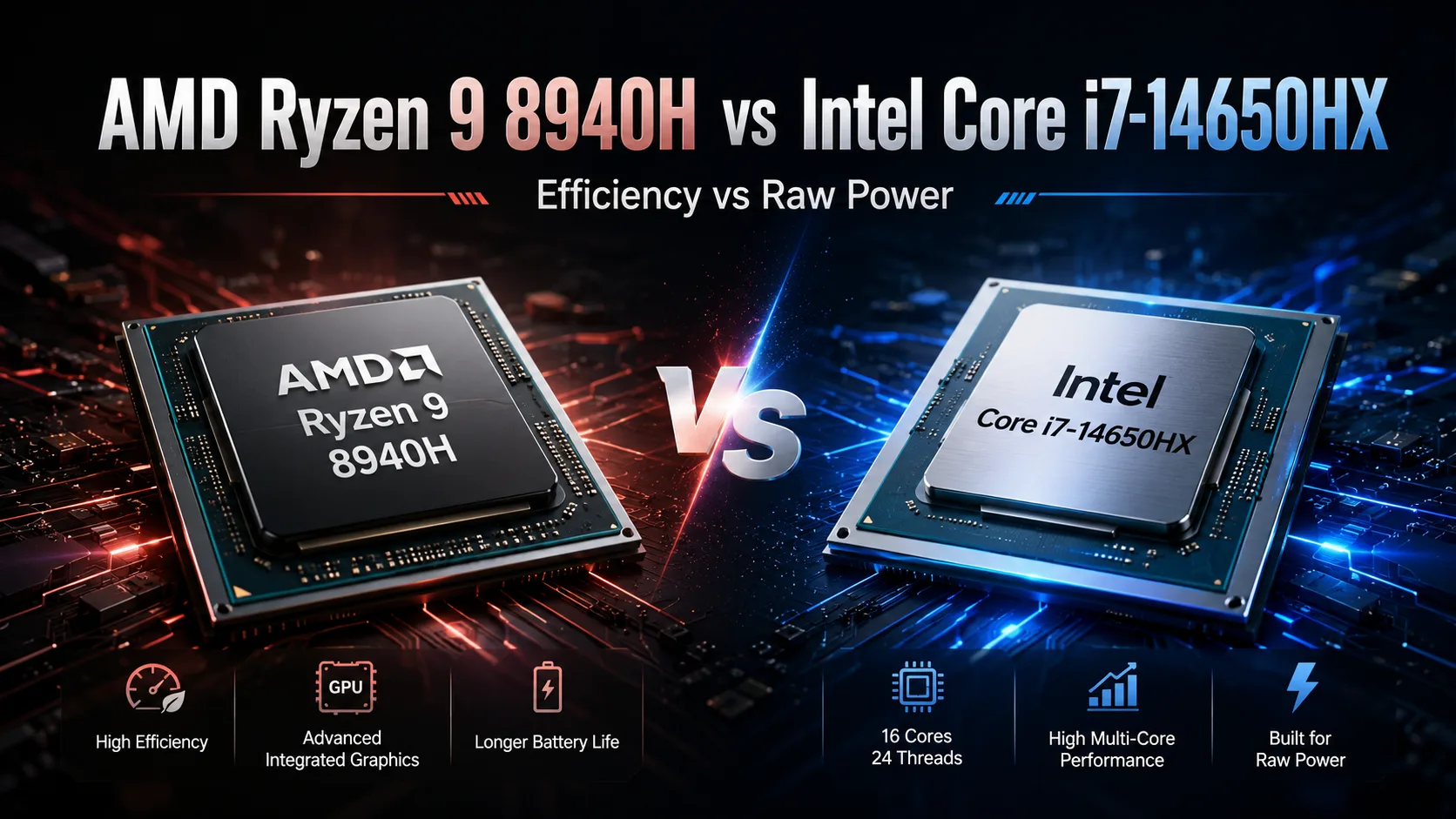
The AMD Ryzen 9 8940H and Intel Core i7-14650HX made their debut in early configurations of gaming laptops for 2024, but they represent two completely different approaches. AMD offers eight powerful Zen 4 cores, strong integrated graphics, and relatively moderate power consumption. Intel responds with a 16-core hybrid configuration, a high power limit, and a noticeably greater headroom in prolonged multi-threaded tasks.
However, there is an important caveat to this comparison. The Ryzen 9 8940H appears to be an early designation for a processor that has already entered mass production under a different name. The model was mentioned in preliminary materials from ASUS, while the current page for the TUF Gaming A15 and its configuration table indicate the Ryzen 9 8945H with the same baseline parameters: 8 cores, 16 threads, a frequency of up to 5.2 GHz, and integrated NPU. AMD has not published a separate page for the Ryzen 9 8940H. Most likely, we are looking at a pre-production name for the Ryzen 9 8945H or a close variant, the Ryzen 9 8945HS, rather than a standalone mass-market processor.
Key Differences
| Feature | AMD Ryzen 9 8940H | Intel Core i7-14650HX |
|---|---|---|
| Architecture | Zen 4, Hawk Point | Raptor Lake-HX Refresh |
| Cores / Threads | 8 / 16 | 16 / 24 |
| Configuration | 8 identical cores | 8 P-cores + 8 E-cores |
| Max Frequency | up to 5.2 GHz | up to 5.2 GHz |
| L2 + L3 Cache | 24 MB | 30 MB Smart Cache |
| Integrated Graphics | Radeon 780M | Intel UHD Graphics, 16 EU |
| Memory | DDR5-5600, likely LPDDR5X-7500 | DDR5-5600 or DDR4-3200 |
| Base Power | approximately 45 W | 55 W |
| Max Power | depends on laptop configuration | up to 157 W |
| NPU | AMD XDNA, up to 16 TOPS | no dedicated NPU |
The specifications of the Ryzen 9 8940H have to be reconstructed from early laptops and its mass-produced relatives. The official Ryzen 9 8945HS features eight Zen 4 cores, 16 threads, frequencies of 4.0-5.2 GHz, 24 MB total cache, Radeon 780M, and support for DDR5-5600 or LPDDR5X-7500. Its standard TDP is 45 W, with a configurable range of 35-54 W. For the 8940H, the 45 W figure seems most plausible, but AMD has not provided separate confirmation.
Architecture and Performance
The Ryzen 9 8940H uses eight identical cores with SMT support. This design is simple for the operating system scheduler and predictably performs well in gaming, office applications, and most professional software. All 16 threads are based on the full-fledged Zen 4 cores, and the maximum frequency reaches 5.2 GHz.
The Core i7-14650HX is more complicated. It combines eight powerful P-cores with Hyper-Threading support and eight compact E-cores. As a result, Intel achieves 16 physical cores and 24 threads. The frequency of the P-cores also reaches 5.2 GHz, while the E-cores clock up to 3.7 GHz.
In short workloads, the gap between the processors may be small. Both have high single-threaded performance, allowing them to handle everyday applications, photo processing, web browsing, and most games quickly.
In extended rendering, compilation, archiving, or video encoding, the advantage typically shifts to the Core i7-14650HX. The additional E-cores significantly enhance its multi-threaded performance. These are not equal-class processors: Intel HX essentially falls into the category of mobile counterparts to desktop solutions, while AMD is closer to a universal high-performance chip for thinner laptops.
Gaming Performance
With a discrete GPU like the GeForce RTX 4060 or RTX 4070, both processors deliver adequate gaming performance. The difference is more pronounced at lower resolutions and high frame rates, where the load hits the CPU. In such cases, the Core i7-14650HX can achieve a higher ceiling, especially if its cooling allows it to maintain higher power for longer.
At 1440p resolution, the primary load often shifts to the GPU, reducing the differences between the processors. The GPU's TGP, cooling system, dual-channel memory, and selected performance profile become much more significant.
AMD has a significant advantage outside of gaming with discrete graphics. The Radeon 780M features 12 RDNA 3 graphics blocks and operates at a frequency of up to 2.8 GHz in the official Ryzen 9 8945HS. It is suitable for less demanding games, hardware video decoding, and allowing the laptop to operate without constantly relying on a discrete GPU.
The Intel UHD Graphics with 16 execution units is significantly weaker. It is primarily intended for image output, video, and basic tasks. The main limitation of the Core i7-14650HX without a discrete GPU remains its integrated graphics.
Power Consumption and Cooling
The Core i7-14650HX has a base power of 55W and a maximum turbo power of 157W. This allows the processor to maintain high performance for extended periods but requires a substantial cooling system. Laptops based on it are usually larger, noisier under load, and heavily reliant on being plugged in.
The Ryzen 9 8940H, if considered as an early variant of the Ryzen 9 8945H or 8945HS, should operate approximately in the 45W class. It has fewer cores, but its cooling requirements are significantly lower. This enables manufacturers to create more compact designs with acceptable performance and better efficiency.
The specific outcome will still depend on the laptop. An aggressively tuned Ryzen may end up running hotter than an economically tuned Intel, while a large battery could offset high energy consumption. Therefore, assessing battery life based solely on the processor name is not feasible.
Which Processor is Better
Choose Intel Core i7-14650HX if:
- The laptop will be used for rendering, editing, and compiling;
- Maximum multi-threaded performance is required;
- The device primarily operates while plugged in;
- A powerful discrete GPU is installed.
AMD Ryzen 9 8940H is preferable if:
- Performance per watt and moderate heating are important;
- Strong integrated graphics are needed;
- The laptop should remain relatively compact;
- Heavy multi-threaded tasks are not a primary scenario.
Conclusion
The Core i7-14650HX is significantly stronger in prolonged multi-threaded loads, but it achieves this at the cost of high power consumption. It is a processor for large gaming and workstation laptops with serious cooling.
The Ryzen 9 8940H offers a more balanced combination of performance, integrated graphics, and efficiency. However, it should not be viewed as a standalone model. Judging by ASUS materials and the absence of a page on AMD’s website, the Ryzen 9 8940H was an early designation for a chip that entered mass production as the Ryzen 9 8945H or a close variant, the Ryzen 9 8945HS.
Thus, this comparison primarily reflects the rivalry between the mobile eight-core Hawk Point and the more powerful Intel HX. For a heavy workstation, the Core i7-14650HX is better. For a versatile laptop with lower heat output and strong integrated graphics, AMD is the wiser choice.
Advantages
- Higher Technology: 4 nm (4 nm vs 10 nm)
- More Total Cores: 16 (8 vs 16)
- Larger L3 Cache: 30 MB (shared) (16MB vs 30 MB (shared))
- Newer Launch Date: January 2024 (January 2024 vs January 2024)
Basic
CPU Specifications
Memory Specifications
GPU Specifications
Interfaces and Ports
Benchmarks
Related CPU Comparisons



Share in social media
Or Link To Us
<a href="https://cputronic.com/en/cpu/compare/amd-ryzen-9-8940h-vs-intel-core-i7-14650hx" target="_blank">AMD Ryzen 9 8940H vs Intel Core i7-14650HX</a>