AMD Ryzen 7 260
vs
AMD Ryzen 9 8940HX
CPU Comparison Result
AMD Ryzen 7 260 vs AMD Ryzen 9 8940HX: Balance vs Maximum Power
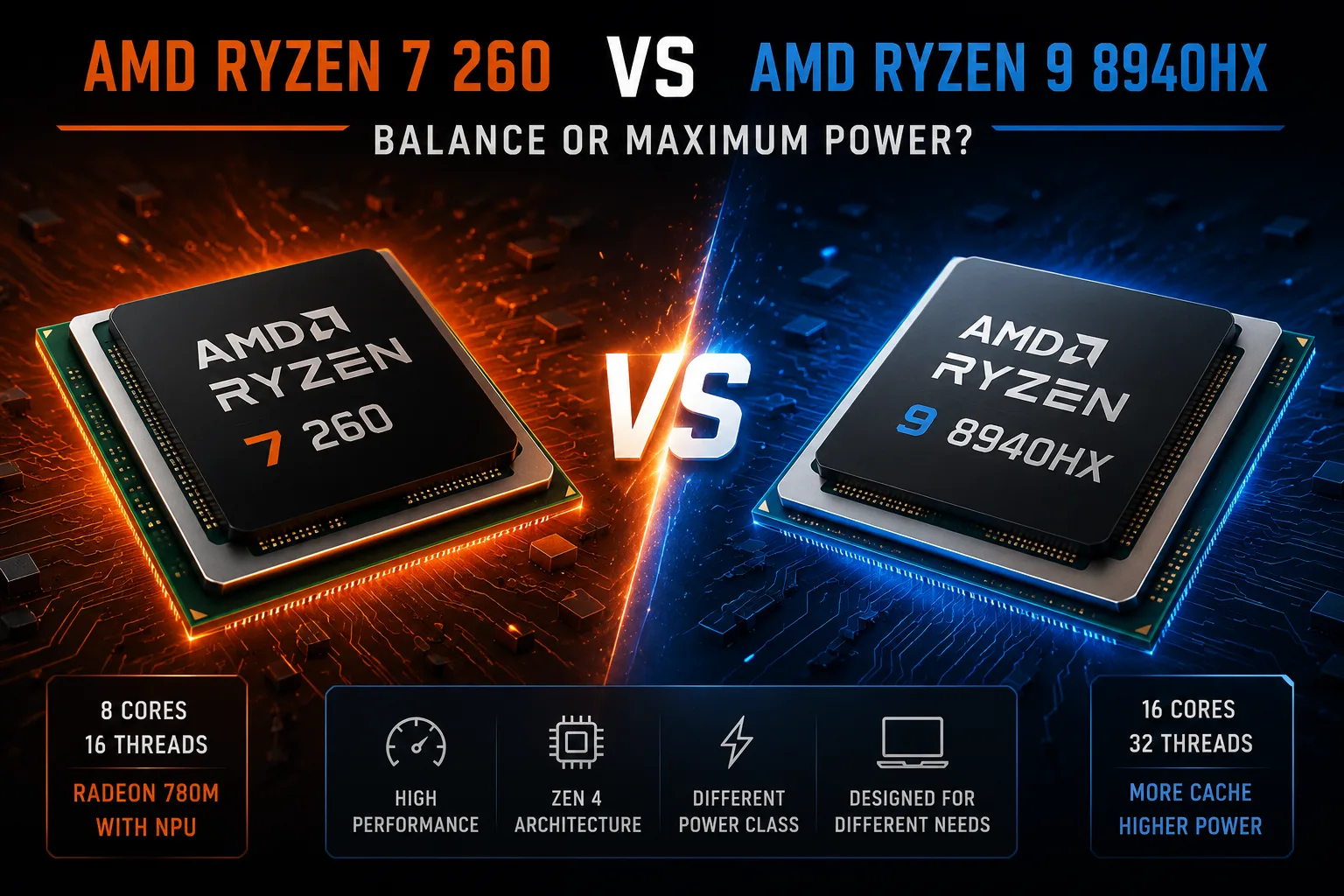
AMD Ryzen 7 260 and Ryzen 9 8940HX use Zen 4 architecture but are designed for different classes of laptops. The Ryzen 7 260 is a versatile 8-core model with powerful integrated graphics, LPDDR5X support, and a dedicated NPU. The Ryzen 9 8940HX is a 16-core processor meant for large gaming systems and mobile workstations.
In single-threaded tasks, the difference between them is not significant. The advantage of the Ryzen 9 8940HX becomes apparent in rendering, video encoding, compilation, and other extended workloads that can utilize all 32 threads. The Ryzen 7 260 is more energy-efficient, versatile, and performs significantly better without a discrete graphics card.
Key Differences
| Feature | AMD Ryzen 7 260 | AMD Ryzen 9 8940HX |
|---|---|---|
| Cores / Threads | 8 / 16 | 16 / 32 |
| Max Frequency | 5.1 GHz | 5.3 GHz |
| L3 Cache | 16 MB | 64 MB |
| Configurable TDP | 35-54 W | 55-75 W |
| Integrated Graphics | Radeon 780M, 12 CUs | Radeon 610M, 2 CUs |
| NPU | Up to 16 TOPS | No |
| Memory | DDR5-5600, LPDDR5X-7500 | DDR5-5200 |
| PCIe Interface | PCIe 4.0, 20 lanes | PCIe 5.0, 28 lanes |
The Ryzen 7 260 is a monolithic mobile chip. The Ryzen 9 8940HX uses a chiplet layout with two compute dies and a separate I/O die. The higher model has double the cores and four times the L3 cache, but it also has higher power and cooling requirements.
Where They Appear
The Ryzen 7 260 is found in both versatile models and mid-range gaming laptops. Notable examples include ASUS Vivobook 18 M1807HA, Lenovo Legion 5 15AHP10, and ASUS TUF Gaming A16. The first can utilize the integrated Radeon 780M, while gaming configurations typically complement it with GeForce RTX 5050, RTX 5060, or RTX 5070 Laptop GPUs.
The Ryzen 9 8940HX is primarily found in high-performance systems. It is used in the Lenovo Legion Pro 5 16ADR10, Lenovo ThinkBook 16p G6, and MSI Crosshair A16/A17 HX. Such laptops almost always come equipped with a discrete graphics card and an enhanced cooling system.
Interestingly, ASUS offers the TUF Gaming A16 with both processors. Versions with the Ryzen 7 260 are aimed at more balanced configurations, while the Ryzen 9 8940HX is chosen for maximum multi-threaded speed. However, the same series name does not mean identical power settings: configurations may differ in cooling systems, firmware, and available performance modes.
Performance in Specific Laptops
For mobile processors, a single averaged result does not always reflect the real picture. The same CPU can perform differently depending on the chassis, temperature, and manufacturer settings. This is especially evident in long multi-threaded tests like Cinebench R23.
| Processor and Laptop | CPU Power in Review | Single-Core | Multi-Core |
|---|---|---|---|
| Ryzen 7 260 - ASUS Vivobook 18 M1807HA | 54 W | 1,760 | 15,864 |
| Ryzen 7 260 - ASUS TUF Gaming A16 FA608UP | 80 W | 1,760 | 17,277 |
| Ryzen 7 260 - Lenovo Legion 5 15AHP G10 | 80 W | 1,801 | 17,712 |
| Ryzen 9 8940HX - HP Omen 16-ap0091ng | Not Specified | 1,917 | 27,145 |
| Ryzen 9 8940HX - MSI Crosshair A17 HX D8WGKG | 90 W | 1,930 | 32,521 |
| Ryzen 9 8940HX - MSI Crosshair A16 HX E8WGK | 102 W | 1,886 | 32,745 |
Power values in reviews may exceed the official TDP range. Laptop manufacturers use their own short-term and long-term Boost limits, while monitoring software may show total power consumption of the CPU package. Therefore, these numbers are primarily for assessing the specific laptop's settings and not for replacing the official TDP.
Cinebench results also pertain to specific configurations and do not guarantee the same performance in every device with the same processor.
In single-threaded mode, the variability within each group is small. Laptops with the Ryzen 7 260 score around 1,760-1,801 points, while those with the Ryzen 9 8940HX score between 1,886-1,930 points. The advantage of the higher processor is about 5-7%, so in web browsers, office applications, and most common software, the difference will be small.
In multi-threaded testing, the influence of the chassis is much more pronounced. The Ryzen 7 260 scores from 15,864 points in the general Vivobook 18 to 17,712 points in the Lenovo Legion 5, with a difference of about 12% between implementations.
The range is wider for the Ryzen 9 8940HX: from 27,145 points in the HP Omen 16 to 32,745 points in the MSI Crosshair A16 HX. The difference between specific laptops exceeds 20%.
Even the lowest result of the Ryzen 9 8940HX in this sample is 53% higher than the best result of the Ryzen 7 260. When comparing the fastest configurations, the advantage of the 16-core model reaches about 85%. This confirms its superiority in rendering, encoding, compilation, and other well-parallelizable tasks.
At the same time, the table shows why mobile processors shouldn’t be evaluated solely by name. The Lenovo Legion 5 reveals the Ryzen 7 260 significantly better than the more versatile ASUS Vivobook 18, and the difference between laptops with the Ryzen 9 8940HX exceeds 5,000 points. For heavy workloads, tests of specific configurations are important.
Gaming with Discrete Graphics
The Ryzen 9 8940HX is better suited for laptops with powerful discrete graphics. Additional cores and 64 MB of L3 cache aid in high FPS, streaming, background video recording, and running heavy applications simultaneously.
However, the gaming difference is usually smaller than the advantage in Cinebench. In most modern games, the main limitation remains the graphics card, its TGP, and the laptop's cooling system. With a mid-range GPU, switching to the Ryzen 9 8940HX will not yield gains comparable to the difference in multi-threaded workload tests.
The advantage of the higher model becomes more pronounced with a powerful GPU, in CPU-dependent games, and when trying to achieve the highest FPS possible. Therefore, when choosing a gaming laptop, it’s essential to first compare the GPU, its power limit, and then the processor.
Integrated Graphics
Without a discrete graphics card, the advantage fully shifts to the Ryzen 7 260. Its Radeon 780M contains 12 compute units and allows running esports, less demanding, and some modern games at reduced settings.
The Ryzen 9 8940HX uses the Radeon 610M, which has only two compute units. Its capabilities are sufficient for outputting visuals, video playback, and regular tasks, but not for modern gaming.
The Radeon 780M turns the Ryzen 7 260 into a full-fledged platform without a separate graphics card. The Radeon 610M in the Ryzen 9 8940HX plays a supporting role, so a gaming laptop with this processor should have a discrete GPU.
Power Consumption, Memory, and NPU
The Ryzen 7 260 operates in the 35-54 W range and supports DDR5-5600 and LPDDR5X-7500. This allows it to be used in both gaming models and relatively compact versatile laptops.
The integrated NPU provides up to 16 TOPS and can accelerate certain local AI functions, image processing, and video calls. However, this is a secondary advantage that should not dictate the choice between the two processors.
The Ryzen 9 8940HX is designed for 55-75 W, supports DDR5-5200, and has more PCIe 5.0 lanes. It does not have a separate NPU; the model is aimed at maximum computing power in conjunction with a discrete graphics card.
What to Choose
The Ryzen 7 260 is better suited for versatile laptops, operation without discrete graphics, and mid-range gaming configurations. It only slightly lags in single-threaded speed but offers Radeon 780M, LPDDR5X support, and more moderate power consumption.
The Ryzen 9 8940HX is justified for regular rendering, encoding, compilation, virtualization, and professional multitasking. In such scenarios, its 16 cores provide an advantage of 50% or more.
For gaming laptops, it’s more important to first compare the graphics card, its TGP, and cooling. The Ryzen 9 8940HX is undoubtedly more powerful, but the Ryzen 7 260 remains a more balanced processor for most users.
Advantages
- Higher Technology: TSMC 4nm FinFET (TSMC 4nm FinFET vs TSMC 5nm FinFET)
- More Total Cores: 16 (8 vs 16)
- Higher Max Turbo Frequency: Up to 5.3 GHz (Up to 5.1 GHz vs Up to 5.3 GHz)
- Larger L3 Cache: 64 MB (16 MB vs 64 MB)
- Newer PCI Express Version: PCIe® 5.0 (PCIe® 4.0 vs PCIe® 5.0)
- Newer Launch Date: April 2025 (February 2025 vs April 2025)
Basic
CPU Specifications
Memory Specifications
GPU Specifications
Miscellaneous
Benchmarks
Related CPU Comparisons



Share in social media
Or Link To Us
<a href="https://cputronic.com/en/cpu/compare/amd-ryzen-7-260-vs-amd-ryzen-9-8940hx" target="_blank">AMD Ryzen 7 260 vs AMD Ryzen 9 8940HX</a>