AMD Ryzen 5 150
vs
Intel Core 5 120U

CPU Comparison Result
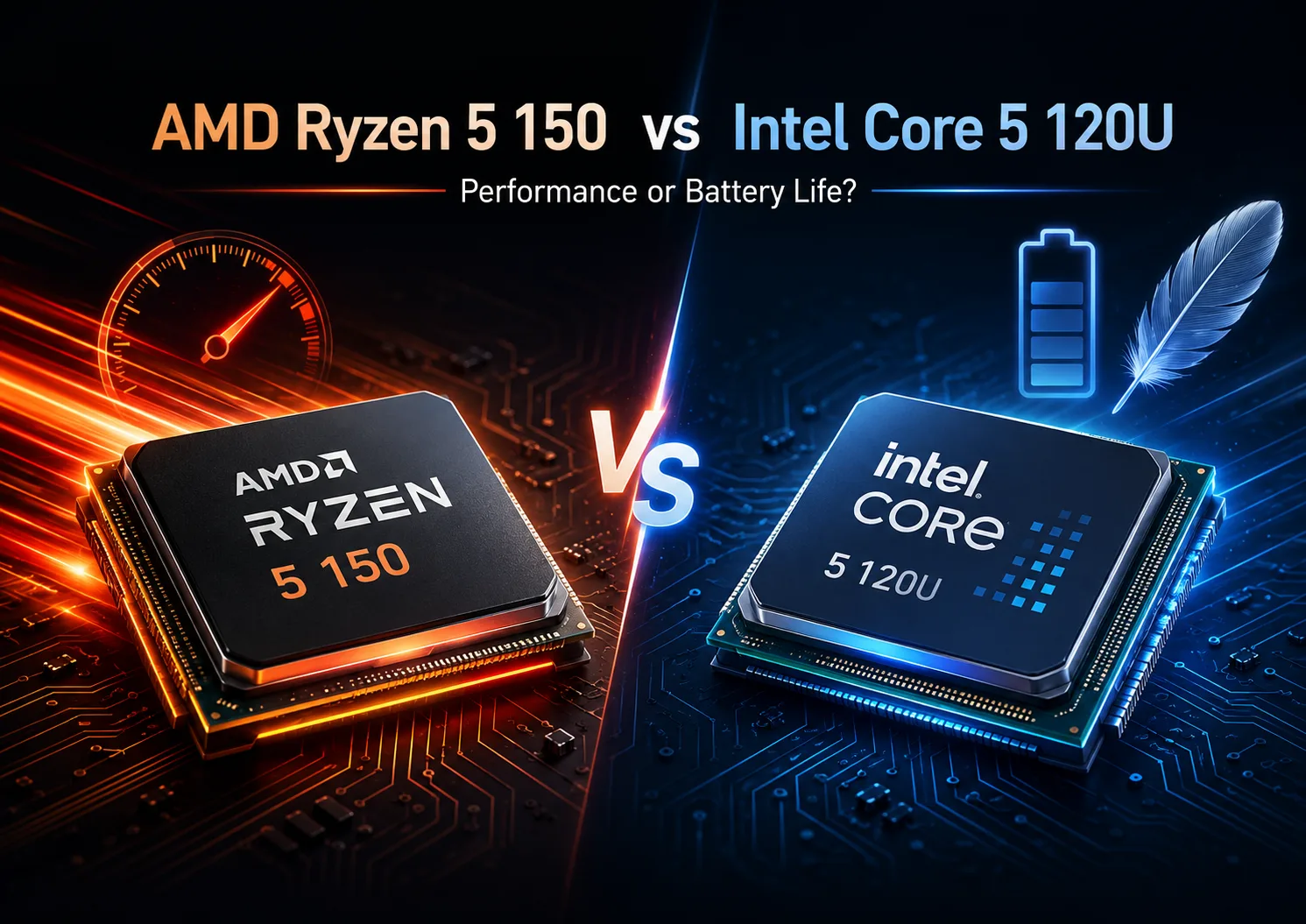
AMD Ryzen 5 150 vs Intel Core 5 120U: more powerful under load or longer without a socket
Similar names conceal processors for laptops of different classes. The Ryzen 5 150 operates at a higher power level and is designed for prolonged workloads, while the Core 5 120U is aimed at slim models with moderate heat generation and good battery life. AMD is better for heavy tasks, while Intel is more suited for mobile work.
New names, familiar hardware
The Ryzen 5 150 is built on the Zen 3+ architecture and has specifications that closely match the Ryzen 5 7535HS: six cores, twelve threads, a frequency of up to 4.55 GHz, and integrated Radeon 660M graphics. This is not a new generation but a familiar processor with a different designation.
The six identical Zen 3+ cores are still sufficient for compiling, photo processing, archiving, and other multithreaded tasks. The new designation does not indicate a transition to a more modern architecture.
The Core 5 120U is also based on Raptor Lake and is similar to the Core i5-1335U. It features two performance P-cores and eight energy-efficient E-cores. The processor has a total of ten cores and twelve threads, but the cores here are not equal: the P-cores handle the most demanding threads, while the E-cores take care of parallel and background processes.
Both manufacturers essentially offer familiar designs under updated names. The difference between the processors is defined not by the age of the architecture, but by the core configuration and permissible power consumption.
The difference begins with the laptop class
| Parameter | AMD Ryzen 5 150 | Intel Core 5 120U |
|---|---|---|
| Typical format | Full-size laptop | Thin mobile laptop |
| CPU configuration | 6 identical cores | 2 P-cores + 8 E-cores |
| Threads | 12 | 12 |
| Maximum frequency | 4.55 GHz | 5.0 GHz |
| Base power | 45 W | 15 W |
| Integrated graphics | Radeon 660M | Intel Graphics, 80 EU |
| Strength | Multithreaded speed and graphics | Low power consumption and fast P-cores |
In turbo mode, the Core 5 120U consumes more than 15 W, but under normal loads it remains more economical than the Ryzen. The Ryzen 5 150 operates at a higher power, requiring a more robust cooling system.
The same processor in different enclosures can demonstrate varying speeds. In a thin laptop with weak cooling, the Ryzen may lose some of its advantage, while the Core 5 120U, with a successful power configuration, can sustain turbo frequencies longer.
Who is faster
On average, the Ryzen 5 150 is faster in multithreaded tests, while the Core 5 120U excels in single-threaded tasks.
| Test | Ryzen 5 150 | Core 5 120U | Difference |
|---|---|---|---|
| PassMark CPU Mark | 18 005 | 15 239 | Ryzen is about 18% faster |
| PassMark Single Thread | 3 184 | 3 512 | Intel is about 10% faster |
The six identical Ryzen cores provide an advantage in compilation, rendering, extracting large archives, and batch exporting photos. Under full load, the work is evenly distributed across all cores, allowing the processor to handle prolonged computations more effectively.
The P-cores of the Core 5 120U can boost up to 5 GHz, making it fast for short single-threaded tasks. Programs and web pages open at a speed that is sometimes faster.
In browsers, office applications, and video calls, it will be hard to notice the difference. The advantage of the Ryzen becomes apparent where all threads are kept busy for several minutes in a row.
Radeon 660M is faster in games
The Ryzen 5 150 is fitted with Radeon 660M based on RDNA 2 architecture with six compute units. This graphics solution is weak for demanding modern games but can run online projects and older games at low or medium settings.
The Core 5 120U features Intel Graphics with 80 execution units. It's sufficient for video, office applications, and simple games, but typically, the Radeon 660M is faster.
The performance of both graphics systems heavily depends on the RAM. Integrated graphics use system memory instead of dedicated video memory, making dual-channel mode particularly important. A single memory stick significantly reduces frame rates for both processors.
Intel has an edge when it comes to video processing. Quick Sync is supported by many video editors and encoders, and hardware decoding of AV1 reduces load when viewing modern streaming video.
The verdict on graphics is simple: the Radeon 660M is faster in games, while Intel Graphics is more convenient in applications that utilize Quick Sync.
Battery life and heat
The Core 5 120U is designed for slim laptops prioritizing battery life. Its low base power allows for more compact enclosures and small cooling systems. With office workloads, such models usually heat up less and activate fans at high speeds less often.
The Ryzen 5 150 is more often found in larger 15- and 16-inch laptops. Its high power limit allows it to maintain speed longer, but under full load, the processor heats up more and drains the battery faster.
Battery life depends not only on the processor. The battery capacity, screen brightness and type, power settings, and background software often significantly impact usage time more than the difference between the Ryzen 5 150 and the Core 5 120U.
Thus, a laptop with a Ryzen and a large battery may outlast a model with Intel and a small battery. Comparing battery life should be done based on specific device tests.
Which processor to choose
Choose Ryzen 5 150 for:
- compiling, rendering, and photo processing;
- undemanding gaming without a discrete graphics card;
- a full-size laptop that will mostly be plugged in;
- tasks where multithreaded performance is crucial.
Choose Core 5 120U for:
- office work, browsing, studying, and video calls;
- a lightweight laptop for travel;
- extended battery use;
- video editors and encoders that support Quick Sync;
- connecting docks and fast peripherals via Thunderbolt 4.
Conclusion
The Ryzen 5 150 is faster in rendering, compiling, and other multithreaded tasks, while the Radeon 660M handles gaming better. At the same price point, AMD is more advantageous for heavy work and basic gaming tasks-provided the laptop has dual-channel memory and sufficiently powerful cooling.
The Core 5 120U is slower when all threads are fully loaded but fits better in thin everyday laptops. Its strengths lie in fast P-cores, moderate power consumption, Quick Sync, and hardware AV1 decoding.
Choose the Ryzen 5 150 for multithreaded speed and the Radeon 660M, and the Core 5 120U for a slim form factor and battery life. When purchasing, you should compare entire laptops: screen, battery, memory, and cooling often matter more than the differences between the processors.
Advantages
- Larger L3 Cache: 16 MB (16 MB vs 12 MB)
- Higher Technology: TSMC 6nm FinFET (TSMC 6nm FinFET vs Intel 7)
- Newer Launch Date: October 2025 (October 2025 vs January 2024)
- More Total Cores: 10 (6 vs 10)
- Higher Max Turbo Frequency: 5 GHz (Up to 4.55 GHz vs 5 GHz)
Basic
CPU Specifications
Memory Specifications
GPU Specifications
AI Specifications
Miscellaneous
Benchmarks
Related CPU Comparisons



Share in social media
Or Link To Us
<a href="https://cputronic.com/en/cpu/compare/amd-ryzen-5-150-vs-intel-core-5-120u" target="_blank">AMD Ryzen 5 150 vs Intel Core 5 120U</a>