AMD Ryzen 5 PRO 225
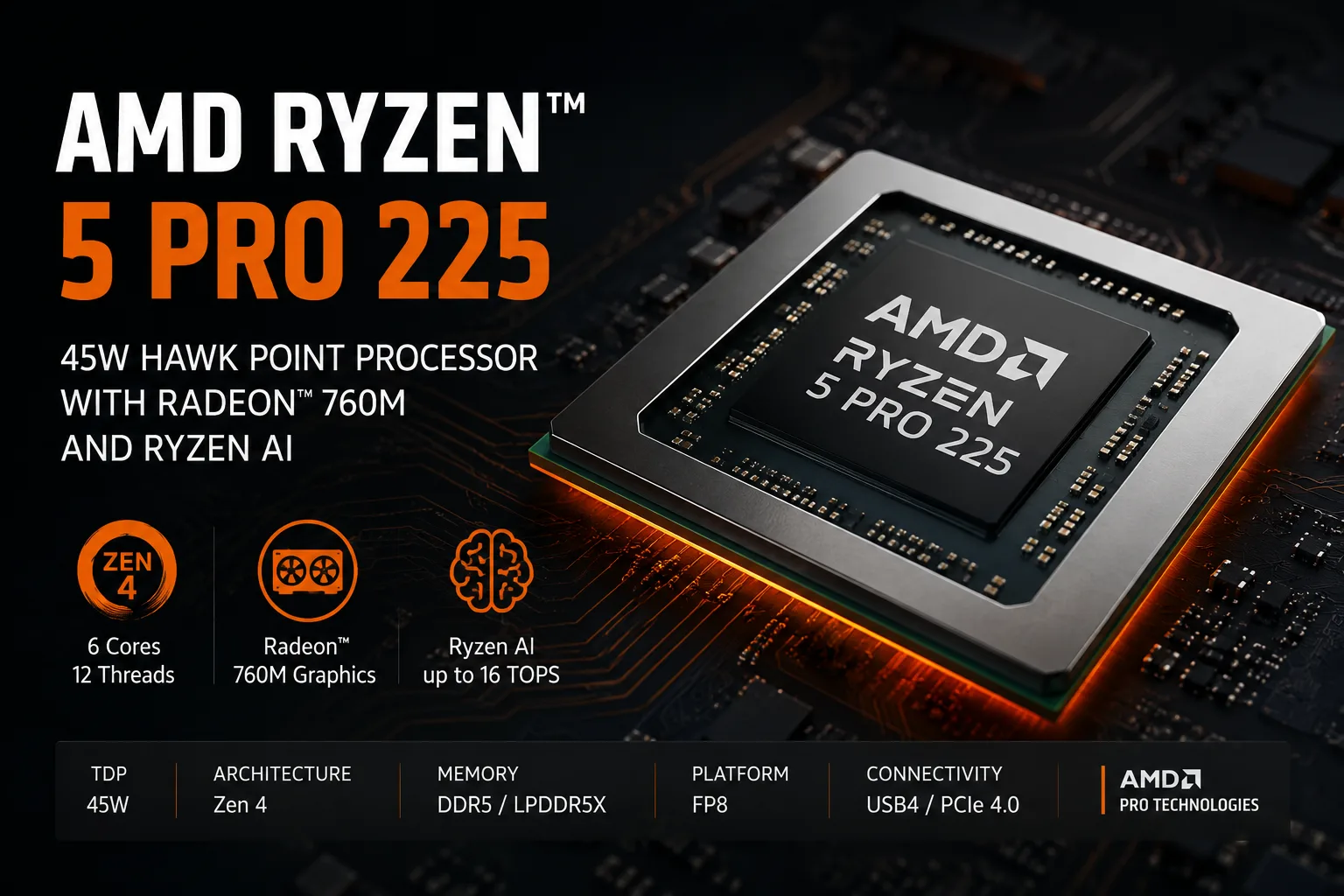
AMD Ryzen 5 PRO 225: 45-Watt Hawk Point with Radeon 760M and Ryzen AI
The AMD Ryzen 5 PRO 225 is a corporate mobile processor from the Ryzen PRO 200 series based on Hawk Point. It is a 6-core Zen 4 chip with Radeon 760M and Ryzen AI up to 16 TOPS, closely comparable to the Ryzen 5 PRO 8645HS. It cannot be called a new generation: AMD has transferred the familiar Hawk Point platform into its new corporate lineup.
The Ryzen 5 PRO 225 is positioned more clearly than the Ryzen 7 PRO 217. In configuration, it is a typical Ryzen 5: 6 cores, 12 threads, Radeon 760M, and NPU up to 16 TOPS. The main question is not in the name but in how this model differs from previous Hawk Point models, primarily from the Ryzen 5 PRO 8645HS.
The processor is designed for the FP8 platform, supports DDR5 and LPDDR5X, PCIe 4.0, two USB4 40 Gbps interfaces, and corporate AMD PRO technologies. Full specifications will be below the page, so it is more important in the article to assess the position of the Ryzen 5 PRO 225 in the lineup: it is a 45-watt Ryzen 5 for business laptops with Radeon 760M and a basic NPU, but without transitioning to a new architecture.
What You Need to Know About Ryzen 5 PRO 225
The Ryzen 5 PRO 225 uses 6 Zen 4 cores and 12 threads. The base frequency is 3.3 GHz, with boost up to 4.8 GHz. The nominal TDP is 45 watts, and the configurable range is from 35 to 54 watts. This is not an economical U-class but a 45-watt configuration for laptops with enhanced cooling.
For a mid-range corporate laptop, this configuration is sufficient for browsing, office applications, video calls, CRM, remote desktops, light data processing, and multitasking. However, it is not a replacement for 8-core Ryzen 7s and does not transition to Zen 5. The Ryzen 5 PRO 225 remains a 6-core mid-range Hawk Point.
The main differences from the lower models are the Radeon 760M and Ryzen AI. The Radeon 760M has 8 RDNA 3 graphics cores instead of 4 in the Radeon 740M, making it better suited for multiple monitors, video, light 3D graphics, and basic multimedia tasks. The NPU up to 16 TOPS allows running some local AI functions on a separate accelerator, although it does not reach the level of new AI platforms.
Relation to Ryzen 8000
The closest benchmark for the Ryzen 5 PRO 225 is the Ryzen 5 PRO 8645HS. It is also Hawk Point: 6 cores, 12 threads, Radeon 760M, Ryzen AI, and a thermal class of 45 watts. The Ryzen 5 PRO 225 is a new corporate position on the same platform base, not a completely new processor.
In terms of nominal frequencies, the Ryzen 5 PRO 8645HS has higher boost rates up to 5.0 GHz and the Radeon 760M can operate at up to 2600 MHz. The boost of the Ryzen 5 PRO 225 is lower, at up to 4.8 GHz, while the graphics operate at up to 2400 MHz. The Ryzen 5 PRO 225, in turn, belongs to the Ryzen PRO 200 series, utilizing the FP8 platform and integrating into AMD's new corporate lineup.
This is not a new level of performance but a transfer of the proven Hawk Point base into a new business nomenclature. For the buyer, this means familiar Zen 4 performance, mid-range integrated graphics, a basic NPU, and AMD PRO features.
Comparison with Neighboring Models
| Model | Cores / Threads | TDP | Graphics | Ryzen AI | Role |
|---|---|---|---|---|---|
| Ryzen 5 PRO 220 | 6 / 12 | 28 W | Radeon 740M | No | Economical model with basic graphics |
| Ryzen 7 PRO 217 | 6 / 12 | 35 W | Radeon 740M | No | 6-core Ryzen 7 PRO without NPU and with Radeon 740M |
| Ryzen 5 PRO 225 | 6 / 12 | 45 W | Radeon 760M | Yes, up to 16 TOPS | 45-watt model with Radeon 760M and NPU |
| Ryzen 5 PRO 230 | 6 / 12 | 28 W | Radeon 760M | Yes, up to 16 TOPS | Close model with lower TDP |
| Ryzen 5 PRO 8645HS | 6 / 12 | 45 W | Radeon 760M | Yes, up to 16 TOPS | Close analog on Hawk Point base |
Compared to the Ryzen 5 PRO 220, the Ryzen 5 PRO 225 is noticeably better equipped: the same CPU configuration but stronger graphics, higher TDP, and the presence of Ryzen AI. This makes it more suitable for business laptops with multimedia and local AI capabilities.
Against the backdrop of the Ryzen 7 PRO 217, the new Ryzen 5 PRO 225 appears more balanced. Despite a lower index, it has the Radeon 760M instead of Radeon 740M, features an NPU, and a higher thermal limit. The Ryzen 7 PRO 217 wins in naming but is inferior in specification.
With the Ryzen 5 PRO 230, the comparison is not so straightforward. The 230 has a lower TDP but a higher peak CPU frequency and higher graphics frequency. The advantage of the Ryzen 5 PRO 225 is the 45-watt mode, which is better suited for sustained loads with good cooling.
The Ryzen 5 PRO 8645HS remains the main benchmark. It is close in class and even stronger in frequencies, so the Ryzen 5 PRO 225 cannot be considered a direct upgrade. It is a new corporate position on a familiar base.
Radeon 760M: A Step Above Radeon 740M
The Radeon 760M is an important distinction of the Ryzen 5 PRO 225 from lower models with Radeon 740M. This is integrated RDNA 3 graphics with 8 graphics cores. It doesn’t make the laptop gaming-capable but provides enough headroom for office graphics, video, and light 3D tasks.
Such graphics are sufficient for multiple monitors, video, hardware decoding, simple image editing, light 3D graphics, and undemanding games at lower settings. In basic visual tasks, the Radeon 760M typically will not be a limitation.
Compared to the Radeon 780M, the integrated graphics of the Ryzen 5 PRO 225 are noticeably weaker: the higher-end graphics have more blocks and higher performance. Therefore, the Radeon 760M occupies the middle ground - significantly better than the Radeon 740M but below AMD's higher configurations.
Ryzen AI: Basic NPU, Not a New AI Platform
The Ryzen 5 PRO 225 features Ryzen AI with an NPU of up to 16 TOPS. This distinguishes it from models without a separate AI block: some local AI tasks can be performed on a specialized accelerator if the application and drivers support it.
For a corporate laptop, this is a foundation for several years of operation. Video conferencing, image processing, background AI functions, and some office scenarios are gradually beginning to utilize the NPU. However, 16 TOPS is a basic level for early Ryzen AI and not on par with modern AI platforms. The Ryzen 5 PRO 225 can be referred to as a processor with Ryzen AI, but it cannot be compared with contemporary AI platforms.
What the PRO Suffix Offers
The Ryzen 5 PRO 225 is aimed at the business segment and supports corporate AMD technologies. Their role is not to accelerate gaming or rendering but to simplify device fleet maintenance.
For companies, remote management, data protection, support for corporate policies, platform stability, compatibility with business OS images, and predictability of supply are important. In the Ryzen 5 PRO 225, this is combined with adequate CPU performance, Radeon 760M, and a basic NPU.
For home users, PRO features are usually not a decisive argument. In retail, the laptop's price, screen, cooling, memory, and battery are more critical. For corporate purchase, AMD PRO, Memory Guard, Secure Processor, fTPM, DASH, and virtualization are often more important than a small difference in frequencies.
Suitable Devices
The Ryzen 5 PRO 225 is appropriate for mid-range corporate laptops, compact workstation systems, and business configurations where basic office tasks are not the only requirement, but stronger integrated graphics are needed.
Suitable scenarios include:
- Mid-range corporate laptops;
- Mini-PCs and compact workstation systems;
- Devices for remote work and video conferencing;
- Office systems with multiple monitors;
- Business laptops with a basic reserve for local AI functions;
- Configurations where the capabilities of the Radeon 740M are already insufficient but Radeon 780M is not necessary.
For home users, the Ryzen 5 PRO 225 is only interesting as part of a successful laptop. If there is a Ryzen 5 PRO 8645HS, Ryzen 5 8645HS, Ryzen 7 8845HS, or Ryzen AI 300 at a similar price, the Ryzen 5 PRO 225 makes sense only due to its price, device quality, or corporate features.
Main Conclusion
The AMD Ryzen 5 PRO 225 is a balanced mid-range corporate model: 6 Zen 4 cores, Radeon 760M, Ryzen AI up to 16 TOPS, and 45 W TDP. This is not a new generation but a transfer of the proven Hawk Point base into the Ryzen PRO 200 lineup.
The main context for this model is its closeness to the Ryzen 5 PRO 8645HS. In terms of architecture and equipment, the Ryzen 5 PRO 225 does not represent a step forward, but it is suitable for business laptops where AMD PRO, Radeon 760M, and a basic NPU are needed.
In a corporate configuration, the Ryzen 5 PRO 225 is justified if AMD PRO, Radeon 760M, 45-watt mode, and a basic NPU are required. If maximum CPU performance, stronger graphics, or a modern AI block are important, it is better to look at Ryzen 7, Ryzen AI 300, or newer business models.
CPU Comparison
Compare Ryzen 5 PRO 225 with other CPUs
Basic
CPU Specifications
Memory Specifications
GPU Specifications
Miscellaneous
Benchmarks
Compared to Other CPU
Share in social media
Or Link To Us
<a href="https://cputronic.com/en/cpu/amd-ryzen-5-pro-225" target="_blank">AMD Ryzen 5 PRO 225</a>