AMD Ryzen 5 7500
AMD Ryzen 5 7500: Benchmark and Gaming Performance, Is It Worth Buying for $189?
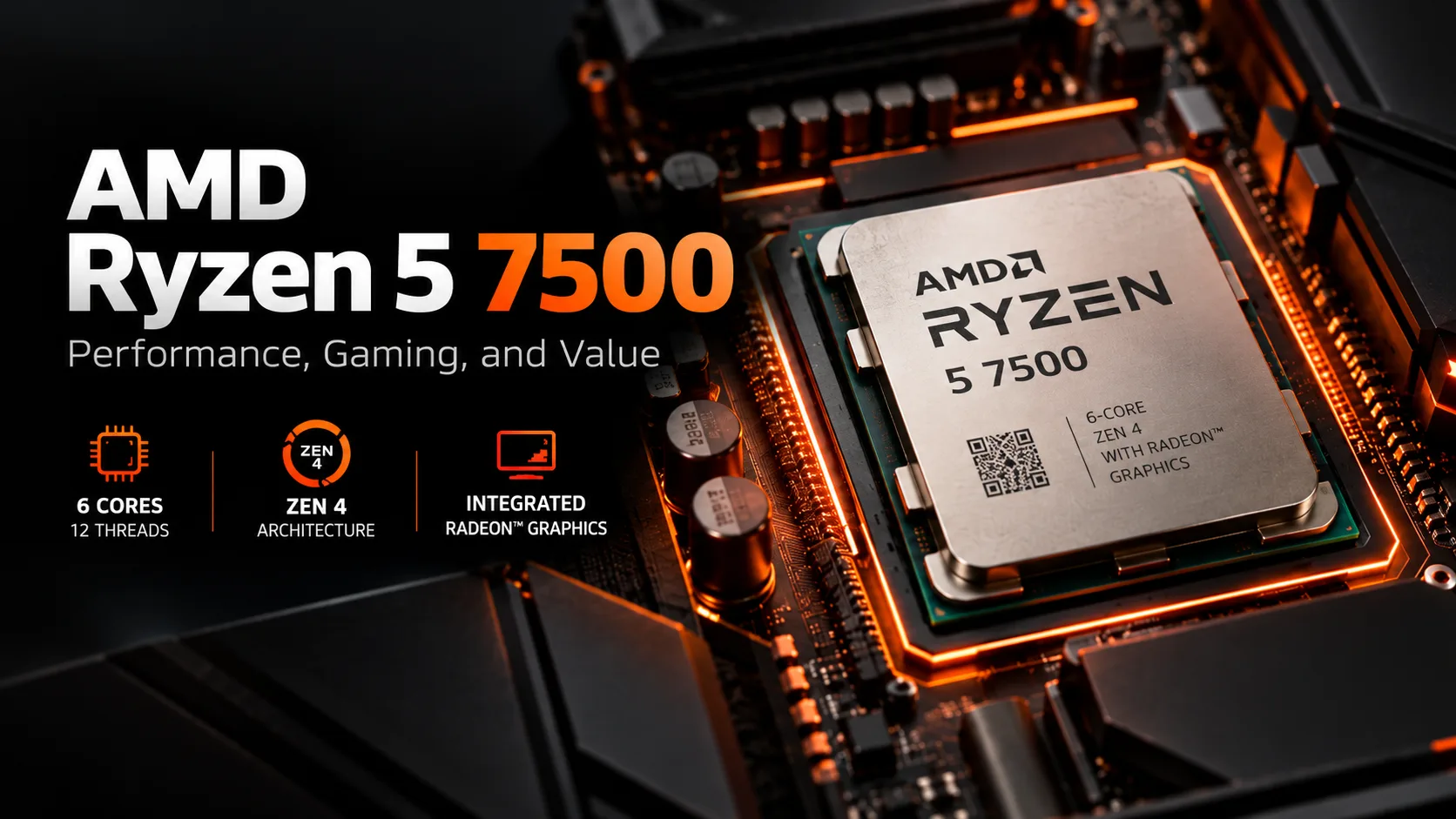
The AMD Ryzen 5 7500 is a six-core Zen 4 processor for the AM5 platform with 12 threads, clock speeds of 3.7-5.0 GHz, and a 65 W TDP. On the CPU side, it is almost identical to the Ryzen 5 7500F, but unlike that model, it includes integrated Radeon Graphics with two compute units. This allows the computer to be used without a discrete graphics card and can be useful for troubleshooting or replacing the primary GPU.
The processor was released in September 2026 with a recommended price of $189. The Ryzen 5 7500 does not offer a noticeable increase in CPU performance over the already familiar six-core Zen 4 processors, so its price relative to the Ryzen 5 7500F, Ryzen 5 7600, and Ryzen 5 9600X is especially important.
Ryzen 5 7500 vs. 7500F, 7600, and 9600X
The Ryzen 5 7500 and Ryzen 5 7500F have the same 6 cores and 12 threads, a 3.7 GHz base clock, Boost clocks of up to 5.0 GHz, and 32 MB of L3 cache. The main difference is the integrated graphics on the Ryzen 5 7500.
The Ryzen 5 7600 is slightly faster, with a 3.8 GHz base clock and Boost clocks of up to 5.1 GHz. It also has Radeon Graphics with two CUs.
The Ryzen 5 9600X is still a six-core processor, but it uses the Zen 5 architecture and boosts to 5.4 GHz. Zen 5’s advantage is especially noticeable in single-threaded workloads.
| Processor | Architecture | Cores / Threads | Boost | Integrated Graphics | TDP | US Price |
|---|---|---|---|---|---|---|
| Ryzen 5 7500 | Zen 4 | 6 / 12 | 5.0 GHz | Radeon Graphics, 2 CU | 65 W | $189 |
| Ryzen 5 7500F | Zen 4 | 6 / 12 | 5.0 GHz | No | 65 W | around $140-150 |
| Ryzen 5 7600 | Zen 4 | 6 / 12 | 5.1 GHz | Radeon Graphics, 2 CU | 65 W | around $204 |
| Ryzen 5 9600X | Zen 5 | 6 / 12 | 5.4 GHz | Radeon Graphics | 65 W | around $172-200 |
The prices clearly illustrate the Ryzen 5 7500’s problem. The Ryzen 5 7500F is around $40-50 cheaper, while the Ryzen 5 7600 costs only about $15 more. At the same time, the Ryzen 5 9600X can already be found for less than $180, despite using the newer Zen 5 architecture.
At these prices, the Ryzen 5 7500 is in an awkward position. Buyers have to pay a substantial premium over the 7500F just for integrated graphics, while moving to a faster processor can sometimes cost the same or even less.
Benchmark Performance
The Ryzen 5 7500 was released recently, and there are still few results from independent tests. Therefore, the Ryzen 5 7500F results below are provided for reference only.
Both models have 6 cores, 12 threads, clock speeds of 3.7-5.0 GHz, and the Zen 4 architecture, so their CPU performance should be similar.
| Processor | Cinebench R23 Single | Cinebench R23 Multi | PassMark CPU Mark | Current Price |
|---|---|---|---|---|
| Ryzen 5 7500F | 1827 | 14072 | 26932 | around $140-150 |
| Ryzen 5 7600 | 1868 | 14540 | 27248 | around $204 |
| Ryzen 5 9600X | 2207 | 17689 | 30510 | around $172-200 |
| Core i5-14400F | 1773-1839 | 16074-18180 | 25797 | around $179-185 |
Cinebench R23 clearly shows the difference between the six-core Zen 4 processors and the newer Ryzen 5 9600X. The Ryzen 5 7600 is slightly faster than the 7500F thanks to its higher clock speed, while the move to Zen 5 delivers a noticeable performance increase.
In the single-threaded test, the Ryzen 5 9600X scores around 2207 points, compared with 1827 for the Ryzen 5 7500F. The difference is approximately 21%. At the same time, the Ryzen 5 9600X may currently cost less than the Ryzen 5 7500’s recommended price.
The Core i5-14400F is faster in some multithreaded workloads thanks to its 6 performance and 4 efficiency cores, although its single-threaded performance is roughly on par with the six-core Zen 4 processors. At a price of around $180-185, it also directly overlaps with the Ryzen 5 7500 in terms of cost, but it requires the LGA1700 platform and lacks integrated graphics.
3DMark CPU Profile Results
| Processor | 1 Thread | Max Threads |
|---|---|---|
| Ryzen 5 7500F | 972 | 6273 |
| Ryzen 5 7600 | 999 | 6439 |
| Ryzen 5 9600X | 1256 | 7585 |
| Core i5-14400F | 984 | 7393 |
The difference between the Ryzen 5 7500F and Ryzen 5 7600 is small in this test. When all threads are loaded, the Core i5-14400F is faster, while the Ryzen 5 9600X has a clear lead in single-threaded performance.
These figures are a reference for the Ryzen 5 7500, not test results from the processor itself.
How the Ryzen 5 7500 Performs in Games
With a discrete graphics card, the Ryzen 5 7500 should be very close to the Ryzen 5 7500F. Six Zen 4 cores and 12 threads are sufficient for most modern games.
The Ryzen 5 7500 is suitable for systems with a GeForce RTX 5060, RTX 5060 Ti, Radeon RX 9060 XT, and graphics cards in the same class. In such systems, gaming performance will more often be limited by the graphics card rather than the processor.
The Ryzen 5 7500 can also be used with an RTX 5070 and faster GPUs, especially at 1440p and 4K. At 1080p with a high refresh rate, processor requirements are higher, so the Ryzen 5 9600X and X3D models can deliver higher average FPS and better 1% low results.
The Ryzen 5 7500 is sufficient for Cyberpunk 2077, Baldur's Gate 3, Forza Horizon 5, Red Dead Redemption 2, Hogwarts Legacy, Counter-Strike 2, and Fortnite. In most of these games, FPS depends more heavily on the graphics card and resolution.
The exception is competitive gaming, where 200-300 FPS or more is required. In this scenario, a faster processor can already provide a noticeable advantage.
Can You Game on the Integrated Radeon Graphics?
The Ryzen 5 7500 includes Radeon Graphics with two CUs and a clock speed of up to 2.2 GHz. This graphics solution is primarily intended for displaying an image rather than modern gaming.
Two CUs are sufficient for the desktop, web browsing, video, office applications, and computer diagnostics. Older and less demanding games can also be run at low settings and reduced resolutions.
This level of graphics performance is not enough for modern AAA games. The Ryzen 5 7500 should not be purchased specifically for gaming without a discrete graphics card.
For a computer without a discrete graphics card, it is better to choose the Ryzen 5 8600G or Ryzen 7 8700G. Their integrated graphics are much more powerful than the two CUs in standard desktop Ryzen processors.
For Work and Programming
Six cores and 12 threads are suitable for IDEs, browsers with many tabs, local servers, Docker, compilation, office applications, and photo processing.
The Ryzen 5 7500 offers more than enough performance for PHP, JavaScript, and typical web development. A faster processor will be more helpful during lengthy compilations and other workloads capable of loading all cores.
The Ryzen 5 7500 is also suitable for occasional video editing or rendering. For regular rendering and editing, it is better to choose an eight-core Ryzen 7 or a faster Zen 5 processor.
Power Consumption and Cooling
The Ryzen 5 7500 has a 65 W TDP. It does not require a powerful liquid-cooling system.
The included Wraith Stealth is sufficient for operation at the standard settings. An inexpensive tower cooler will reduce temperatures and noise during sustained loads.
The processor is unlocked and supports Precision Boost Overdrive and Curve Optimizer. For a daily-use PC, Curve Optimizer is more useful than manual overclocking: it can reduce voltage and temperatures without a noticeable loss of performance.
Is the Ryzen 5 7500 Worth Buying?
At its recommended price of $189, the Ryzen 5 7500 is in a difficult position.
The Ryzen 5 7500F currently costs around $140-150. The difference reaches $40-50, so for a computer with a discrete graphics card, the F version is much cheaper while offering practically the same CPU performance.
The Ryzen 5 7600 sells for around $204. Paying about $15 more provides slightly higher clock speeds and the same integrated Radeon Graphics. With such a small price difference, saving money on the Ryzen 5 7500 is difficult to justify.
The Ryzen 5 9600X makes the new processor look even worse. It can be found for around $172-200. At the lower end of that range, Zen 5 costs even less than the Ryzen 5 7500 while being significantly faster in single-threaded tests. The 9600X does not include a bundled cooler, but the performance difference is considerably more significant than the difference between the 7500 and 7600.
The Core i5-14400F costs around $179-185. It is practically in the same price category, although the comparison is complicated by its different platform and lack of integrated graphics.
A price of around $160-170 would significantly improve the Ryzen 5 7500’s position. The premium over the 7500F would then be smaller, while the Ryzen 5 7600 and 9600X would be farther away in price.
Conclusion
The Ryzen 5 7500 is fast enough for a mid-range gaming and work PC, but its launch price of $189 looks unfavorable given the current market.
The Ryzen 5 7500F costs approximately $140-150 and delivers almost the same CPU performance. The Ryzen 5 7600 costs around $204, is faster, and is only $15 more expensive. The Ryzen 5 9600X sells for around $172-200 and, at a favorable price, is not only faster but also cheaper than the Ryzen 5 7500.
Therefore, at $189, the Ryzen 5 7500 is difficult to recommend. Its price should fall to approximately $160-170 for the integrated graphics, included cooler, and AM5 platform to offset the difference compared with its competitors.
CPU Comparison
Compare Ryzen 5 7500 with other CPUs
Basic
CPU Specifications
Memory Specifications
GPU Specifications
Miscellaneous
Benchmarks
Compared to Other CPU
Share in social media
Or Link To Us
<a href="https://cputronic.com/en/cpu/amd-ryzen-5-7500" target="_blank">AMD Ryzen 5 7500</a>