AMD Ryzen 5 7430U
AMD Ryzen 5 7430U: Review of the Laptop Processor on the Proven Zen 3 Architecture
In the world of mobile processors, the constant race for new generations and flagship chips often distracts from solutions that offer an optimal balance of performance, energy efficiency, and cost. One such "workhorse" is the AMD Ryzen 5 7430U processor. At first glance, its numbering may be misleading, but under the hood, this chip houses a mature and refined technology capable of providing comfortable performance for most everyday tasks. Let's break down what this processor is all about and what it can do.
1. Architecture and Process Technology: Mature Zen 3 and Proven Platform
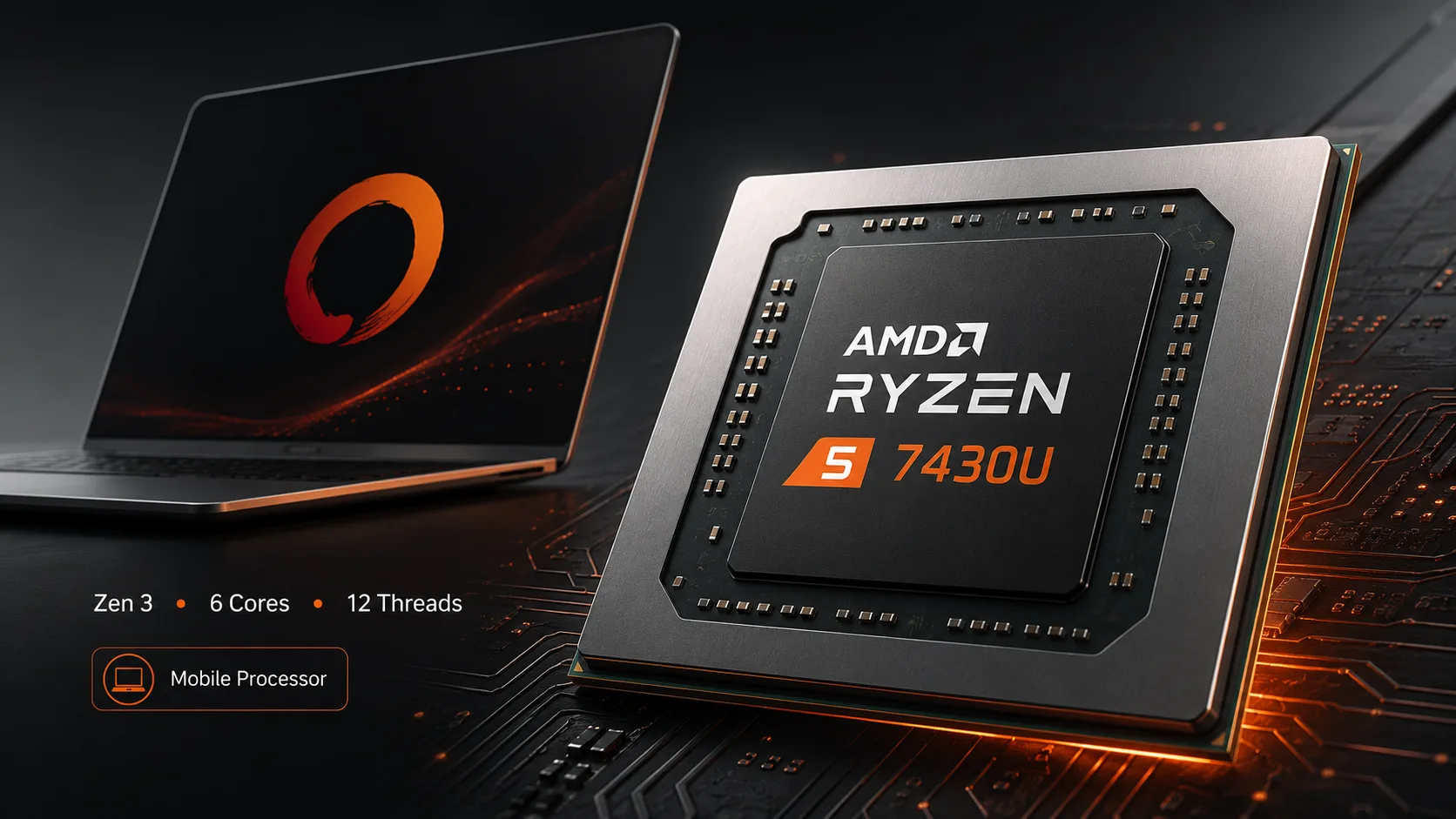
The Ryzen 5 7430U is built on the Zen 3 microarchitecture, which made a significant leap in instructions per cycle (IPC) compared to Zen 2. While it's not the latest Zen 4, for most users, the difference will be negligible, especially in the context of a laptop’s limited thermal envelope.
- Cores and Threads: The chip features 6 computing cores and 12 threads thanks to simultaneous multithreading (SMT) support. This configuration is more than enough for smooth multitasking, working with dozens of browser tabs, office applications, and even light photo or video editing.
- Clock Frequencies: The base frequency of the processor is 2.3 GHz, which is typical for energy-efficient U-series processors. A key feature is the maximum turbo frequency (Precision Boost) of up to 4.3 GHz, allowing cores to temporarily speed up for quick responsiveness in single-threaded tasks.
- Cache Memory: One of the secrets to Zen 3's efficiency is the unified 16 MB L3 cache available for all cores, which speeds up data exchange between the cores and reduces latency. It is complemented by 3 MB of L2 cache (512 KB per core) and 384 KB of L1 cache.
- Integrated Graphics: The chip includes an AMD Radeon Graphics core with 7 compute units (CUs) running at a frequency of up to 1800 MHz. It is based on the Vega architecture, not the newer RDNA. This means that while gaming performance is limited, its power is sufficient for display output, user interface tasks, and video decoding (H.264, H.265/HEVC).
- Process Technology: The production is carried out using the 7nm TSMC FinFET process. This is a mature, economical, and energy-efficient technology.
2. Power Consumption and Thermal Design Power (TDP): The Foundation for Slim and Light Laptops
The nominal thermal design power (TDP/cTDP) of the processor is 15 W. This is a classic figure for U-series processors, intended for installation in thin and light laptops, ultrabooks, and 2-in-1 devices.
- In practice, this means that the laptop's cooling system is designed to dissipate heat in the range of 15-25 W under sustained loads.
- Thanks to such a TDP, manufacturers can create compact devices, positively affecting weight, thickness, and noise levels.
- The processor supports dynamic power management, so in idle state, its power consumption can drop to a few watts, which is critical for battery life.
3. Performance: Real-World Usage Scenarios
Based on the provided benchmark data (Geekbench 6, PassMark), conclusions about the real performance can be drawn.
- Office Tasks and Multitasking: With a score of around 2992 points in PassMark Single Thread and 1562 points in Geekbench 6 Single Core, the processor shows high responsiveness in everyday tasks. Any office application, email clients, messengers, and web browsing will work seamlessly. The multi-threaded result of 15944 points (PassMark) and 5439 points (Geekbench 6 Multi) ensures that working with several programs simultaneously won't cause noticeable slowdowns.
- Multimedia: The built-in video decoder handles streaming video effortlessly. For light photo editing or creating home videos in simple video editors, 6 cores and 12 threads provide acceptable speed. However, this processor is not intended for professional rendering.
- Gaming: The integrated Vega graphics with 7 compute units is not a gaming solution. Its capabilities are sufficient for:
- Comfortable play in classic and undemanding indie games.
- Running modern online games like Dota 2 or CS:GO at low to medium graphics settings in Full HD (1080p) with acceptable frame rates.
- Cloud gaming.
- Turbo Mode (Precision Boost): The automatic overclocking technology effectively operates in short bursts of load. Under prolonged multi-core loads, frequencies stabilize at levels that the specific laptop's cooling system allows.
4. Usage Scenarios: Target Audience
The Ryzen 5 7430U is aimed at pragmatic users for whom stable and fast performance in typical scenarios is important.
- Students: Ideal for studying: working with texts, presentations, researching information, online courses, and video calls.
- Office Workers: An excellent choice for corporate laptops where reliability, battery life, and sufficient performance for corporate software are essential.
- Users for Everyday Tasks: For those who use a laptop as their main home device for internet surfing, social media interaction, and movie watching.
- As a Second Device: As a lightweight and portable laptop for traveling.
5. Battery Life: Power-Saving Technologies in Action
The Zen 3 architecture was initially designed with energy efficiency in mind. Combined with the 7nm process technology, this gives the Ryzen 5 7430U advantages in battery life.
- Dynamic Management: The processor constantly monitors the load and adjusts the voltage and frequency of each core.
- Efficiency at Low Frequencies: The Zen 3 architecture maintains high performance even at low power consumption.
- Impact on Battery Life: The final battery life depends on the laptop's battery capacity, display energy efficiency, OS optimization, and user behavior. In a thin laptop with a battery capacity of 50-60 Wh, one can expect 6-10 hours of mixed-use.
6. Comparison with Competitors: Market Positioning
- Within the AMD Lineup: The Ryzen 5 7430U is essentially an updated version of the popular Ryzen 5 5625U (also Zen 3). It sits below the current 7040U series processors (Zen 4). Its direct competitor in the AMD lineup is the Ryzen 5 7530U.
- Against Intel: The main competitor is the Intel Core i5 processors from the P and U series of the 12th or 13th generation, such as the Intel Core i5-1240P. In multi-threaded tasks, 6 cores of Zen 3 can be competitive, and they often have an advantage in energy efficiency.
- Against Apple M-Series: In terms of battery life and performance per watt, Apple Silicon (M1, M2) remains unrivaled. However, the Ryzen 5 7430U offers the advantage of a more open platform and often lower-cost laptops.
7. Pros and Cons
Strengths:
- Balanced Performance: 6 Zen 3 cores provide excellent speed for office work and multitasking.
- High Energy Efficiency: Enables the creation of thin, light laptops with long battery life.
- Support for Modern Memory: Support for LPDDR4X-4267 memory positively impacts performance.
- ECC Memory Support: ECC support (requires platform implementation) can be beneficial in the corporate segment.
- Sufficient Gaming Potential for Undemanding Projects.
Potential Drawbacks:
- Outdated Interfaces: Support for only PCIe 3.0, while competitors and newer AMD processors offer PCIe 4.0/5.0. For SSDs and most peripherals in this class, this is not critical, but it limits peak storage speeds.
- Outdated iGPU Architecture: Vega graphics significantly lag behind in efficiency compared to newer RDNA 2/3 and Intel Iris Xe.
- Confusing Numbering: The model from the 7030 series uses not the newest architecture, which may mislead buyers.
8. Recommendations for Choosing a Laptop
A laptop based on the Ryzen 5 7430U is generally a budget or mid-budget ultrabook.
- Device Type: Look for thin and light laptops (ultrabooks), 2-in-1 devices, or classic business laptops.
- What to Pay Attention To:
- RAM: At least 8GB, preferably 16GB. The speed of the memory (DDR4-3200 / LPDDR4X-4267) is important for performance.
- Storage: Be sure to have an SSD (NVMe PCIe 3.0). A capacity of 256GB is the minimum, preferably 512GB.
- Display: Pay attention to the resolution (Full HD is sufficient), the type of panel (IPS), and brightness.
- Cooling System: In compact laptops, this can be a weak point. Read reviews to find out whether a specific model overheats under load.
- Ports and Battery: Ensure that the port selection and claimed battery capacity meet your needs.
9. Final Conclusion
The AMD Ryzen 5 7430U is a reliable and energy-efficient processor for the mass user. It doesn't break records, but it offers the exact performance most people need for work and entertainment. Its key benefits are an excellent balance between speed and battery life, as well as the affordable price of laptops based on it.
It is perfectly suited for:
- Students and schoolchildren.
- Office workers.
- Those seeking an inexpensive yet powerful laptop for home use.
- Users for whom mobility and long battery life are essential.
If your tasks do not exceed web surfing, office applications, streaming video, and undemanding gaming, and your budget is limited, then a laptop with the AMD Ryzen 5 7430U will be a wise and practical choice.
CPU Comparison
Compare Ryzen 5 7430U with other CPUs
Basic
CPU Specifications
Memory Specifications
GPU Specifications
Miscellaneous
Benchmarks
Compared to Other CPU
Related CPU Comparisons


Share in social media
Or Link To Us
<a href="https://cputronic.com/en/cpu/amd-ryzen-5-7430u" target="_blank">AMD Ryzen 5 7430U</a>