AMD Ryzen 5 5500F
AMD Ryzen 5 5500F: Tests, Gaming, and Whether It’s Worth Buying for $99
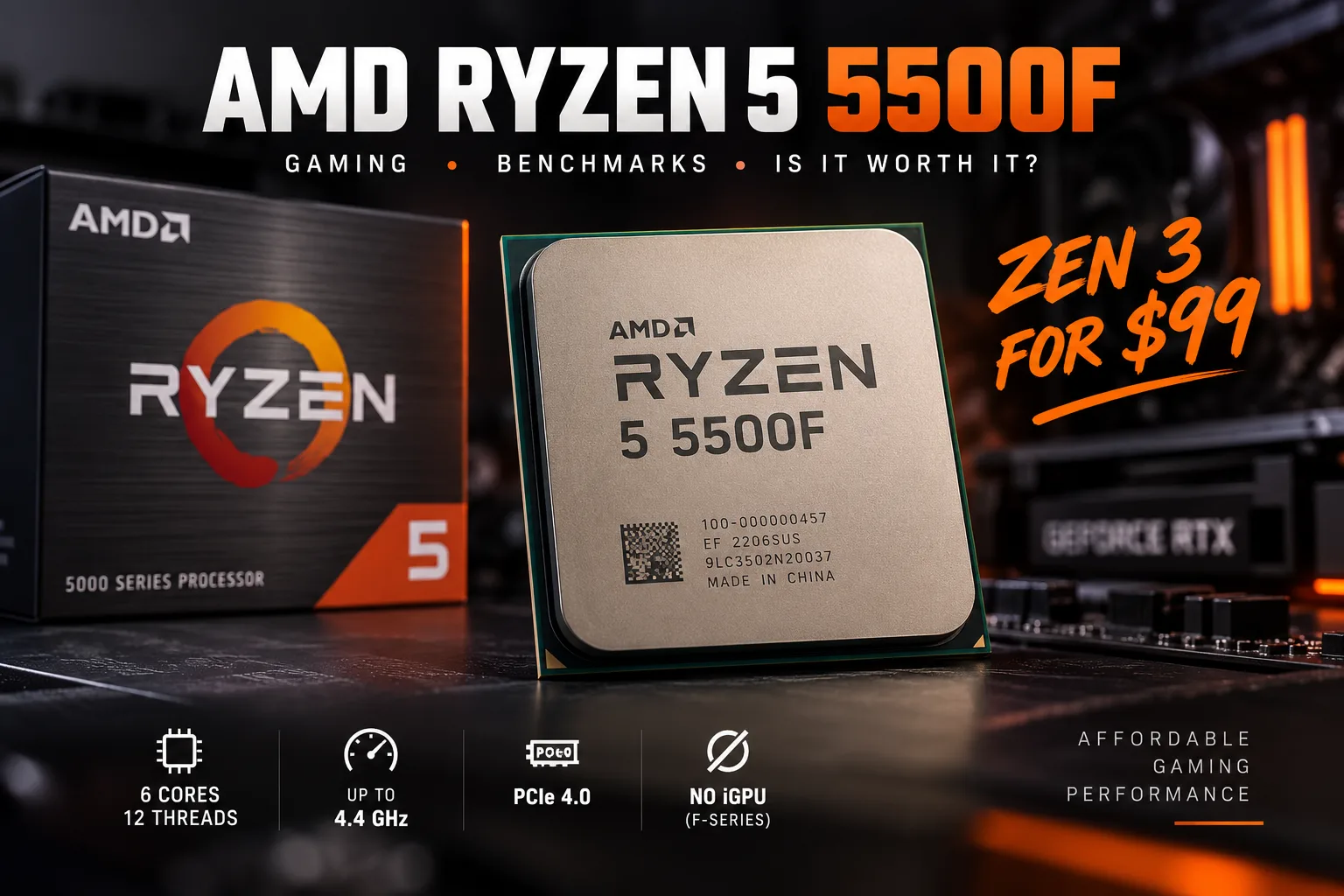
The AMD Ryzen 5 5500F is a six-core Zen 3 processor for the AM4 platform with 12 threads, clock speeds of 3.0-4.4 GHz, and a 65 W TDP. It launched on September 10, 2026, with a recommended price of $99. At that price, its main use cases are an inexpensive gaming PC and upgrading an older AM4 system.
The F suffix here does not indicate a graphics-related difference from the Ryzen 5 5500: neither model has an integrated GPU. The more important distinction is that the Ryzen 5 5500F is based on Vermeer and supports PCIe 4.0, while the regular Ryzen 5 5500 uses Cezanne and is limited to PCIe 3.0.
Ryzen 5 5500F vs. 5500 and 5600
All three processors use Zen 3, have 6 cores, 12 threads, and a 65 W TDP, but they differ in clock speeds, L3 cache capacity, and PCIe support.
The Ryzen 5 5500F boosts to 4.4 GHz and supports PCIe 4.0. The Ryzen 5 5500 is limited to a 4.2 GHz boost clock and uses a PCIe 3.0 interface.
The Ryzen 5 5600 also runs at up to 4.4 GHz and supports PCIe 4.0, but it has 32 MB of L3 cache compared with 16 MB on the 5500F.
| Processor | Cores / threads | Clocks | L3 | PCIe | Graphics | Price |
|---|---|---|---|---|---|---|
| Ryzen 5 5500F | 6 / 12 | 3.0-4.4 GHz | 16 MB | 4.0 | No | $99 |
| Ryzen 5 5500 | 6 / 12 | 3.6-4.2 GHz | 16 MB | 3.0 | No | around $84-99 |
| Ryzen 5 5600 | 6 / 12 | 3.5-4.4 GHz | 32 MB | 4.0 | No | around $130-140 |
| Core i3-12100F | 4 / 8 | up to 4.3 GHz | 12 MB | 5.0 | No | around $110-115 |
At the same price as the Ryzen 5 5500, the newer model is preferable: its boost clock is 200 MHz higher, and PCIe 4.0 is better suited to modern graphics cards and SSDs.
The Ryzen 5 5600 is faster and has twice as much L3 cache, but it costs about $30-40 more. That premium increases the processor’s cost by roughly one-third.
Ryzen 5 5500F vs. Ryzen 5 5500 in Gaming
The Ryzen 5 5500F has only just launched, so there is not yet a large base of independent results. The first direct gaming tests already make it possible to compare it with the Ryzen 5 5500.
Both processors were tested on a B550 platform with 16 GB of DDR4-3200 and a 16 GB Radeon RX 9060 XT at 1080p resolution.
| Game | Ryzen 5 5500F | Ryzen 5 5500 | Difference |
|---|---|---|---|
| Counter-Strike 2, High | 200.5 FPS | 185.6 FPS | +8% |
| Battlefield 6, High | 106.9 FPS | 92.1 FPS | +16% |
| GTA 5 Enhanced, Very High RT | 95.9 FPS | 88.1 FPS | +9% |
| Cyberpunk 2077, Ultra | 80.2 FPS | 72.3 FPS | +11% |
| Red Dead Redemption 2, High | 115.3 FPS | 111.1 FPS | +4% |
| Forza Horizon 6, Ultra | 90.8 FPS | 91.2 FPS | 0% |
The largest gains came in Battlefield 6 and Cyberpunk 2077-around 16% and 11%, respectively. The advantage in Counter-Strike 2 is approximately 8%, while in Red Dead Redemption 2 it drops to 4%.
Forza Horizon 6 is practically unaffected by the processor replacement. Therefore, you should not expect the same level of improvement in every game.
For now, this is only a single test suite, so it is too early to draw definitive conclusions. However, the difference from the Ryzen 5 5500 is already visible not only in the specifications.
Ryzen 5 5500F vs. Ryzen 5 5600 and Core i3-12100F
There are not yet enough direct Ryzen 5 5500F results in Geekbench, PassMark, and 3DMark. For comparison, we can look at the closest processors in the same price range.
| Processor | Geekbench 6 Single | Geekbench 6 Multi | PassMark CPU Mark | 3DMark CPU Profile Max Threads | Price |
|---|---|---|---|---|---|
| Ryzen 5 5500 | 1858 | 7691 | 19456 | 5430 | $84-99 |
| Ryzen 5 5600 | 2023 | 8527 | 21570 | 5660 | $130-140 |
| Core i3-12100F | 2212 | 7425 | 14153 | 4012 | $110-115 |
The Ryzen 5 5600 is faster than the 5500 thanks to its 32 MB of L3 cache and remains the more powerful six-core AM4 processor in most tasks.
The Core i3-12100F is strong in single-threaded tests, but it has only four cores and eight threads. In multithreaded workloads, the six-core Ryzen processors are faster.
The first gaming tests place the Ryzen 5 5500F above the regular 5500. However, because it has only 16 MB of L3 cache, it is unlikely to catch up with the Ryzen 5 5600 in every workload.
Why the Ryzen 5 5500F Needs PCIe 4.0
The Ryzen 5 5500 supports only PCIe 3.0, while the Ryzen 5 5500F supports PCIe 4.0.
This is especially useful with modern budget graphics cards that use eight PCIe lanes. In PCIe 3.0 x8 mode, bandwidth is half that of PCIe 4.0 x8. The impact is small in most games, but the difference is noticeable in some cases.
With a compatible B550 or X570 motherboard, the Ryzen 5 5500F also allows you to use a fast NVMe SSD through PCIe 4.0.
On older motherboards, PCIe 4.0 availability depends on the motherboard itself and its BIOS.
Gaming and Choosing a Graphics Card
The Ryzen 5 5500F is suitable for budget builds with a GeForce RTX 5060, Radeon RX 9060 XT, or graphics cards in the same class.
With such a graphics card, the processor can handle Cyberpunk 2077, Battlefield 6, Red Dead Redemption 2, GTA 5 Enhanced, Counter-Strike 2, Fortnite, Forza Horizon 6, and other modern games.
The first tests with the RX 9060 XT show more than 80 FPS in Cyberpunk 2077 at Ultra, around 107 FPS in Battlefield 6 at High, and approximately 200 FPS in Counter-Strike 2. These results apply to a specific test system and do not show the FPS achievable with less expensive graphics cards.
With a more powerful GPU, the limitations of Zen 3 and 16 MB of L3 cache will become more noticeable, especially at 1080p with a high refresh rate.
With a more powerful graphics card than the RTX 5060 or RX 9060 XT, it is worth comparing the price of the Ryzen 5 5500F with that of the Ryzen 5 5600. For the maximum gaming upgrade on the AM4 platform, the Ryzen 7 5700X3D is considerably more interesting.
No Integrated Graphics
The Ryzen 5 5500F requires a discrete graphics card. The same applies to the regular Ryzen 5 5500.
If you need an inexpensive AM4 processor with integrated graphics, the Ryzen 5 5600G or Ryzen 5 5600GT is a better choice.
For Work and Programming
Six cores and 12 threads are suitable for a browser with many tabs, IDEs, PHP, JavaScript, local servers, Docker, office applications, and photo processing.
The Ryzen 5 5500F is powerful enough for typical web development. Six physical cores are useful when working simultaneously with an IDE, browser, database, and several containers.
For regular rendering, video editing, and lengthy compilation tasks, the Ryzen 5 5600, eight-core Ryzen 7 processors, and newer CPUs will complete demanding workloads faster.
Cooling and Power Consumption
The Ryzen 5 5500F has a 65 W TDP, and the boxed version includes a Wraith Stealth cooler.
This cooler is sufficient at stock settings. An inexpensive tower cooler will reduce temperatures and noise levels under sustained load.
The multiplier is unlocked, and Precision Boost 2 and Ryzen Master are also supported. Buying expensive cooling for the sake of overclocking the budget 5500F is not worthwhile-the savings on the processor would quickly lose their meaning.
Upgrading an Older AM4 System or Building a New One
The Ryzen 5 5500F is especially useful for owners of an existing AM4 platform. If the motherboard supports the processor after a BIOS update, you can get 6 Zen 3 cores without replacing your DDR4 memory or the entire platform.
Upgrading from a Ryzen 3, Ryzen 5 1600, or Ryzen 5 2600 will provide a noticeable improvement both in games and in everyday work.
Replacing a Ryzen 5 5500 with a 5500F is not worthwhile. There is a difference in games, but it is too small to justify buying a new processor.
Owners of a Ryzen 5 3600 should also look higher up the range-at the Ryzen 5 5600 or Ryzen 7 5700X3D.
For a completely new PC, AM4 is no longer as obvious a choice. The platform allows you to use inexpensive DDR4 memory and affordable motherboards, but its future upgrade options are severely limited. Before buying a new B550 motherboard, memory, and processor, compare the total system cost with that of a budget AM5 build.
The Ryzen 5 5500F is considerably better suited to upgrading an existing AM4 system than to building a completely new PC.
Is the Ryzen 5 5500F Worth Buying for $99?
At $99, the Ryzen 5 5500F competes primarily with the regular Ryzen 5 5500.
If the 5500 costs $84, the $15 saving may still be justified for an extremely low-cost system. At the same or nearly the same price, the 5500F is the better choice because of its higher clock speed and PCIe 4.0 support.
The Ryzen 5 5600, at around $130-140, is faster and has 32 MB of L3 cache. For an additional $30 or so, it is preferable for a system with a more powerful graphics card.
The Core i3-12100F costs around $110-115 and is faster in some single-threaded tasks, but it has only 4 cores and 8 threads. For multitasking and heavy multithreaded workloads, the six cores of the Ryzen 5 5500F are more practical.
If your processor budget is limited to $100, or if your computer already has a compatible AM4 motherboard and DDR4 memory, the Ryzen 5 5500F remains one of the most affordable six-core options.
Conclusion
The Ryzen 5 5500F is one of the least expensive ways to get 6 Zen 3 cores and PCIe 4.0 on the AM4 platform.
The first gaming tests show an advantage over the Ryzen 5 5500: around 8% in Counter-Strike 2, 11% in Cyberpunk 2077, and up to 16% in Battlefield 6. In some games, there is practically no difference.
At $99, the Ryzen 5 5500F is particularly well suited as an upgrade for an older AM4 computer. For a completely new build, you should first compare the total system cost with that of a budget AM5 system.
If the Ryzen 5 5600 costs only $20-30 more, it is better to pay extra for 32 MB of L3 cache and higher performance. With a price difference of around $40, the savings justify choosing the Ryzen 5 5500F.
CPU Comparison
Compare Ryzen 5 5500F with other CPUs
Basic
CPU Specifications
Memory Specifications
GPU Specifications
Miscellaneous
Related CPU Comparisons


Share in social media
Or Link To Us
<a href="https://cputronic.com/en/cpu/amd-ryzen-5-5500f" target="_blank">AMD Ryzen 5 5500F</a>