AMD Ryzen 5 40
AMD Ryzen 5 40: A New Name for the Old Ryzen 5 7520U
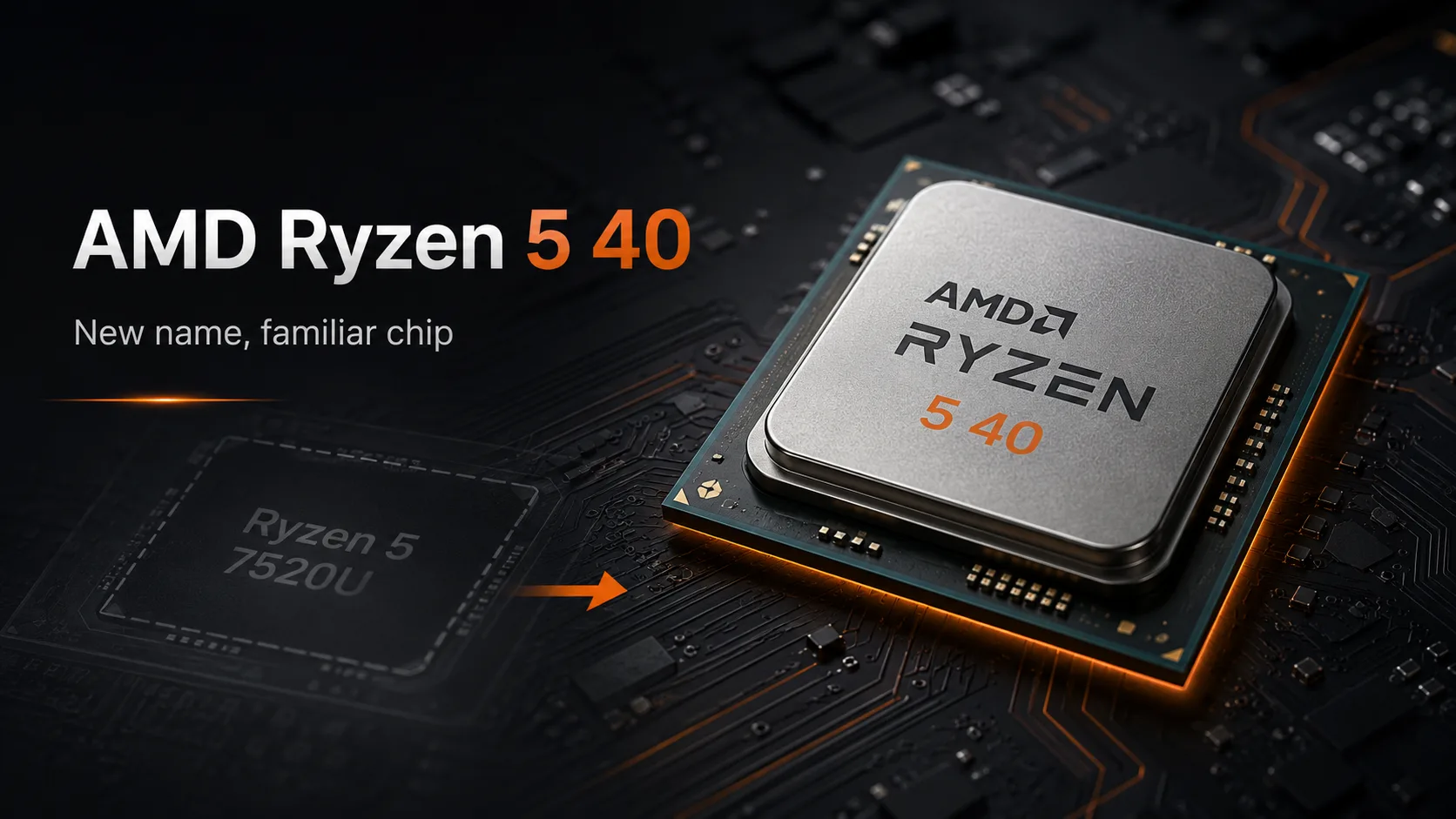
The AMD Ryzen 5 40 looks like a new-generation processor, but there is nothing new inside. It’s the same Ryzen 5 7520U released in 2022: four Zen 2 cores, eight threads, and weak integrated Radeon 610M graphics.
Renaming doesn’t make the processor worse. However, the Ryzen 5 designation may create inflated expectations: modern models in this class typically offer six cores and significantly faster graphics.
Ryzen 5 40 and Ryzen 5 7520U - One Processor
The Ryzen 5 40 belongs to the Ryzen 10 series, introduced by AMD in 2025. Despite the new name, its specifications are identical to those of the Ryzen 5 7520U.
| Specification | AMD Ryzen 5 40 |
|---|---|
| Architecture | Zen 2 |
| Cores and Threads | 4 / 8 |
| Frequency | 2.8-4.3 GHz |
| L3 Cache | 4 MB |
| Integrated Graphics | Radeon 610M |
| Thermal Design Power | 15 W |
| Memory | LPDDR5-5500, up to 16 GB |
The main issue here is not the processor itself, but the labeling. A buyer sees Ryzen 5 but receives a budget platform with an architecture that dates back to 2019.
Performance: Faster than Intel N100, but Far from Modern Ryzen
Four cores and eight threads are sufficient for browsing, office applications, video calls, and light multitasking. In terms of multithreaded performance, the Ryzen 5 40 usually outpaces the four-core Intel N100 and N150 since it supports eight threads.
| Processor | Cinebench 2024, Single Core | Cinebench 2024, All Cores |
|---|---|---|
| Ryzen 5 40 | about 60 | about 280 |
| Intel N150 | about 59 | about 163 |
| Intel N100 | about 61 | about 195 |
| Intel Core i3-N305 | about 65 | about 324 |
For a budget laptop, this result is normal. The system shouldn’t lag when working with documents, multiple browser tabs, and messaging apps.
Limitations become apparent under prolonged loads. Tasks like video editing, compiling large projects, batch processing images, and heavy multitasking quickly hit the limits of four cores and the small cache.
If a laptop with a Ryzen 5 7530U, Ryzen 5 7430U, or another six-core Ryzen 5 is available nearby, the extra cost is usually justified. Such models have better multithreaded performance and greater future-proofing.
Radeon 610M - The Main Weak Point
The Ryzen 5 40 uses Radeon 610M graphics based on the RDNA 2 architecture. It sounds modern, but the configuration is minimal: just two compute units.
The graphics can handle the Windows interface, high-resolution video, browsing, and simple games. You can run older titles, indie games, and some online titles at low settings.
For modern demanding games, the Radeon 610M is too weak. Even older integrated solutions like Vega with six or seven compute units often prove to be faster.
Therefore, a laptop with Ryzen 5 40 is not worth purchasing for gaming. Its purpose is daily work, studying, and video playback.
It's Better to Opt for 16 GB of Memory Right Away
The Ryzen 5 40 supports LPDDR5-5500 memory of up to 16 GB. In most laptops, this memory is soldered to the motherboard and cannot be replaced.
The 8 GB version will suffice for simple tasks, but it has little headroom. Modern Windows, a browser, and several applications quickly take up most of the memory.
A configuration with 16 GB is significantly more practical. It’s better suited for multitasking and will remain viable for everyday work for a longer time.
When purchasing, it’s also worth checking:
- Screen type and brightness;
- SSD capacity;
- Possibility of replacing the storage device;
- Quality of the case and keyboard;
- Battery capacity.
In a budget laptop, these parameters are often more important than minor differences between processors.
When to Consider Buying the Ryzen 5 40
The Ryzen 5 40 makes sense in a budget laptop with 16 GB of memory, a decent screen, and an SSD of at least 512 GB. Its performance is sufficient for documents, studying, video calls, movies, and browsing.
However, the new name does not make it a modern Ryzen 5. It remains a four-core Mendocino with Zen 2 architecture and entry-level graphics.
If a laptop with a six-core Ryzen costs only a bit more, it’s not worth saving on the Ryzen 5 40. This model is justified only at a significantly lower price.
CPU Comparison
Compare Ryzen 5 40 with other CPUs
Basic
CPU Specifications
Memory Specifications
GPU Specifications
Miscellaneous
Benchmarks
Compared to Other CPU
Related CPU Comparisons


Share in social media
Or Link To Us
<a href="https://cputronic.com/en/cpu/amd-ryzen-5-40" target="_blank">AMD Ryzen 5 40</a>