AMD Ryzen 5 230
AMD Ryzen 5 230: The Name Changes, but the Architecture Does Not
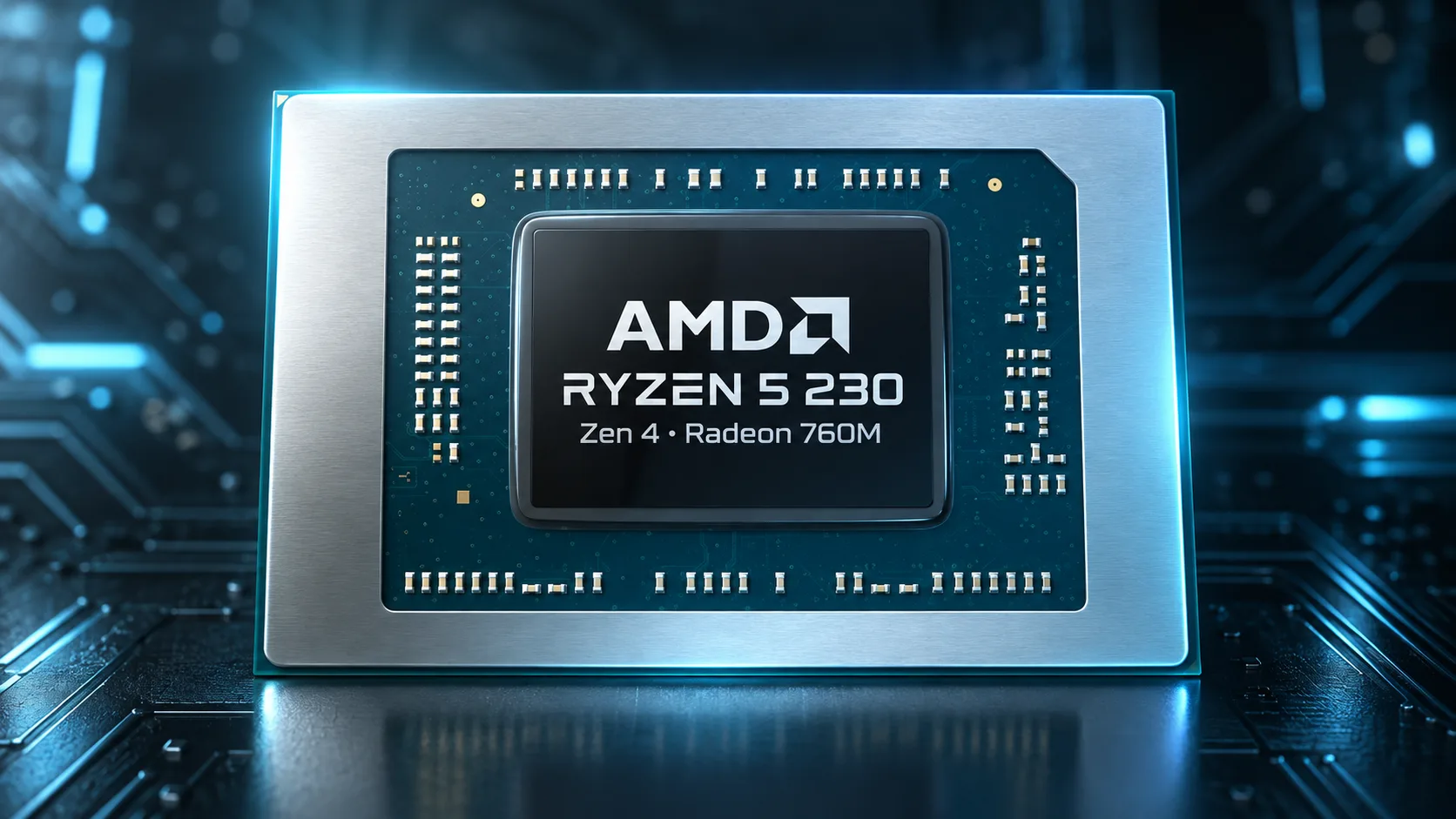
The AMD Ryzen 5 230 is a mobile six-core processor from the Ryzen 200 family, built on the already familiar Zen 4 architecture. It is based on Hawk Point and features 6 cores, 12 threads, and an integrated Radeon 760M. In terms of specifications, the Ryzen 5 230 is virtually identical to the Ryzen 5 8640U, while its main difference from the older Ryzen 5 7640U is a faster NPU.
Its clock speed ranges from 3.5 to 4.9 GHz, and it has 6 MB of L2 cache and 16 MB of L3 cache. The TDP can be configured between 15 and 30 W, so performance depends on the specific laptop.
| Specification | Ryzen 5 230 | Ryzen 5 8640U | Ryzen 5 7640U |
|---|---|---|---|
| Release date | January 7, 2025 | December 6, 2023 | May 3, 2023 |
| CPU architecture | Zen 4 | Zen 4 | Zen 4 |
| Codename | Hawk Point | Hawk Point | Phoenix |
| Cores / threads | 6 / 12 | 6 / 12 | 6 / 12 |
| Clock speeds | 3.5-4.9 GHz | 3.5-4.9 GHz | 3.5-4.9 GHz |
| L2 + L3 | 6 + 16 MB | 6 + 16 MB | 6 + 16 MB |
| TDP | 15-30 W | 15-30 W | 15-30 W |
| iGPU | Radeon 760M | Radeon 760M | Radeon 760M |
| GPU CUs | 8 | 8 | 8 |
| GPU clock speed | up to 2.6 GHz | up to 2.6 GHz | up to 2.6 GHz |
| NPU | 16 TOPS | 16 TOPS | 10 TOPS |
After two renamings, the core CPU and GPU specifications have barely changed. The Ryzen 5 230 is virtually identical to the Ryzen 5 8640U, while the Ryzen 5 7640U primarily differs in having an NPU rated at 10 rather than 16 TOPS.
Performance in Real-World Laptops
Results from specific laptops show not only how fast the Ryzen 5 230 is, but also how strongly its performance depends on the manufacturer's settings. The Lenovo ThinkPad E14 Gen 6 with an Intel Core Ultra 5 125U is included for comparison.
| Laptop | Processor | Configuration | Geekbench 6 Single | Geekbench 6 Multi | Price |
|---|---|---|---|---|---|
| Lenovo ThinkPad E14 Gen 7 | Ryzen 5 230 | 32 GB DDR5* | 2568 | 10218 | ~€983** |
| HP ProBook 4 G1a 16 | Ryzen 5 230 | 16 / 512 GB | 2448 | 8437 | ~€799 |
| HP ProBook 4 G1a 14 | Ryzen 5 230 | 16 / 512 GB | 2409 | 7902 | ~€951 |
| Lenovo ThinkPad E14 Gen 6 | Core Ultra 5 125U | 16 / 512 GB | 2166 | 8550 | ~€1054 |
- The Geekbench result was obtained on a ThinkPad E14 Gen 7 with 32 GB of memory.
The price refers to the standard retail configuration of the ThinkPad E14 Gen 7 with 16 GB of memory and a 512 GB SSD.
The Ryzen 5 230 shows a wide performance spread. The ThinkPad E14 Gen 7 scores more than 10,000 points in Geekbench 6 Multi Core, while the HP ProBook 4 G1a 14 remains below 8,000. The difference in Single Core is smaller, but still noticeable.
The comparison with the Core Ultra 5 125U is more interesting. The ThinkPad E14 Gen 6 scores 2166 points in Single Core and 8550 in Multi Core. The best Ryzen 5 230 result is noticeably higher, but the HP ProBook 4 G1a 16 is already roughly on par with Intel in the multithreaded test.
The price does not follow the benchmark results, however. The least expensive HP ProBook 4 G1a 16 costs around €799 and scores 2448/8437 points, while the ThinkPad E14 Gen 6 with the Core Ultra 5 125U costs approximately €1054.
Radeon 760M
The Ryzen 5 230 features a Radeon 760M based on the RDNA 3 architecture, with 8 compute units and 512 stream processors. The GPU's maximum clock speed reaches 2.6 GHz.
The Radeon 760M is noticeably faster than the entry-level Radeon 740M and can handle less demanding games without a discrete graphics card. In demanding modern games, resolution and graphics quality will need to be reduced.
The Radeon 760M is sufficient for office applications, multimedia, and hardware video decoding.
Ryzen AI
The Ryzen 5 230 is equipped with an NPU delivering up to 16 TOPS. In this respect, it matches the Ryzen 5 8640U and surpasses the Ryzen 5 7640U, with its 10 TOPS.
Compared with AMD's newer mobile platforms, 16 TOPS is already a modest figure. The NPU is therefore more of an additional capability than a reason to choose the Ryzen 5 230 over the older 8640U.
Price and Choosing a Laptop
Real-world listings show that the Ryzen 5 230 itself does not determine a laptop's price. The HP ProBook 4 G1a 16 with 16 GB of memory and a 512 GB SSD costs approximately €799, while laptops with the same processor can approach €1000.
At a higher price, the buyer is paying for the display, chassis, keyboard, battery, ports, and business features. Paying more does not mean that the Ryzen 5 230 inside a more expensive laptop will automatically be faster.
The HP ProBook 4 G1a 14 demonstrates this clearly: despite costing around €951, it delivers the lowest Multi Core result among the three tested Ryzen 5 230 models.
Conclusion
The Ryzen 5 230 is a good example of how a new name does not necessarily mean a new architecture. In terms of its CPU, integrated graphics, clock speeds, and cache, it is virtually identical to the Ryzen 5 8640U. Even the Ryzen 5 7640U, released almost two years earlier, differs from it mainly by having a less powerful NPU.
The Ryzen 5 230 itself remains a fast mid-range processor, however. In the well-tuned ThinkPad E14 Gen 7, it scores 2568 points in Geekbench 6 Single Core and more than 10,000 in Multi Core, clearly outperforming the Core Ultra 5 125U in the tested ThinkPad E14 Gen 6.
Laptops with the Ryzen 5 230 priced around €800 are the most attractive. The HP ProBook 4 G1a 16, at approximately €799, offers 6 Zen 4 cores, a Radeon 760M, 16 GB of memory, and a 512 GB SSD.
There is no reason to pay extra just for the Ryzen 200 designation. The main criteria here remain the laptop's price, display, memory, battery life, and chassis quality.
CPU Comparison
Compare Ryzen 5 230 with other CPUs
Basic
CPU Specifications
Memory Specifications
GPU Specifications
Miscellaneous
Benchmarks
Compared to Other CPU
Related CPU Comparisons


Share in social media
Or Link To Us
<a href="https://cputronic.com/en/cpu/amd-ryzen-5-230" target="_blank">AMD Ryzen 5 230</a>