Intel Core i3-7100

Intel Core i3-7100
Intel Core i3-7100 processor review

Intel Core i3-7100: Review and Performance in 2026

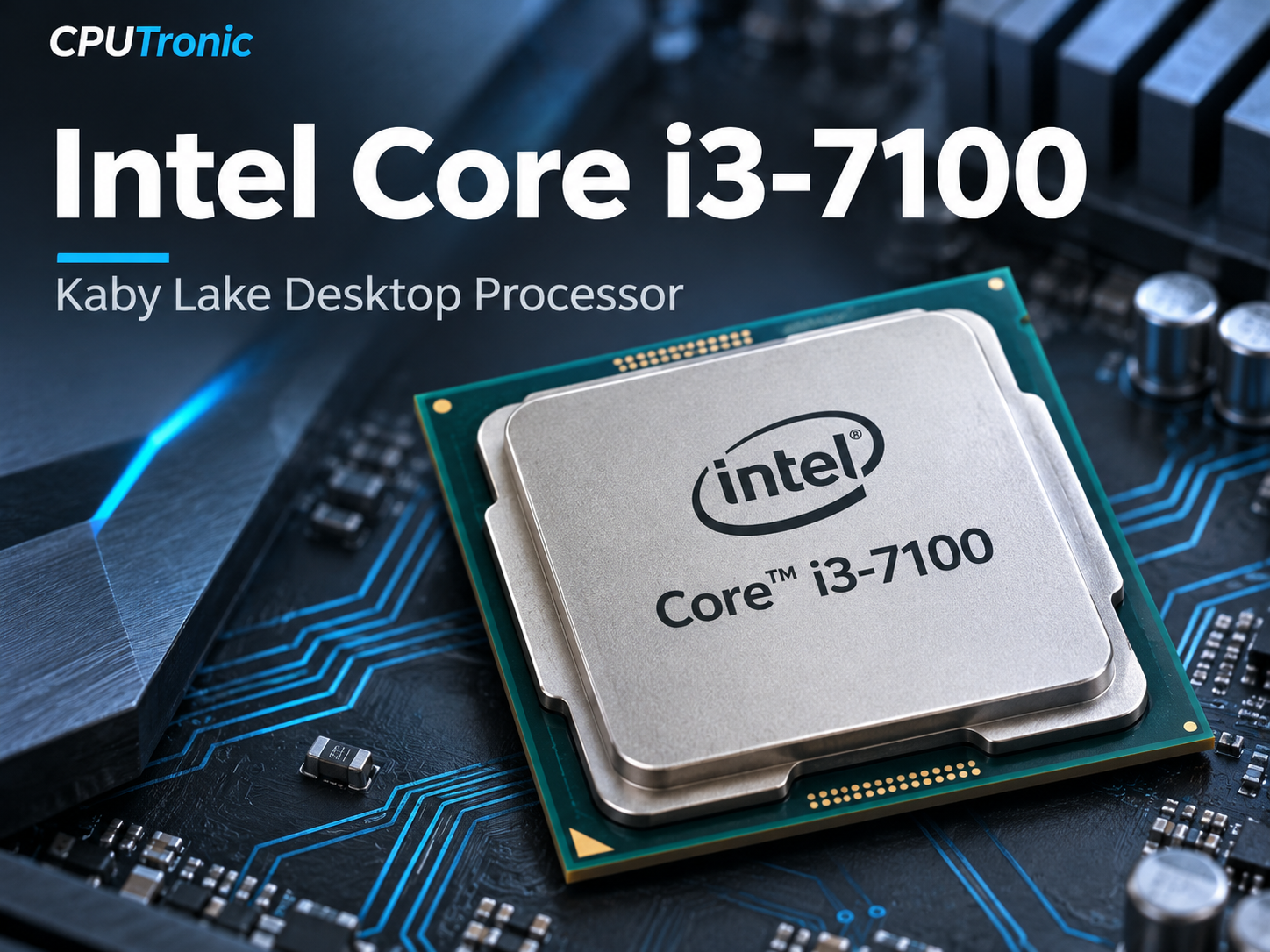
The Intel Core i3-7100 is a Kaby Lake desktop processor released in January 2017. The model was designed for affordable home and office computers and combined a high clock speed for its class with Hyper-Threading support and integrated Intel HD Graphics 630.

In 2026, the processor is still suitable for working with documents, watching videos, and playing older games. However, its two physical cores limit performance in modern multithreaded applications.

Architecture and Features

The Core i3-7100 uses the Kaby Lake architecture and is manufactured using a 14 nm process. The processor has two cores and four threads, 3 MB of L3 cache, and a TDP of 51 W.

Its base clock speed is 3.9 GHz. Turbo Boost is not supported, and the clock speed may decrease under light workloads to save energy.

In terms of performance per clock, Kaby Lake is practically no different from Skylake. The main advantages of the new generation were higher clock speeds, support for faster memory, and hardware video decoding for the HEVC Main10 and VP9 formats.

Differences from Other Processors

Characteristic Pentium G4560 Core i3-6100 Core i3-7100 Core i5-7400
Architecture Kaby Lake Skylake Kaby Lake Kaby Lake
Cores / threads 2 / 4 2 / 4 2 / 4 4 / 4
Clock speed 3.5 GHz 3.7 GHz 3.9 GHz 3.0-3.5 GHz
L3 cache 3 MB 3 MB 3 MB 6 MB
Integrated graphics HD 610 HD 530 HD 630 HD 630
AVX2 support No Yes Yes Yes
DDR4 speed 2400 MT/s 2133 MT/s 2400 MT/s 2400 MT/s
TDP 54 W 51 W 51 W 65 W

The Pentium G4560 was one of the Core i3-7100’s main competitors in the budget segment. It also supported four processing threads, but operated at a lower clock speed, had weaker integrated graphics, and did not support the AVX or AVX2 instruction sets.

Despite its lower clock speed, the Core i5-7400 had four physical cores and handled multithreaded workloads better.

Performance in Geekbench 6

Processor Cores / threads Single-Core Multi-Core
Pentium G4560 2 / 4 706 1451
Core i3-6100 2 / 4 1187 2317
Core i3-7100 2 / 4 1231 2407
Core i5-7400 4 / 4 1169 3214
Core i7-7700 4 / 8 1384 4655
Core i3-12100 4 / 8 2146 6894

The Core i3-7100 significantly outperforms the Pentium G4560 in Geekbench 6. However, the difference between these processors may be considerably smaller in everyday applications.

Compared with the Core i3-6100, the gain is approximately 4% in both tests. Upgrading between these models makes practically no sense.

The Core i5-7400 trails the i3-7100 by 5% in the single-threaded test but outperforms it by 34% in the multithreaded test. The Core i7-7700 provides a 93% increase in multithreaded performance.

The Alder Lake-based Core i3-12100 is 74% faster in the single-threaded test and 2.86 times faster in the multithreaded test. The difference is especially noticeable when compiling programs, archiving files, processing photos, and running resource-intensive applications simultaneously.

Integrated Intel HD Graphics 630

Intel HD Graphics 630 has 24 execution units (EUs) and operates at a frequency of 350 to 1100 MHz. It has no dedicated video memory; the graphics processor uses the computer’s system memory.

Key features:

  • Hardware decoding of H.264, HEVC Main10, and VP9.
  • Hardware video encoding using Intel Quick Sync.
  • Support for 4K resolution at 60 Hz via DisplayPort.
  • Support for up to three displays when the motherboard has the appropriate video outputs.

Hardware AV1 decoding is not available. When playing video in this format, the workload falls on the CPU, which may result in dropped frames at high resolutions.

Gaming Performance

Test results for the Core i3-7100 with integrated Intel HD Graphics 630 in 2017:

Test Settings Result
3DMark Fire Strike Standard 1084 points
Dota 2 1920 × 1080, Low 79.1 FPS
Counter-Strike: Global Offensive 1920 × 1080, Low 66.4 FPS
Minecraft 1920 × 1080, Fast 107.1 FPS

The system requirements for Dota 2 and Minecraft have changed since then, while CS:GO has been replaced by Counter-Strike 2. Performance may differ substantially in the current versions of these games.

With a discrete graphics card such as the GeForce GTX 1050 Ti or GTX 1650, the processor is suitable for running many games from previous years. In modern titles, insufficient CPU performance may limit average and minimum frame rates regardless of the graphics card’s capabilities.

System Memory and Compatibility

Platform specifications:

  • Maximum memory capacity: 64 GB.
  • Support for DDR4-2133/2400 and DDR3L-1333/1600 at 1.35 V.
  • Dual-channel memory controller.
  • 16 PCIe 3.0 lanes.
  • LGA1151 socket.
  • Compatibility with Intel 100-series and 200-series chipsets.

Installing the processor on some 100-series motherboards requires a BIOS update. Motherboards based on 300-series chipsets are incompatible, despite using the same LGA1151 socket designation.

The Core i3-7100 is not included in the official list of processors supported by Windows 11. Standard Windows 10 support ended on October 14, 2025, while the Extended Security Updates program for home users remains available until October 12, 2027. Linux may be an alternative for continuing to use the computer.

Price and Upgrade Options in 2026

The approximate price of a Core i3-7100 on the used market is $10-20. At this price, the processor is suitable for an inexpensive repair of a computer with a compatible motherboard.

Upgrade options:

  • Core i5-7400 or i5-7500 - an inexpensive move to four physical cores for improved multitasking performance.
  • Core i7-7700 - an upgrade to four cores and eight threads while retaining the motherboard and system memory, provided the BIOS supports it.
  • Core i3-12100 - a platform replacement offering a substantial performance increase and official Windows 11 support.

Buying a Core i7-7700 is justified if its price is significantly lower than the cost of moving to a more modern platform. If the costs are comparable, replacing the entire platform is the better option.

Conclusion

The Intel Core i3-7100 is still suitable for office computers, home file servers, and multimedia systems. Combined with an SSD and 8-16 GB of system memory, it delivers acceptable performance in undemanding applications.

For building a budget computer in 2026, a more modern processor is preferable-one with at least four physical cores, official support for current operating systems, and hardware AV1 decoding.

CPU Comparison

Compare Core i3-7100 with other CPUs

Please select CPU from the dropdown list.

Basic

Label Name
Intel
Platform
Desktop
Launch Date
January 2017
Model Name
The Intel processor number is just one of several factors - along with processor brand, system configurations, and system-level benchmarks - to be considered when choosing the right processor for your computing needs.
i3-7100
Code Name
Kaby Lake

CPU Specifications

Total Cores
Cores is a hardware term that describes the number of independent central processing units in a single computing component (die or chip).
2
Total Threads
Where applicable, Intel® Hyper-Threading Technology is only available on Performance-cores.
4
Basic Frequency
3.90 GHz
Intel Virtualization Technology (VT-x)
Intel® Virtualization Technology (VT-x) allows one hardware platform to function as multiple “virtual” platforms. It offers improved manageability by limiting downtime and maintaining productivity by isolating computing activities into separate partitions.
Yes
Intel Virtualization Technology for Directed I/O (VT-d)
Intel® Virtualization Technology for Directed I/O (VT-d) continues from the existing support for IA-32 (VT-x) and Itanium® processor (VT-i) virtualization adding new support for I/O-device virtualization. Intel VT-d can help end users improve security and reliability of the systems and also improve performance of I/O devices in virtualized environments.
Yes
Instruction Set Extensions
Intel® SSE4.1, Intel® SSE4.2, Intel® AVX2
Enhanced Intel SpeedStep Technology
Enhanced Intel SpeedStep® Technology is an advanced means of enabling high performance while meeting the power-conservation needs of mobile systems. Conventional Intel SpeedStep® Technology switches both voltage and frequency in tandem between high and low levels in response to processor load. Enhanced Intel SpeedStep® Technology builds upon that architecture using design strategies such as Separation between Voltage and Frequency Changes, and Clock Partitioning and Recovery.
Yes
Intel Hyper-Threading Technology
Intel® Hyper-Threading Technology (Intel® HT Technology) delivers two processing threads per physical core. Highly threaded applications can get more work done in parallel, completing tasks sooner.
Yes
Intel Turbo Boost Technology
Intel® Turbo Boost Technology dynamically increases the processor's frequency as needed by taking advantage of thermal and power headroom to give you a burst of speed when you need it, and increased energy efficiency when you don’t.
No
L3 Cache
3 MB
Cache
CPU Cache is an area of fast memory located on the processor. Intel® Smart Cache refers to the architecture that allows all cores to dynamically share access to the last level cache.
3 MB Intel® Smart Cache
CPU Socket
The socket is the component that provides the mechanical and electrical connections between the processor and motherboard.
FCLGA1151
Intel AES New Instructions
Intel® AES New Instructions (Intel® AES-NI) are a set of instructions that enable fast and secure data encryption and decryption. AES-NI are valuable for a wide range of cryptographic applications, for example: applications that perform bulk encryption/decryption, authentication, random number generation, and authenticated encryption.
Yes
Technology
Lithography refers to the semiconductor technology used to manufacture an integrated circuit, and is reported in nanometer (nm), indicative of the size of features built on the semiconductor.
14 nm
TDP
51 W
Max. Operating Temperature
Junction Temperature is the maximum temperature allowed at the processor die.
100°C
PCI Express Version
PCI Express Revision is the supported version of the PCI Express standard. Peripheral Component Interconnect Express (or PCIe) is a high-speed serial computer expansion bus standard for attaching hardware devices to a computer. The different PCI Express versions support different data rates.
3.0
Max Number of PCI Express Lanes
A PCI Express (PCIe) lane consists of two differential signaling pairs, one for receiving data, one for transmitting data, and is the basic unit of the PCIe bus. Max # of PCI Express Lanes is the total number of supported lanes.
16
Instruction Set
An instruction set refers to the basic set of commands and instructions that a microprocessor understands and can carry out. The value shown represents which Intel’s instruction set this processor is compatible with.
64-bit
Intel 64
Intel® 64 architecture delivers 64-bit computing on server, workstation, desktop and mobile platforms when combined with supporting software.¹ Intel 64 architecture improves performance by allowing systems to address more than 4 GB of both virtual and physical memory.
Yes
Intel VT-x with Extended Page Tables (EPT)
Intel® VT-x with Extended Page Tables (EPT), also known as Second Level Address Translation (SLAT), provides acceleration for memory intensive virtualized applications. Extended Page Tables in Intel® Virtualization Technology platforms reduces the memory and power overhead costs and increases battery life through hardware optimization of page table management.
Yes
PCI Express Configurations
PCI Express (PCIe) Configurations describe the available PCIe lane configurations that can be used to link to PCIe devices.
Up to 1x16 | 2x8 | 1x8+2x4

Memory Specifications

Memory Type
Intel® processors come in four different types: Single Channel, Dual Channel, Triple Channel, and Flex Mode. Maximum supported memory speed may be lower when populating multiple DIMMs per channel on products that support multiple memory channels.
DDR4-2133/2400 | DDR3L-1333/1600 @ 1.35V
Max Memory Size
Max memory size refers to the maximum memory capacity supported by the processor.
64 GB
Memory Channels
The number of memory channels refers to the bandwidth operation for real world application.
2
Bus Speed
8 GT/s
ECC Memory Support
ECC Memory Supported indicates processor support for Error-Correcting Code memory. ECC memory is a type of system memory that can detect and correct common kinds of internal data corruption. Note that ECC memory support requires both processor and chipset support.
Yes

GPU Specifications

GPU Name
Intel® HD Graphics 630
Graphics Base Frequency
Graphics Base frequency refers to the rated/guaranteed graphics render clock frequency in MHz.
350 MHz
Graphics Frequency
Graphics max dynamic frequency refers to the maximum opportunistic graphics render clock frequency (in MHz) that can be supported using Intel® HD Graphics with Dynamic Frequency feature.
1.10 GHz
4K Support
Yes | at 60Hz
Graphics Video Max Memory
64 GB
DirectX Support
DirectX* Support indicates support for a specific version of Microsoft’s collection of APIs (Application Programming Interfaces) for handling multimedia compute tasks.
12
Max Resolution (DP)
Max Resolution (DP) is the maximum resolution supported by the processor via the DP interface (24bits per pixel & 60Hz). System or device display resolution is dependent on multiple system design factors; actual resolution may be lower on your system.
4096x2304@60Hz
Max Resolution (eDP - Integrated Flat Panel)
Max Resolution (Integrated Flat Panel) is the maximum resolution supported by the processor for a device with an integrated flat panel (24bits per pixel & 60Hz). System or device display resolution is dependent on multiple system design factors; actual resolution may be lower on your device.
4096x2304@60Hz
Max Resolution (HDMI)
Max Resolution (HDMI) is the maximum resolution supported by the processor via the HDMI interface (24bits per pixel & 60Hz). System or device display resolution is dependent on multiple system design factors; actual resolution may be lower on your system.
4096x2304@24Hz
Number of Displays Supported
3
Intel Clear Video HD Technology
Intel® Clear Video HD Technology, like its predecessor, Intel® Clear Video Technology, is a suite of image decode and processing technologies built into the integrated processor graphics that improve video playback, delivering cleaner, sharper images, more natural, accurate, and vivid colors, and a clear and stable video picture. Intel® Clear Video HD Technology adds video quality enhancements for richer color and more realistic skin tones.
Yes
Intel Clear Video Technology
Yes
Intel InTru 3D Technology
Yes
OpenGL Support
OpenGL (Open Graphics Library) is a cross-language, multi-platform API (Application Programming Interface) for rendering 2D and 3D vector graphics.
4.5
Intel Quick Sync Video
Intel® Quick Sync Video delivers fast conversion of video for portable media players, online sharing, and video editing and authoring.
Yes

Miscellaneous

Execute Disable Bit
Execute Disable Bit is a hardware-based security feature that can reduce exposure to viruses and malicious-code attacks and prevent harmful software from executing and propagating on the server or network.
Yes
Intel Boot Guard
Intel® Device Protection Technology with Boot Guard helps protect the system’s pre-OS environment from viruses and malicious software attacks.
Yes
Intel OS Guard
Yes

Benchmarks

Geekbench 6
Single Core Score
1231
Geekbench 6
Multi Core Score
2407
Geekbench 5
Single Core Score
959
Geekbench 5
Multi Core Score
2123
Passmark CPU
Single Core Score
2315
Passmark CPU
Multi Core Score
4342

Compared to Other CPU

Geekbench 6 Single Core
1310 +6.4%
1272 +3.3%
1191 -3.2%
1164 -5.4%
Geekbench 6 Multi Core
2914 +21.1%
2618 +8.8%
2158 -10.3%
1981 -17.7%
Geekbench 5 Single Core
1003 +4.6%
976 +1.8%
937 -2.3%
922 -3.9%
Geekbench 5 Multi Core
2446 +15.2%
2290 +7.9%
1982 -6.6%
1871 -11.9%
Passmark CPU Single Core
2383 +2.9%
2347 +1.4%
2288 -1.2%
2257 -2.5%
Passmark CPU Multi Core
4760 +9.6%
4530 +4.3%
4100 -5.6%
3874 -10.8%