Intel Core Ultra 5 125H
vs
Intel Core Ultra 5 325

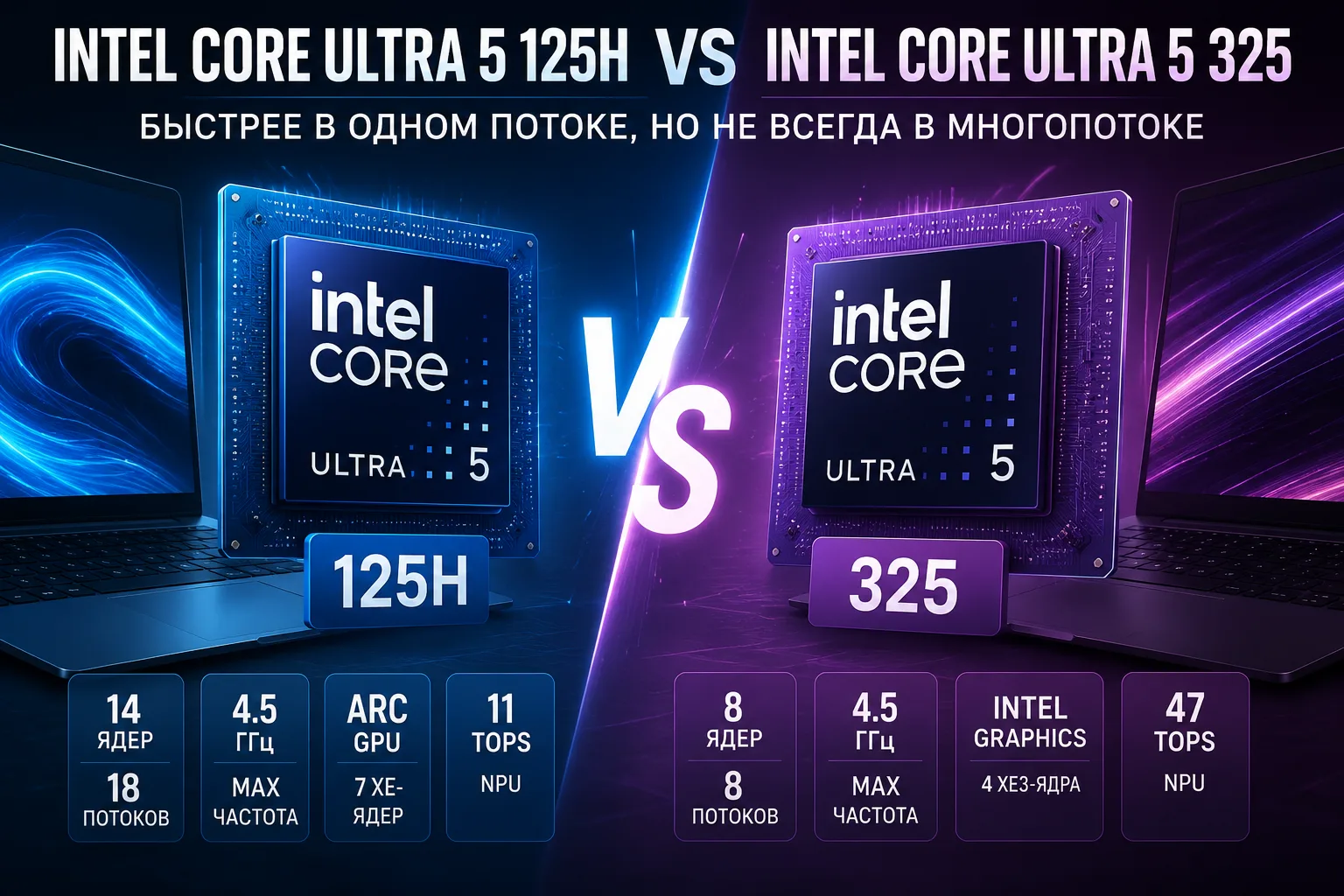
CPU Comparison Result
Intel Core Ultra 5 325 vs Core Ultra 5 125H: faster in single-threaded tasks, but not always in multi-threaded ones
The Intel Core Ultra 5 325 cannot be considered a direct replacement for the Core Ultra 5 125H. The new processor has 8 cores and 8 threads compared to its predecessor's 14 cores and 18 threads, but it has transitioned to Panther Lake architecture and the Intel 18A manufacturing process. As a result, the Core Ultra 5 325 is significantly faster in single-threaded tasks, while the Core Ultra 5 125H can still outperform it under sustained loads on all cores.
Key Differences
| Specification | Intel Core Ultra 5 125H | Intel Core Ultra 5 325 |
|---|---|---|
| Generation | Core Ultra Series 1 | Core Ultra Series 3 |
| Architecture | Meteor Lake | Panther Lake |
| Manufacturing Process | Intel 4 | Intel 18A |
| Core Configuration | 4 P + 8 E + 2 LP E | 4 P + 4 LP E |
| Threads | 18 | 8 |
| Max Frequency | 4.5 GHz | 4.5 GHz |
| L3 Cache | 18 MB | 12 MB |
| Base Power | 28 W | 25 W |
| Max Turbo Power | 115 W | 55 W |
| Integrated Graphics | Intel Arc, 7 Xe Cores | Intel Graphics, 4 Xe3 Cores |
| NPU | 11 TOPS | 47 TOPS |
| Memory Support | Up to DDR5-5600 | Up to DDR5-6400 |
| Maximum Memory Size | 96 GB | 128 GB |
| Release Date | Q4 2023 | Q1 2026 |
Both processors can boost to 4.5 GHz, so the Core Ultra 5 325’s advantage in single-threaded performance is attributed to the new architecture, rather than higher clock speeds.
Panther Lake also features a significantly lower official power limit: 55 W compared to 115 W. However, these values cannot be directly used to compare efficiency or thermal output. Real-world behavior depends on power limits, cooling solutions, and specific laptop configurations.
Performance Results in Specific Laptops
| Processor and Device | Geekbench 6 Single | Geekbench 6 Multi | Cinebench R23 Multi | 3DMark Time Spy CPU |
|---|---|---|---|---|
| Core Ultra 5 125H - Lenovo ThinkBook 13x G4 | 2,279 | 11,192 | 9,194 | 6,216 |
| Core Ultra 5 125H - Samsung Galaxy Book4 Pro 360 | 2,310 | 11,571 | 9,965 | 6,391 |
| Core Ultra 5 125H - Lenovo IdeaPad Slim 5 14IMH9 | 2,258 | 11,555 | 12,620 | 8,721 |
| Core Ultra 5 325 - Lenovo ThinkPad T14 Gen 7 | 2,576 | 10,575 | 10,487 | 6,959 |
| Core Ultra 5 325 - Lenovo ThinkBook 14 G9 IPL | 2,571 | 10,907 | 11,015 | 7,732 |
| Core Ultra 5 325 - Dell XPS 16 | 2,622 | 11,088 | 10,989 | 7,587 |
The results were gathered from Notebookcheck. The laptops were tested with different versions of Geekbench 6, varying memory sizes, cooling solutions, and power limits, so the table reflects the behavior of specific devices rather than a lab-accurate difference between processors.
Single-Threaded Performance
In the provided laptops, the Core Ultra 5 325 scores between 2,571 and 2,622 points in Geekbench 6 Single-Core. The Core Ultra 5 125H results range from 2,258 to 2,310 points.
The Panther Lake advantage is about 12-16%. It is most noticeable in web browsing, office applications, launching programs, processing small images, and other tasks that do not load all cores simultaneously.
Multi-Threaded Performance
Under full-core loads, the advantage of the new processor disappears. In Geekbench 6 Multi-Core, laptops with Core Ultra 5 125H score around 11,200-11,600 points, while devices with Core Ultra 5 325 score approximately 10,600-11,100 points.
The specific laptop's influence is particularly evident in Cinebench R23. The Core Ultra 5 125H scores 9,194 points in the slim ThinkBook 13x G4 and 12,620 points in the IdeaPad Slim 5. The difference between devices with the same processor can reach 37%.
For the Core Ultra 5 325, the results of three laptops fall within a narrower range - from 10,487 to 11,015 points. The new model demonstrates more consistent behavior, but its eight cores do not always compensate for the 14 cores and 18 threads of the Core Ultra 5 125H.
For rendering, video encoding, and extended compilation, not only the processor but also the sustained power limits of the laptop are important. The Core Ultra 5 125H in a well-cooled model may be faster, while in a slim chassis, it might fall behind the Core Ultra 5 325.
Integrated Graphics
The Core Ultra 5 125H features Intel Arc graphics with seven Xe cores. The Core Ultra 5 325 has received a newer Xe3 architecture, but only has four graphics cores.
The GPU Peak TOPS rating has increased from 18 to 40; however, this reflects INT8 computation speed and does not directly indicate gaming performance.
From the few available results, both graphics configurations appear to be in a similar class. The Lenovo ThinkBook 14 G9 IPL with the Core Ultra 5 325 scores around 2,856 points in 3DMark Time Spy Graphics, while the Samsung Galaxy Book4 Pro 360 with the Core Ultra 5 125H scores around 3,000 points.
These results were obtained in different laptops, so it is yet to be determined whether there is a clear winner. The Core Ultra 5 325 possesses a more modern architecture and media block, but does not show a convincing advantage over the Arc 7-Core in gaming.
The overall performance of the integrated graphics also depends on the memory bandwidth and the total power limit of the processor.
NPU and New Platform
In terms of neural processing unit (NPU) performance, the Core Ultra 5 325 is significantly ahead: 47 TOPS compared to 11 TOPS for the Core Ultra 5 125H.
This advantage is important for applications that leverage the NPU for image processing, noise reduction, speech recognition, and other local AI functions. In typical office applications, the difference is almost negligible.
Panther Lake also supports faster DDR5-6400 memory and up to 128 GB of RAM. For most laptops, the maximum memory size is not a major concern, but the new platform offers more options for device manufacturers.
Laptops and Pricing
The Core Ultra 5 125H is found in many models from 2024 and 2025:
- Lenovo IdeaPad Slim 5 14IMH9;
- Lenovo ThinkBook 13x G4;
- Samsung Galaxy Book4 Pro 360;
- MSI Prestige 13 AI Evo;
- Acer Swift Go 14.
The Core Ultra 5 325 is currently primarily being installed in new laptops for 2026:
- Lenovo ThinkBook 14 G9 IPL;
- Lenovo ThinkPad T14 Gen 7;
- Dell XPS 14;
- Dell XPS 16;
- Lenovo ThinkPad E14 Gen 8.
Devices with the Core Ultra 5 125H have been on the market longer and are more commonly available at discounts. Depending on the configuration, they can be found starting around €700-800.
Laptops with the Core Ultra 5 325 are predominantly part of new business series and premium lines. Available models start at around €900-1,000, while Dell XPS and higher-end ThinkPads can cost significantly more.
Prices vary greatly depending on the display, casing, memory size, and region, so the difference between two laptops is not always determined by the processor.
Which Processor to Choose
The Core Ultra 5 325 is better suited if you prioritize:
- high single-threaded performance;
- powerful NPU;
- new platform;
- more predictable results in thin laptops;
- support for faster memory.
The Core Ultra 5 125H is more advantageous if you care about:
- sustained multi-threaded performance;
- lower laptop price;
- a wide selection of available models;
- no requirements for a modern NPU;
- the option to choose a device with strong cooling.
Conclusion
The Intel Core Ultra 5 325 is approximately 12-16% faster than the Core Ultra 5 125H in single-threaded tests and features a NPU that is more than four times more powerful. It is a more modern processor for everyday tasks and applications utilizing the neural accelerator.
In multi-threaded tasks, there is no clear winner. The Core Ultra 5 325 exhibits more consistent results across different laptops, but the Core Ultra 5 125H, with its 14 cores and 18 threads, can be faster with adequate cooling.
The integrated graphics of both processors appear to be in the same class. The new Xe3 configuration does not demonstrate a noticeable advantage over the Arc 7-Core, despite a higher GPU TOPS rating.
At the same price point, the Core Ultra 5 325 is preferable due to its faster cores, powerful NPU, and new platform. The Core Ultra 5 125H is more advantageous at a significantly lower price or for prolonged multi-threaded workloads in laptops with good cooling.
Advantages
- More Total Cores: 14 (14 vs 8)
- Larger L3 Cache: 18 MB (18 MB vs 12 MB shared)
- Higher Technology: 2 nm (7 nm vs 2 nm)
- Newer Launch Date: January 2026 (December 2023 vs January 2026)
Basic
CPU Specifications
Memory Specifications
GPU Specifications
Interfaces and Ports
Benchmarks
Related CPU Comparisons




Share in social media
Or Link To Us
<a href="https://cputronic.com/cpu/compare/intel-core-ultra-5-125h-vs-intel-core-ultra-5-325" target="_blank">Intel Core Ultra 5 125H vs Intel Core Ultra 5 325</a>