Intel Core 7 240H
vs
AMD Ryzen 7 260

CPU Comparison Result
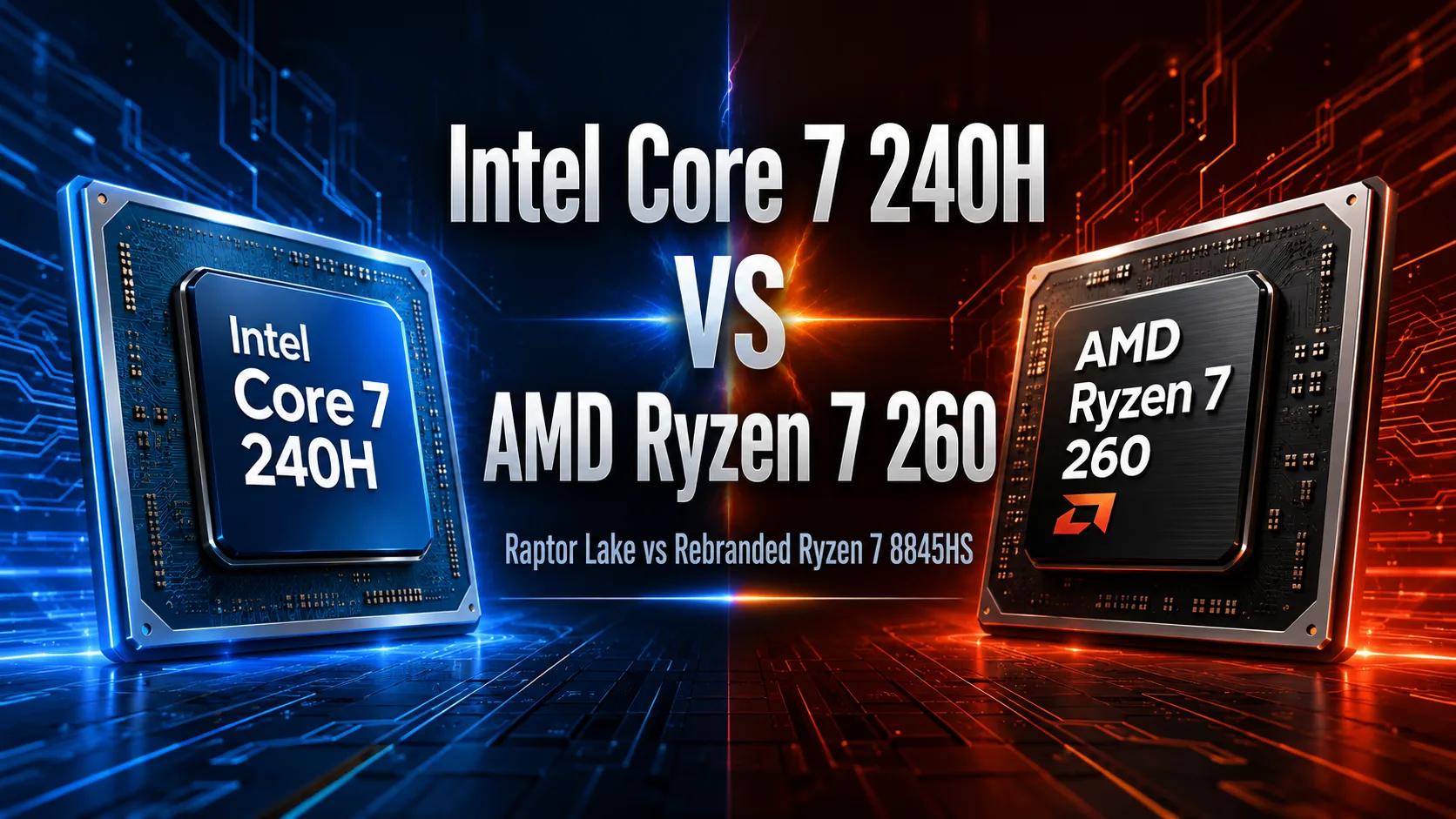
Intel Core 7 240H vs Ryzen 7 260: Raptor Lake vs Renamed Ryzen 7 8845HS
By their model numbers, the Core 7 240H and Ryzen 7 260 could easily be mistaken for processors of a new generation. However, neither side represents a new generation: the Core 7 240H is still based on Raptor Lake, while the Ryzen 7 260 closely mirrors the Ryzen 7 8845HS. Therefore, the comparison should focus on the two processors built on familiar architectures rather than their model numbers.
Intel employs six performance cores and four efficiency cores. AMD offers eight full Zen 4 cores, a Radeon 780M, and a separate NPU.
| Specification | Intel Core 7 240H | AMD Ryzen 7 260 |
|---|---|---|
| Architecture | Raptor Lake | Zen 4, Hawk Point |
| Cores / Threads | 10 / 16 | 8 / 16 |
| Configuration | 6 P-cores + 4 E-cores | 8 Zen 4 |
| Maximum Frequency | 5.2 GHz | 5.1 GHz |
| L3 Cache | 24 MB | 16 MB |
| Process Technology | Intel 7 | TSMC 4 nm |
| TDP | 45 W | 45 W |
| Configurable TDP | - | 35-54 W |
| Maximum Turbo Power | Up to 115 W | No similar specification |
| Integrated Graphics | Intel Graphics, 64 EUs | Radeon 780M, 12 CUs |
| iGPU Frequency | Up to 1.55 GHz | Up to 2.7 GHz |
| NPU | No modern NPU | Ryzen AI, up to 16 TOPS |
| Memory Support | Up to DDR5-6400, DDR4 supported | DDR5-5600 / LPDDR5X-7500 |
| PCI Express | PCIe 5.0 | PCIe 4.0 |
Origin of the Core 7 240H and Ryzen 7 260
Core 7 240H - Another Version of Raptor Lake-H
The 240H designation is misleading: it is not Arrow Lake, but Raptor Lake.
In terms of main characteristics, the Core 7 240H closely resembles the Core i7-13620H:
- 6 P-cores and 4 E-cores;
- 10 cores and 16 threads;
- 24 MB L3;
- Intel 7 process technology;
- Base power of 45 W;
- Maximum Turbo Power up to 115 W;
- Integrated graphics with 64 EUs.
The main changes include increased frequencies and official support for faster DDR5. The maximum frequency of P-cores increased from 4.9 to 5.2 GHz, E-cores from 3.6 to 4.0 GHz, and memory from DDR5-5200 to DDR5-6400.
The Core 7 240H is just another update of Raptor Lake-H, not a new generation of Intel mobile processors.
Ryzen 7 260 - Essentially the Same as Ryzen 7 8845HS
AMD's situation is even simpler. The Ryzen 7 260 closely mirrors the Ryzen 7 8845HS.
Common features include:
- 8 Zen 4 cores and 16 threads;
- Frequencies of 3.8-5.1 GHz;
- 8 MB L2 and 16 MB L3;
- TDP of 45 W and cTDP of 35-54 W;
- TSMC 4 nm process technology;
- Radeon 780M with 12 CUs;
- GPU frequency up to 2.7 GHz;
- NPU Ryzen AI up to 16 TOPS;
- DDR5-5600 and LPDDR5X-7500;
- PCIe 4.0.
The Ryzen 7 260 has not received a new architecture: it is the same Hawk Point on Zen 4 that was previously sold as the Ryzen 7 8845HS.
Processor Performance
In single-threaded tests, the processors are nearly equal: the high frequency of the P-cores allows the Core 7 240H to occasionally take the lead.
| Test | Core 7 240H | Ryzen 7 260 | Difference |
|---|---|---|---|
| Geekbench 6 Single-Core | 2567 | 2555 | Intel +0.5% |
| Geekbench 6 Multi-Core | 12,456 | 12,923 | AMD +3.7% |
| 3DMark CPU Profile 1 Thread | 1076 | 1007 | Intel +6.9% |
| 3DMark CPU Profile Multi Thread | 7212 | 7798 | AMD +8.1% |
The Core 7 240H is slightly stronger in single-threaded tests, while the Ryzen 7 260 excels in multi-threaded scenarios.
In Geekbench 6, Ryzen gains about 4% in Multi-Core, and in 3DMark CPU Profile, about 8%. Such differences alone should not dictate the choice of laptop.
The specific model has a greater influence: power limits and cooling can overshadow the differences between the processors themselves.
Geekbench 6 on Real Laptops
| Laptop | Processor | Device Class | Geekbench 6 Single | Geekbench 6 Multi |
|---|---|---|---|---|
| ASUS V16 V3607VH | Core 7 240H | Gaming Laptop | 2611 | 11,566 |
| Alienware 16 Aurora AC16250 | Core 7 240H | Large Gaming Laptop | 2505 | 13,160 |
| ASUS TUF Gaming A16 FA608UH | Ryzen 7 260 | Gaming Laptop | 2657 | 13,574 |
| Acer Nitro ANV16-42 | Ryzen 7 260 | Gaming Laptop | 2577 | 12,763 |
One Core 7 240H in the ASUS V16 scores around 11,600 Multi-Core points, while in the Alienware 16 Aurora, it exceeds 13,000.
For the Ryzen 7 260, the difference between the two discovered laptops is less, around 12,800-13,600 points.
For a gaming laptop, merely having the same CPU name is insufficient. Cooling and power limits can substantially affect results more than the difference between the 240H and 260.
Integrated Graphics - Clear Advantage for Ryzen
Without a discrete graphics card, the advantage of Ryzen becomes much more apparent.
The Core 7 240H features Intel Graphics with 64 execution units and a frequency of up to 1.55 GHz. The Ryzen 7 260 utilizes a Radeon 780M based on the RDNA 3 architecture with 12 compute units and a frequency of up to 2.7 GHz.
The Radeon 780M is noticeably faster than the integrated graphics of the Core 7 240H.
The Radeon 780M allows many less demanding games and older AAA titles to run on lower settings. The Core 7 240H’s graphics are significantly weaker: its capabilities are sufficient for the interface, video, and undemanding applications, but the performance margin for gaming is significantly lower.
Therefore, in a laptop without a discrete graphics card, the Radeon 780M presents a much more significant advantage for Ryzen than a few percentage points difference in CPU tests.
In models with GeForce RTX 5050, RTX 5060, or another discrete graphics card, integrated graphics become nearly irrelevant in the decision-making process. What matters more is the GPU itself, its TGP, and cooling.
Power Consumption
On paper, both processors fall into the 45 W category, but direct comparisons of maximum figures from Intel and AMD are not feasible.
Intel states the following for the Core 7 240H:
- Processor Base Power - 45 W;
- Maximum Turbo Power - up to 115 W.
For the Ryzen 7 260:
- Standard TDP - 45 W;
- Configurable range cTDP - 35-54 W.
The 115 W for Intel and 54 W for AMD represent different values, making direct comparisons impossible.
The Core 7 240H allows for a temporary power increase far beyond the base 45 W. Larger gaming chassis tend to handle such modes better; in slim models, performance is more affected by cooling and factory limits.
NPU and Platform Capabilities
The Ryzen 7 260 is equipped with the Hawk Point generation Ryzen AI NPU with a performance of up to 16 TOPS.
The Core 7 240H lacks a modern standalone NPU. Intel's GNA 3.0 is a considerably simpler block and does not equate to Ryzen AI or the NPUs of modern Core Ultra processors.
However, 16 TOPS are already insufficient for the requirements of Copilot+ PC, so this NPU cannot be compared with the blocks in modern Ryzen AI 300 or Core Ultra 200V.
16 TOPS are a pleasant addition, but it does not make sense to choose the Ryzen 7 260 solely for such an NPU over other laptop specifications.
On the other hand, the Core 7 240H supports Quick Sync Video, which remains useful in compatible video processing applications.
Which Processor is Better
At the same price point, the Ryzen 7 260 is preferable. It is slightly faster in most multi-threaded tests, has a much more powerful Radeon 780M, and a separate NPU.
The Core 7 240H does not fall behind in single-threaded tests, but architecturally it is still the same Raptor Lake-H with increased frequencies.
In gaming laptops with a discrete graphics card, the difference between processors becomes secondary. What is far more important is the model of the GPU, its TGP, cooling, screen, and the price of the laptop itself.
Both manufacturers are selling familiar silicon under fresh model numbers here. However, AMD's starting base is stronger: with similar CPU performance, the Ryzen 7 260 benefits from the Radeon 780M and NPU, to which the Core 7 240H has almost no counter.
Advantages
- More Total Cores: 10 (10 vs 8)
- Larger L3 Cache: 24 MB shared (24 MB shared vs 16 MB)
- Higher Technology: TSMC 4nm FinFET (10 nm vs TSMC 4nm FinFET)
- Newer Launch Date: February 2025 (December 2024 vs February 2025)
Basic
CPU Specifications
Memory Specifications
GPU Specifications
Interfaces and Ports
Miscellaneous
Benchmarks
Related CPU Comparisons




Share in social media
Or Link To Us
<a href="https://cputronic.com/cpu/compare/intel-core-7-240h-vs-amd-ryzen-7-260" target="_blank">Intel Core 7 240H vs AMD Ryzen 7 260</a>