AMD Ryzen Embedded R2544
vs
Intel Processor N100
vs
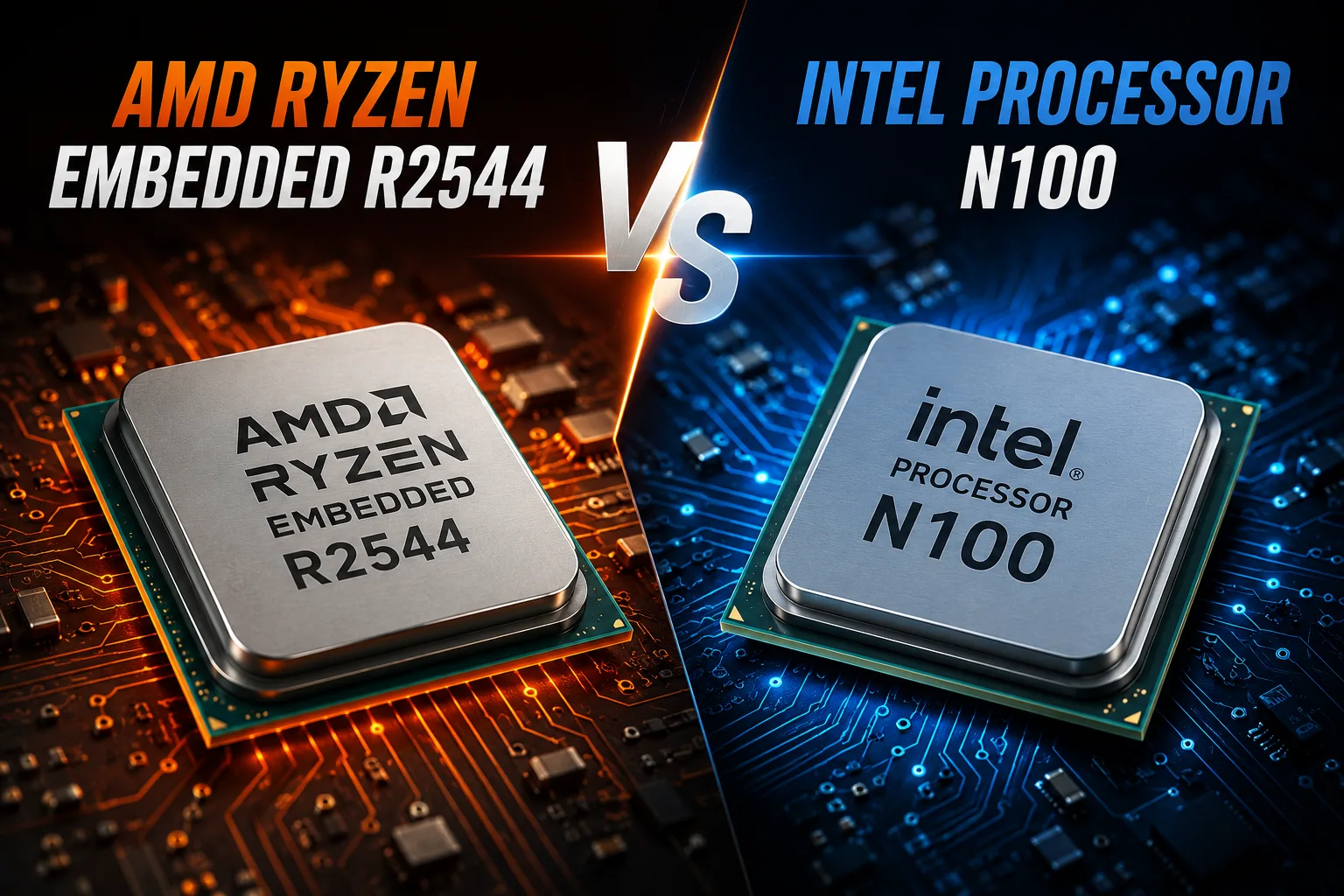
AMD Ryzen Embedded R2544 vs Intel Processor N100 processor comparison
CPU Comparison Result

AMD Ryzen Embedded R2544 vs Intel N100: Eight Threads vs 6-Watt Platform

The AMD Ryzen Embedded R2544 and Intel Processor N100 both feature four cores, but that's where the similarities end. The R2544 supports eight threads, dual-channel memory, and a more powerful integrated graphics configuration, albeit with a nominal TDP of 45 watts. The N100 is limited to four threads and a single memory channel, but it consumes significantly less power and is suitable for compact systems with simple cooling solutions.

Thus, the R2544 should be considered for prolonged multi-threaded workloads, NAS, networking equipment, and specialized computers. The N100 is primarily geared towards budget mini-PCs, office terminals, media systems, and lightweight home servers.

Key Differences

Specification AMD Ryzen Embedded R2544 Intel Processor N100
Architecture Zen+ Alder Lake-N
Cores / Threads 4 / 8 4 / 4
Max Frequency 3.7 GHz 3.4 GHz
L3 Cache 4 MB 6 MB
Nominal TDP 45 W 6 W
Configurable TDP 35-54 W Not specified
Supported Memory DDR4-3200 DDR4-3200, DDR5-4800, LPDDR5-4800
Memory Channels 2 1
Integrated Graphics Radeon Vega, 8 CU Intel UHD Graphics, 24 EU
Max GPU Frequency 1.3 GHz 750 MHz
Display Support Up to 4 Up to 3
PCI Express 3.0 Lines Up to 16 Up to 9
Main Segment Embedded systems, NAS, and industrial PCs Budget mini-PCs and compact systems

The main advantages of the R2544 are its eight threads, dual memory channels, and broader peripheral connectivity options. The N100 is significantly simpler but is designed from the ground up for low power consumption, compact size, and low device cost.

CPU Performance

In average PassMark results, the Ryzen Embedded R2544 scores around 7760 CPU Mark points, while the Intel N100 scores about 5320 points. AMD’s advantage in multi-threaded tests reaches 46%.

Test Ryzen Embedded R2544 Intel Processor N100 Difference
PassMark CPU Mark 7762 5320 R2544 is 46% faster
PassMark Single Thread 2090 1883 R2544 is 11% faster

The eight-threaded R2544 handles tasks that can load all cores simultaneously well: archiving, compiling, running virtual machines, and multiple background services.

In single-threaded mode, the gap is significantly smaller. The newer architecture of the N100 provides sufficient speed for browsing, office applications, and the operating system interface, despite the low power limit.

Geekbench 6 on Specific Devices

The results from ready-made systems are less definitive than the average PassMark scores.

Processor and Device Operating System Single Core Multi Core
Ryzen Embedded R2544 - HC Technology HCAR357-NR2 Linux 1154 3207
Intel N100 - Beelink Mini S12 Pro Debian Linux 1281 3270
Intel N100 - ASUS Mini PC PN42 Linux 1261 2901
Intel N100 - MSI Cubi N ADL Ubuntu Linux 1253 3144

In the Geekbench 6 runs found, the N100 systems are faster in single-threaded mode, while multi-threaded results are roughly on par. However, only one suitable result is available for the R2544, so this table does not reflect the average processor performance.

In contrast, PassMark shows a significant advantage for the R2544 in multi-threaded testing. The discrepancy is related to different types of workloads, power limit settings, memory configurations, and a small sample of R2544 devices.

Therefore, the Geekbench results here are better considered as examples of specific mini-PC behavior rather than as a definitive ranking of the two processors.

Specific Devices

The Ryzen Embedded R2544 is found in mini-PCs like the KAMRUI P2 and ACEMAGIC K1, the ACEMAGIC N3A network storage, as well as in industrial boards and specialized computers.

The Intel N100 has seen much broader adoption. It is used in the Beelink Mini S12 Pro, ASUS Mini PC PN42, MSI Cubi N ADL, and dozens of similar compact systems.

The choice of devices on the N100 is significantly larger, making it easier to find, compare by price, and select based on the number of ports. R2544 models appear less frequently but typically offer more computational resources and expansion capabilities.

Integrated Graphics

The Ryzen Embedded R2544 features Radeon Vega graphics with eight compute units and a frequency of up to 1.3 GHz. An additional advantage is its dual-channel DDR4-3200, as the integrated GPU uses system memory rather than its own VRAM.

The Intel N100 has UHD Graphics with 24 execution units and a frequency of up to 750 MHz. The single-channel memory controller limits bandwidth, especially for graphics tasks.

In terms of GPU and memory configuration, the advantage should belong to the R2544, but the exact gap depends on the specific device's settings. For a reliable comparison of gaming performance, tests on two systems with the same amount of memory and similar cooling conditions are needed.

The N100 excels not in the number of graphics units but in the efficiency of its multimedia capabilities. Intel Quick Sync and hardware video decoding make it suitable for media players, streaming, and light transcoding.

Platform Features

The R2544 supports up to four external displays and provides up to 16 PCI Express 3.0 lanes. This allows manufacturers to install multiple network controllers, storage devices, expansion cards, or additional video outputs.

The N100 offers up to nine PCIe 3.0 lanes and support for up to three displays. This is sufficient for a typical mini-PC, but in NAS and networking devices, limited resources must be divided between NVMe, SATA, Ethernet, and wireless adapters.

Additional PCIe lanes, dual memory channels, and support for four displays make the R2544 a more flexible foundation for specialized computers. The N100 is better suited for simple configurations without many controllers and storage devices.

Power Consumption and Cooling

The nominal TDP of the Intel N100 is 6 watts. The Ryzen Embedded R2544 reaches 45 watts, with a configurable range between 35 and 54 watts.

TDP cannot be directly equated to the power consumption of the entire computer, but the difference between the platforms is still significant. In comparable configurations, systems on the N100 typically consume less power and require simpler cooling.

The R2544 needs a larger heatsink, and in most compact systems, active cooling is required as well. In return, the processor is able to sustain high performance longer when all threads are active.

The N100 is better suited for an always-on media server, office terminal, or home computer under light load. The R2544 is justified in systems with virtual machines, multiple network services, local data processing, or a large number of peripherals.

What to Choose

The Ryzen Embedded R2544 is preferable if you need:

  • higher multi-threaded performance;
  • eight threads for parallel tasks;
  • dual-channel RAM;
  • multiple storage devices or network controllers;
  • support for three to four displays;
  • an embedded platform with a long lifecycle.

The Intel Processor N100 is better suited for:

  • a budget office mini-PC;
  • browsing, documents, and video playback;
  • compact form factor;
  • quiet or passive cooling;
  • an economical home server;
  • 24/7 operation under light load.

Conclusion

The AMD Ryzen Embedded R2544 outperforms in averaged multi-threaded tests and offers a more functional platform. Eight threads, dual-channel memory, additional PCIe lanes, and support for four displays make it preferable for NAS, networking equipment, industrial computers, and mini-PCs under sustained load.

The Intel Processor N100 falls short in computational headroom and expansion capabilities but requires significantly less power. Its performance is sufficient for browsing, office applications, multimedia, and a lightweight home server, while its low thermal output simplifies cooling.

At a similar price and with comparable specifications, the R2544 offers more computational resources. However, devices based on the N100 are more widespread, making it easier to find an affordable, compact, and well-tested model.

Advantages

  • Higher Max Turbo Frequency: up to 3.7 GHz (up to 3.7 GHz vs 3.40 GHz)
  • Larger L3 Cache: 6 MB (4 MB (shared) vs 6 MB)
  • Higher Technology: Intel 7 (12 nm vs Intel 7)
  • Higher Memory Type: DDR4 3200 MT/s DDR5 4800 MT/s LPDDR5 4800 MT/s (DDR4 vs DDR4 3200 MT/s DDR5 4800 MT/s LPDDR5 4800 MT/s)
  • Newer Launch Date: January 2023 (September 2022 vs January 2023)

Basic

AMD
Label Name
Intel
September 2022
Launch Date
January 2023
Desktop
Platform
Mobile
Ryzen Embedded R2544
Model Name
?
The Intel processor number is just one of several factors - along with processor brand, system configurations, and system-level benchmarks - to be considered when choosing the right processor for your computing needs.
N100
Picasso
Code Name
Alder Lake N
Ryzen Embedded (Zen+ (Picasso))
Generation
-

CPU Specifications

4
Total Cores
?
Cores is a hardware term that describes the number of independent central processing units in a single computing component (die or chip).
4
8
Total Threads
?
Where applicable, Intel® Hyper-Threading Technology is only available on Performance-cores.
4
3.35 GHz
Basic Frequency
-
-
Intel Virtualization Technology (VT-x)
?
Intel® Virtualization Technology (VT-x) allows one hardware platform to function as multiple “virtual” platforms. It offers improved manageability by limiting downtime and maintaining productivity by isolating computing activities into separate partitions.
Yes
-
Intel Virtualization Technology for Directed I/O (VT-d)
?
Intel® Virtualization Technology for Directed I/O (VT-d) continues from the existing support for IA-32 (VT-x) and Itanium® processor (VT-i) virtualization adding new support for I/O-device virtualization. Intel VT-d can help end users improve security and reliability of the systems and also improve performance of I/O devices in virtualized environments.
Yes
up to 3.7 GHz
Max Turbo Frequency
?
Max Turbo Frequency is the maximum single-core frequency at which the processor is capable of operating using Intel® Turbo Boost Technology and, if present, Intel® Turbo Boost Max Technology 3.0 and Intel® Thermal Velocity Boost. Frequency is typically measured in gigahertz (GHz), or billion cycles per second.
3.40 GHz
-
Enhanced Intel SpeedStep Technology
?
Enhanced Intel SpeedStep® Technology is an advanced means of enabling high performance while meeting the power-conservation needs of mobile systems. Conventional Intel SpeedStep® Technology switches both voltage and frequency in tandem between high and low levels in response to processor load. Enhanced Intel SpeedStep® Technology builds upon that architecture using design strategies such as Separation between Voltage and Frequency Changes, and Clock Partitioning and Recovery.
Yes
-
Intel Hyper-Threading Technology
?
Intel® Hyper-Threading Technology (Intel® HT Technology) delivers two processing threads per physical core. Highly threaded applications can get more work done in parallel, completing tasks sooner.
No
96 KB (per core)
L1 Cache
-
512 KB (per core)
L2 Cache
-
4 MB (shared)
L3 Cache
6 MB
100 MHz
Bus Frequency
-
-
Cache
?
CPU Cache is an area of fast memory located on the processor. Intel® Smart Cache refers to the architecture that allows all cores to dynamically share access to the last level cache.
6 MB Intel® Smart Cache
AMD Socket FP5
CPU Socket
?
The socket is the component that provides the mechanical and electrical connections between the processor and motherboard.
FCBGA1264
33.5x
Multiplier
-
No
Multiplier Unlocked
-
-
Intel AES New Instructions
?
Intel® AES New Instructions (Intel® AES-NI) are a set of instructions that enable fast and secure data encryption and decryption. AES-NI are valuable for a wide range of cryptographic applications, for example: applications that perform bulk encryption/decryption, authentication, random number generation, and authenticated encryption.
Yes
12 nm
Technology
?
Lithography refers to the semiconductor technology used to manufacture an integrated circuit, and is reported in nanometer (nm), indicative of the size of features built on the semiconductor.
Intel 7
45 W
TDP
6 W
105°C
Max. Operating Temperature
?
Junction Temperature is the maximum temperature allowed at the processor die.
105°C
Gen 3, 16 Lanes (CPU only)
PCI Express Version
?
PCI Express Revision is the supported version of the PCI Express standard. Peripheral Component Interconnect Express (or PCIe) is a high-speed serial computer expansion bus standard for attaching hardware devices to a computer. The different PCI Express versions support different data rates.
-
-
Max Number of PCI Express Lanes
?
A PCI Express (PCIe) lane consists of two differential signaling pairs, one for receiving data, one for transmitting data, and is the basic unit of the PCIe bus. Max # of PCI Express Lanes is the total number of supported lanes.
9
-
Instruction Set
?
The instruction set is a hard program stored inside the CPU that guides and optimizes CPU operations. With these instruction sets, the CPU can run more efficiently. There are many manufacturers that design CPUs, which results in different instruction sets, such as the 8086 instruction set for the Intel camp and the RISC instruction set for the ARM camp. x86, ARM v8, and MIPS are all codes for instruction sets. Instruction sets can be extended; for example, x86 added 64-bit support to create x86-64. Manufacturers developing CPUs that are compatible with a certain instruction set need authorization from the instruction set patent holder. A typical example is Intel authorizing AMD, enabling the latter to develop CPUs compatible with the x86 instruction set.
64-bit
-
Intel VT-x with Extended Page Tables (EPT)
?
Intel® VT-x with Extended Page Tables (EPT), also known as Second Level Address Translation (SLAT), provides acceleration for memory intensive virtualized applications. Extended Page Tables in Intel® Virtualization Technology platforms reduces the memory and power overhead costs and increases battery life through hardware optimization of page table management.
Yes
4,940 million
Transistor Count
-

Memory Specifications

DDR4
Memory Type
?
Intel® processors come in four different types: Single Channel, Dual Channel, Triple Channel, and Flex Mode. Maximum supported memory speed may be lower when populating multiple DIMMs per channel on products that support multiple memory channels.
DDR4 3200 MT/s DDR5 4800 MT/s LPDDR5 4800 MT/s
-
Max Memory Size
?
Max memory size refers to the maximum memory capacity supported by the processor.
16 GB
Dual-channel
Memory Channels
?
The number of memory channels refers to the bandwidth operation for real world application.
1
-
Maximum Memory Speed
4800 MHz
Yes
ECC Memory Support
?
ECC Memory Supported indicates processor support for Error-Correcting Code memory. ECC memory is a type of system memory that can detect and correct common kinds of internal data corruption. Note that ECC memory support requires both processor and chipset support.
No

GPU Specifications

Radeon Vega 8
Integrated Graphics Model
?
An integrated GPU refers to the graphics core that is integrated into the CPU processor. Leveraging the processor's powerful computational capabilities and intelligent power efficiency management, it delivers outstanding graphics performance and a smooth application experience at a lower power consumption.
Intel® UHD Graphics
-
Graphics Frequency
?
Graphics max dynamic frequency refers to the maximum opportunistic graphics render clock frequency (in MHz) that can be supported using Intel® HD Graphics with Dynamic Frequency feature.
750 MHz
-
4K Support
Yes | at 60Hz
-
DirectX Support
?
DirectX* Support indicates support for a specific version of Microsoft’s collection of APIs (Application Programming Interfaces) for handling multimedia compute tasks.
12.1
-
Execution Units
?
The Execution Unit is the foundational building block of Intel’s graphics architecture. Execution Units are compute processors optimized for simultaneous Multi-Threading for high throughput compute power.
24
-
Max Resolution (DP)
?
Max Resolution (DP) is the maximum resolution supported by the processor via the DP interface (24bits per pixel & 60Hz). System or device display resolution is dependent on multiple system design factors; actual resolution may be lower on your system.
4096 x 2160@60Hz
-
Max Resolution (HDMI)
?
Max Resolution (HDMI) is the maximum resolution supported by the processor via the HDMI interface (24bits per pixel & 60Hz). System or device display resolution is dependent on multiple system design factors; actual resolution may be lower on your system.
4096 x 2160@60Hz
-
Number of Displays Supported
3
-
Graphics Output
?
Graphics Output defines the interfaces available to communicate with display devices.
eDP 1.4b | DP 1.4 | HDMI 2.1 | MIPI-DSI 1.3
-
OpenGL Support
?
OpenGL (Open Graphics Library) is a cross-language, multi-platform API (Application Programming Interface) for rendering 2D and 3D vector graphics.
4.6
-
OpenCL Support
?
OpenCL (Open Computing Language) is a multi-platform API (Application Programming Interface) for heterogeneous parallel programming.
3.0
-
Intel Quick Sync Video
?
Intel® Quick Sync Video delivers fast conversion of video for portable media players, online sharing, and video editing and authoring.
Yes

AI Specifications

-
Intel Gaussian Neural Accelerator
?
Intel® Gaussian & Neural Accelerator (GNA) is an ultra-low power accelerator block designed to run audio and speed-centric AI workloads. Intel® GNA is designed to run audio based neural networks at ultra-low power, while simultaneously relieving the CPU of this workload.
3.0

Miscellaneous

-
Intel Image Processing Unit
6.0
-
Intel Standard Manageability (ISM)
?
Intel® Standard Manageability is the manageability solution for Intel vPro® Essentials platforms and is a subset of Intel® AMT with out-of-band management over Ethernet and Wi-Fi, but no KVM or new life cycle management features.
Intel® SSE4.1 | Intel® SSE4.2 | Intel® AVX2
-
Intel High Definition Audio
Yes
-
Intel Boot Guard
?
Intel® Device Protection Technology with Boot Guard helps protect the system’s pre-OS environment from viruses and malicious software attacks.
Yes
-
Intel Control-Flow Enforcement Technology
?
CET - Intel Control-flow Enforcement Technology (CET) helps protect against the misuse of legitimate code snippets through return-oriented programming (ROP) control-flow hijacking attacks.
Yes
-
Intel OS Guard
Yes