AMD Ryzen Embedded R2544
AMD Ryzen Embedded R2544: An Embedded Processor for Mini PCs and Industrial Systems
The AMD Ryzen Embedded R2544 is an embedded SoC from the Ryzen Embedded R2000 series. It should not be evaluated as a regular desktop Ryzen for home builds: this processor is designed for compact devices, thin clients, industrial PCs, digital signage, terminals, and edge systems.
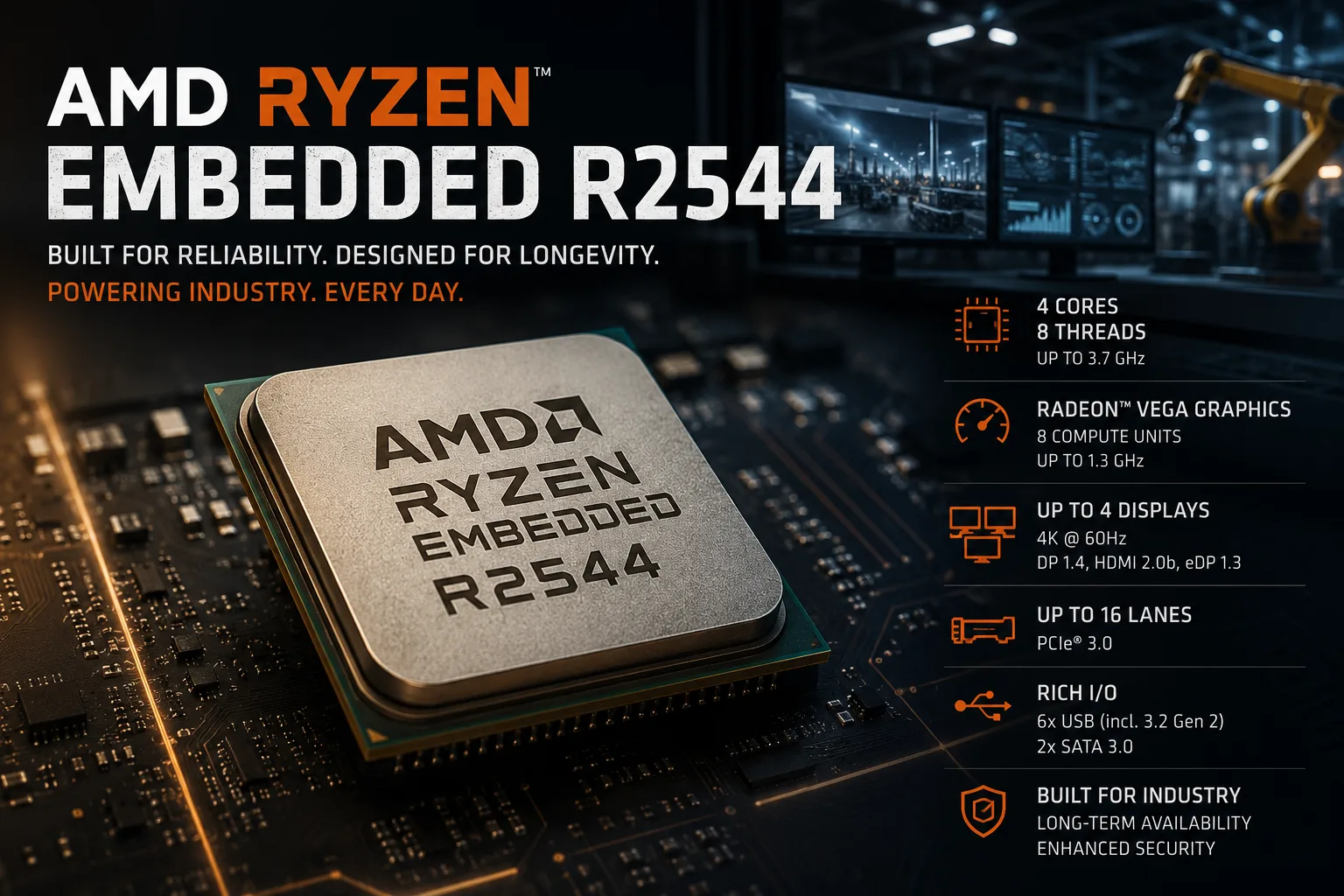
The model features 4 cores, 8 threads, Zen+ architecture, Radeon integrated graphics, and a configurable thermal envelope of 35-54 W. By modern standards, it is not a new flagship CPU, but for the embedded segment, the R2544 has important advantages: a compact platform, built-in graphics, support for multiple displays, and a focus on long product lifecycle.
Where the Ryzen Embedded R2544 is Used
The Ryzen Embedded R2544 is more commonly found not in laptops or classic desktop PCs, but in ready-made compact systems and specialized boards. It is chosen in places where stability, moderate power consumption, integrated graphics, and the ability to operate for years without changing the platform are important.
| Scenario | Suitability of R2544 |
|---|---|
| Mini PC for office and remote work | Well suited |
| Thin client and corporate terminals | Well suited |
| Digital signage and information panels | Well suited |
| Industrial PCs and HMI systems | Well suited |
| Edge devices and local data processing | Suitable for moderate tasks |
| Home gaming build | Poorly suited |
| Heavy rendering and editing | Poorly suited |
The main feature of the R2544 is not maximum performance, but a balance between computing power, graphics, compactness, and long-term platform support.
Real Devices Using AMD Ryzen Embedded R2544
The Ryzen Embedded R2544 is already used in ready-made devices and embedded modules. Examples include mini PCs like the ACEMAGIC K1 and KAMRUI P2, as well as industrial COM Express modules such as the AAEON COM-R2KC6 and Tria MSC C6C-RYZ2.
This clearly demonstrates the purpose of the processor. The R2544 is not a mass CPU for building a regular computer, but a foundation for mini PCs, thin clients, digital signage, terminals, industrial systems, and compact devices with multiple displays. The capabilities of specific devices depend not only on the processor but also on the manufacturer: memory, cooling, port configuration, BIOS, and implementation of video outputs.
Performance: Adequate for the Embedded Segment
The Ryzen Embedded R2544 features 4 cores and 8 threads. With a base clock of 3.35 GHz and support for SMT, the processor can confidently handle office tasks, web browsing, remote desktops, industrial software, control panels, and light local data processing.
Among the Ryzen Embedded R2000 lineup, it is one of the more powerful options. It is significantly more interesting than lower-end models when a device requires not only a basic interface but also a performance buffer for multitasking, working with multiple windows, network services, or visual panels.
However, the R2544 should not be directly compared to modern Ryzen 5, Ryzen 7, or Core i5 desktop CPUs. The Zen+ architecture is already aging, and the 4 cores limit the processor in heavy multithreaded tasks. But for embedded devices, stable operation, predictable power consumption, and compatibility with the required platform are more important than benchmarking records.
Integrated Radeon Graphics
One of the strong points of the Ryzen Embedded R2544 is the integrated Radeon graphics with 8 compute units. It does not replace a discrete graphics card, but for embedded systems, this is an important advantage.
This level of graphics is sufficient for interfaces, video output, multimedia, terminals, control panels, digital signage, and working with multiple screens. In digital signage, thin clients, and industrial interfaces, this is often more important than gaming performance.
A separate graphics card in such devices is usually unnecessary: it increases costs, power consumption, heat, and chassis size. Therefore, the integrated Radeon graphics make the R2544 a more convenient solution for compact systems.
Memory and Platform
The Ryzen Embedded R2544 supports dual-channel DDR4 up to 3200 MT/s. For this processor, this is an important parameter because the integrated graphics use system memory. If the device operates with a single memory module or at a reduced frequency, graphics and overall performance may be lower.
The implementation of a specific board or mini PC is also crucial. One manufacturer may include more video outputs and network ports, while another may stick to a basic configuration. Therefore, when comparing ready-made devices based on the R2544, one should look not only at the processor name but also at memory, cooling, SSD, Ethernet, USB, HDMI/DisplayPort, and operating system support.
How R2544 Differs from Regular Ryzen
The Ryzen Embedded R2544 is similar to mobile Ryzen CPUs in terms of power consumption and compactness, but differs in its purpose. Regular consumer processors are chosen based on price, gaming performance, clock speeds, and benchmark results. Embedded models are selected based on different criteria:
- Long-term platform availability;
- Supply stability;
- Compatibility with industrial boards;
- Support for multiple displays;
- Moderate power consumption;
- Compactness;
- Reliability in systems that must work for years.
This is why the R2544 may appear modest compared to new consumer CPUs while remaining a good choice for devices where stability and predictability are important.
Is the Ryzen Embedded R2544 Suitable for Gaming?
The Ryzen Embedded R2544 is suited for gaming only to a limited extent. The integrated Radeon graphics can handle older, simpler, or less demanding games, but this processor was not created as a gaming solution. The limitations are evident: 4 cores, the aging Zen+ architecture, and integrated graphics without dedicated video memory.
For cloud gaming, older titles, emulating retro platforms, and light gaming, the R2544 may suffice. For modern games, it is better to choose a newer APU or a system with a discrete graphics card.
Conclusion
The AMD Ryzen Embedded R2544 is a successful processor for its niche. It is suitable for mini PCs, thin clients, industrial computers, terminals, digital signage, and compact edge systems. Its strong points include 4 cores and 8 threads, integrated Radeon graphics, DDR4-3200 support, the ability to work with multiple displays, and a focus on a long product lifecycle.
However, the R2544 should not be viewed as a universal processor for home PCs. For gaming, heavy editing, rendering, and modern workstations, newer Ryzen or Intel Core processors are a better fit. The Ryzen Embedded R2544 is interesting when a compact, stable, and durable embedded platform with good integrated graphics is required, rather than maximum benchmark results.
CPU Comparison
Compare Ryzen Embedded R2544 with other CPUs
Basic
CPU Specifications
Memory Specifications
GPU Specifications
Benchmarks
Compared to Other CPU
Related CPU Comparisons


Share in social media
Or Link To Us
<a href="https://cputronic.com/cpu/amd-ryzen-embedded-r2544" target="_blank">AMD Ryzen Embedded R2544</a>